EV vs Gas: The Total-Cost Ledger, Line by Line
Updated 17 September 2026 · By SolarNevs Research Desk, Dealer surveys + verified sources · 2 sources · Method ↗
Key Takeaways
- Five lines settle the argument: purchase, fuel, maintenance, insurance, resale — the EV wins fuel and maintenance decisively, narrows the rest.
- Fuel is the rout: ~5–6¢/mile home-charged against gasoline's double-and-more — the arithmetic that compounds with every mile you drive.
- Miles are the referee: heavy drivers cross over in years, average drivers within ownership, garage queens maybe never.
- The accelerant this site exists for: a solar roof drives the fuel line toward zero — the pairing that ends the comparison.
The five-line ledger
Purchase — gas wins today, less each year: the battery-driven premium keeps narrowing, the used market discounts it aggressively, and surviving state incentives trim it where you live (the federal credit does not, anymore).
Fuel — the EV's landslide. Home charging at national-average rates runs ~5–6¢ a mile; comparable gas sedans run several multiples at typical pump prices (FuelEconomy.gov's side-by-side tool computes your exact pairing — we print structure, not pump prices). Off-peak rates widen the gap; a fast-charge-only life narrows it toward parity — home charging access is the honest asterisk on every EV savings claim.
Maintenance — the quiet second landslide: the index-card service list versus combustion's calendar. Offset by the tire tax; still a rout.
Insurance — modest gas edge in many quotes (repair-network maturity), converging yearly. Shop it; the spread is carrier-shaped.
Resale — historically the EV's weak line, now its buyers' bargain; stabilizing as battery-fear data dies. Call it a tie in motion.
The referee: your odometer
Your miles | The verdict |
|---|---|
15,000+/yr, home charging | Crossover in a few years — the fleet-operator math |
~13,500 (average), home charging | Crossover within typical ownership |
Low miles, home charging | Sticker gap outruns slow fuel savings — the used-EV lane |
Any miles, no home charging | Fast-charge pricing erodes the case — solve charging first |
Structure per the linked arithmetic; FuelEconomy.gov personalizes the fuel line free.
Every line above is per-mile arithmetic wearing different clothes, which is why mileage referees the whole match: the EV is a machine that converts driving into savings, and it needs driving to convert.
The roof that ends the argument
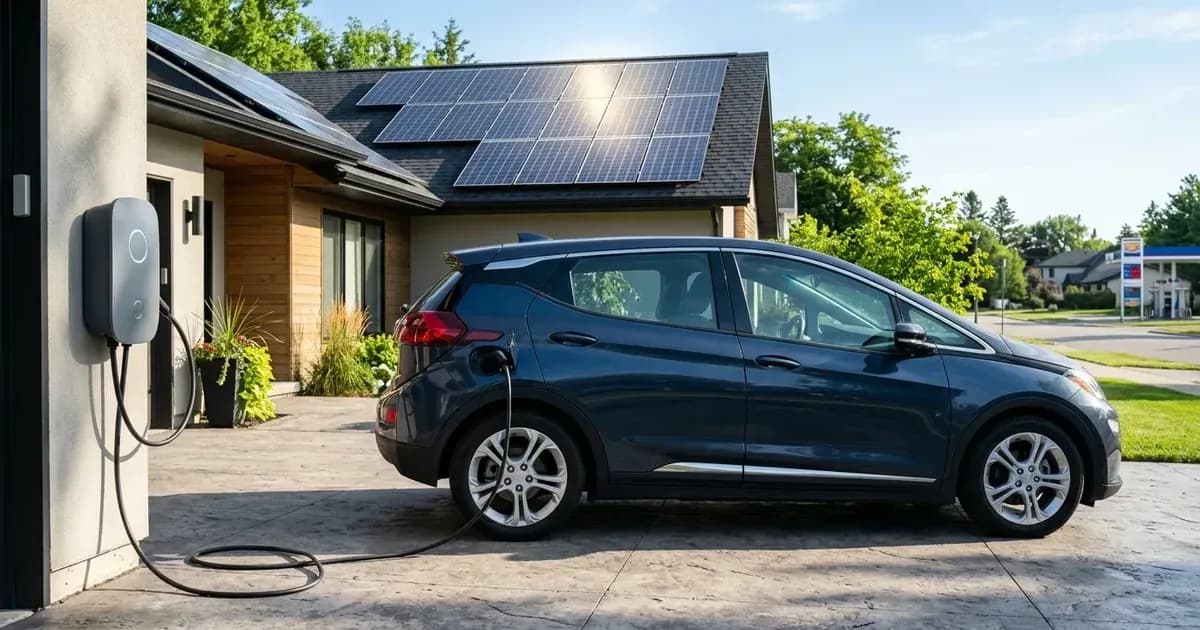
Then there's the version of the ledger this site was built for: add rooftop solar and the fuel line — the EV's biggest win — heads toward the panels' near-zero marginal cost. Eight panels cover average driving; the charging-window habit captures it; and the household that runs both technologies stops comparing against gasoline at all, because its transportation fuel is a roof it already owns. Gas versus EV is a close ledger for some households and a landslide for others — but sun versus gasoline was never close.
Frequently asked questions
Is an EV cheaper than a gas car overall?
For average-and-up drivers with home charging, usually yes over ownership: fuel at roughly 5–6¢/mile versus gasoline's double-plus, and a maintenance list cut to tires close the sticker gap steadily. Low-mileage drivers without home charging see the weakest case.
How much cheaper is EV fuel than gas?
Home charging at the national-average rate runs about 5–6 cents per mile; a comparable gas sedan runs several times that at typical pump prices. Off-peak EV rates widen it; fast-charging-only lifestyles narrow it to near parity.
What does an EV cost more on?
The sticker (a narrowing premium), insurance modestly in many cases, and tires. Everything else — fuel, scheduled maintenance, brakes — runs cheaper, and state incentives where they survive trim the sticker line.
When does an EV break even with a gas car?
Miles decide: high-mileage commuters cross over in a few years; average drivers within ownership; rare drivers may never. A solar roof accelerates every scenario by making the fuel line approach zero.
References
- FuelEconomy.gov – Side-by-side energy cost comparisons — accessed 5 August 2026
- US DOE AFDC – Electric vehicle benefits and considerations — accessed 5 August 2026
Related guides
More from schemes, subsidies & financing.