Charging an EV with Solar in the US (August 2026)
Updated 6 September 2026 · By SolarNevs Research Desk, Dealer surveys + verified sources · 5 sources · Method ↗
Key Takeaways
- Any grid-tied rooftop solar system already charges your EV — the charger is just another load; no special product is required.
- Your utility's net metering policy, not your hardware, decides whether daytime solar charging or overnight grid charging wins.
- The federal subsidies are gone in 2026: the solar credit ended December 31, 2025 and the home charger credit ended June 30, 2026 — state and utility programs are what remain.
- An EV is the largest flexible load a household owns, which makes it the single best tool for soaking up solar that would otherwise export at a discount.
Can you charge an electric car from rooftop solar?
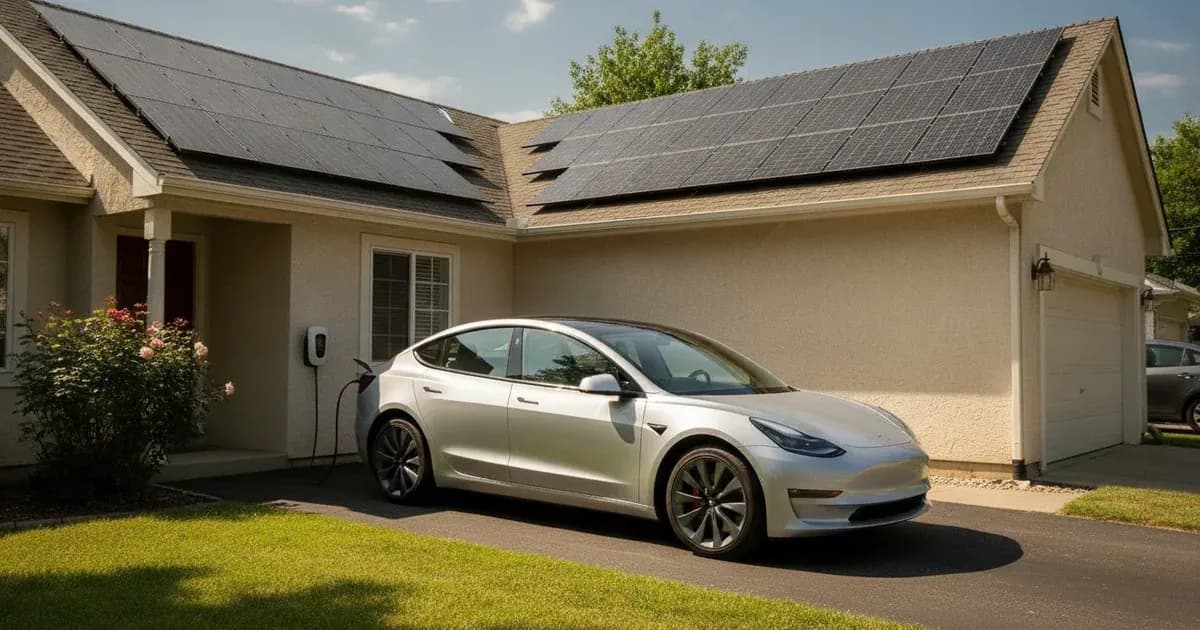
Yes — and in the US the pairing is more natural than almost anywhere, because the same suburban households that buy EVs own the detached, sun-facing roofs that suit solar. A grid-tied PV system feeds your home's electrical panel; a home EV charger draws from that panel. When the sun is generating and the car is plugged in, the charger consumes solar power first and tops up from the grid as needed. There is no separate "solar charging" application, meter, or permission — if you have solar and a charger, you are already doing it.
The practical questions are subtler: whether your system is big enough to matter, and whether your utility's rules reward charging by day or by night.
Why does net metering policy decide your charging strategy?
Every kilowatt-hour your panels produce either gets used on the spot or exported to the grid, and the value gap between those two paths is set by your utility:
- Full retail net metering — exports are credited at the same rate you pay. The grid works like a perfect battery, and when you charge barely affects the math.
- Net billing / avoided-cost regimes — exports earn less than retail, sometimes far less. Every kilowatt-hour you push into the car instead of the grid captures the full retail value; every exported one takes a haircut.
Most states are drifting from the first model toward the second, which quietly makes EVs more valuable to solar households: the car is a battery you were buying anyway. Under discounted exports, plugging in at noon instead of midnight is free money — the structural logic, not a marketing claim. Your specific tariff is listed in DSIRE and your utility's rate schedule; check which regime you're under before optimizing anything.
What hardware do you need?
Three components, two of them standard:
Component | Role | Notes |
|---|---|---|
Rooftop PV system | Generates the power | Sized per home + driving load (see below) |
Level 2 home charger (240V) | Refills the car overnight or midday | A standard hardwired or plug-in unit; permits per your jurisdiction |
Solar-aware charging (optional) | Matches charge rate to surplus | Either a charger's "solar mode" or the car's own scheduled charging |
Framework as of August 2026.
The optional third row deserves demystifying. Several chargers can modulate charging to follow your solar surplus in real time. That is genuinely useful under net billing, but a $0 alternative gets you most of the way: schedule the car to charge during your generation window. The car's own software does this; so does almost every charger app.
A home battery is the fourth, optional component — it shifts solar into the evening for the car and the house alike. It is an economics question, not a requirement, and under strong net metering it rarely pays for itself on EV charging alone.
How much solar does an EV actually need?
The full sizing math gets its own guide, but the shape of the answer: an average American driver covers roughly 37 miles a day, and a typical modern EV uses about 25–30 kWh per 100 miles (your model's exact EPA figure is on FuelEconomy.gov). That works out to roughly 10–12 kWh of charging per day — which a modest 3–4 kW of extra panel capacity covers in most of the country. NREL's free PVWatts calculator turns your address and roof orientation into a production estimate; compare its daily output against your driving and you have your answer in ten minutes.
What happened to the tax credits?
Both federal supports are gone as of this writing. The Residential Clean Energy Credit ended for expenditures after December 31, 2025 — the IRS treats a system's cost as incurred when installation is completed, so 2026 installs get nothing. The Section 30C credit for home charger installations ended for property placed in service after June 30, 2026. What remains is state and utility territory: charger rebates, time-of-use EV rates, and state solar incentives, all catalogued in DSIRE and on your utility's site. Leased solar systems remain an indirect federal route, since providers can claim the business credit for systems placed in service through 2027.
Is charging an EV with solar worth it in 2026?
Strip the subsidies away and the case stands on rates. Home charging already beats public charging on cost nearly everywhere; solar self-consumption beats buying grid power wherever retail rates are meaningfully above your solar's marginal cost — which, for an already-installed system, is near zero. The EV then does something unusual: it gives your solar a flexible, high-volume place to go at exactly the hours exports are worth the least. Households with both assets should coordinate them — schedule the charge window into the solar window, check the tariff once a year, and let the arithmetic run. It is the cheapest mile most American drivers can buy.
Keep reading: V2H bidirectional charging · EV vs home battery backup · solar carports.
Frequently asked questions
Can you charge an electric car with solar panels?
Yes. A grid-tied rooftop system powers your whole home, including the EV charger. The car doesn't know or care where the electrons come from — sizing and timing are the only real questions.
Do you need special equipment to charge an EV from solar?
No special solar-EV product is required: a standard rooftop PV system plus a Level 2 home charger is the whole stack. Some chargers add a solar-only mode that follows your surplus, which is a convenience, not a requirement.
Is there still a federal tax credit for home EV chargers or solar in 2026?
No. The residential solar credit ended for expenditures after December 31, 2025, and the Section 30C charger credit ended for property placed in service after June 30, 2026.
Should I charge my EV during the day or at night with solar?
It depends on your utility's export compensation. Under full retail net metering, timing barely matters; under net billing that credits exports below retail, daytime charging directly from your panels captures more value.
References
- IRS – Instructions for Form 5695 (2025) — accessed 5 August 2026
- IRS – Instructions for Form 8911 (12/2025) — accessed 5 August 2026
- FuelEconomy.gov – Find and compare EV energy use — accessed 5 August 2026
- NREL – PVWatts Calculator — accessed 5 August 2026
- DSIRE – Database of State Incentives for Renewables & Efficiency — accessed 5 August 2026
Related guides
More from going electric in pakistan.