Do Solar Panels Damage Your Roof? The Honest Answer
Updated 17 September 2026 · By SolarNevs Research Desk, Dealer surveys + verified sources · 2 sources · Method ↗
Key Takeaways
- No, when installed correctly — panels shade and shield the shingles beneath them, and the covered area typically ages better than the exposed roof.
- Yes, when flashed badly. The failure mode is workmanship at the penetration, not the presence of an array. Panels don't leak; holes do.
- Contract against it: an installer workmanship warranty covering roof penetrations is the single most important non-hardware term in a solar contract.
- Roof age decides sequence: under roughly five to seven years of remaining life, re-roof first rather than pay to remove and reinstall later.
What panels actually do to a roof
Start with the part nobody expects. An array is a rain screen and a UV shield. Asphalt shingles fail mostly from sun and thermal cycling; the shingles under a panel get neither in full measure. Installers pulling arrays off after fifteen years routinely find the covered field visibly better preserved than the surrounding roof. Hail arrives at an angle the panel intercepts. Summer attic temperatures fall slightly because the roof deck is shaded.
So the fair framing is: the panels are not the risk. The mounting penetrations are the risk, and they are a solved problem in roofing terms — the same problem as a plumbing vent, a chimney, or a satellite mast, executed a few dozen times per array.
The actual failure mode
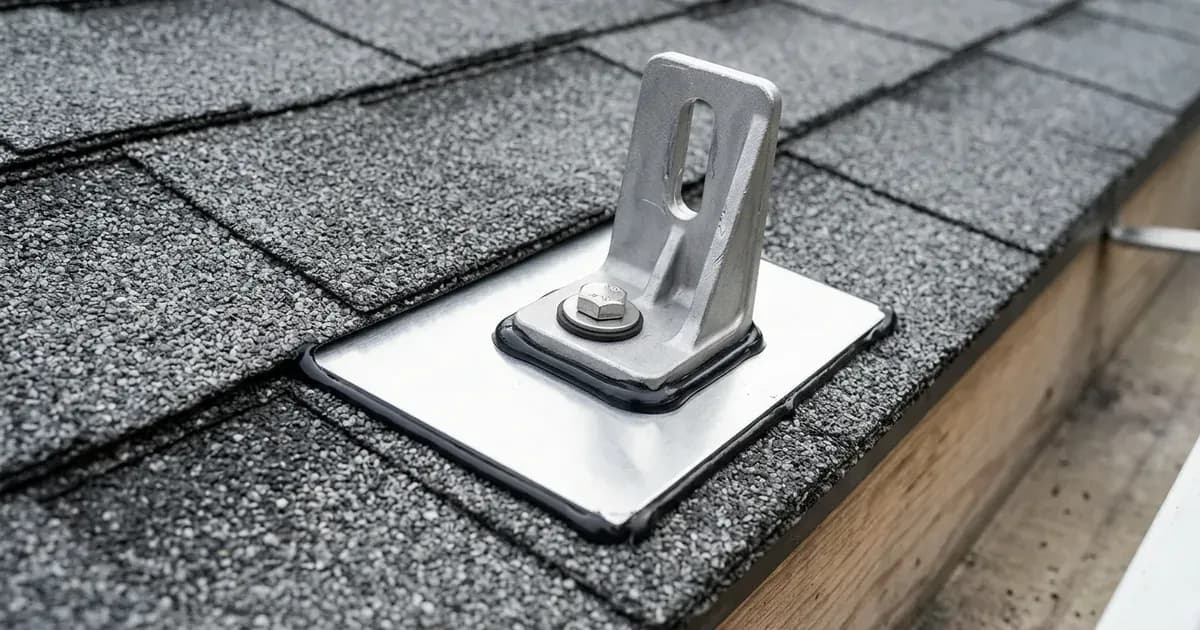
Here's what a correct penetration looks like on asphalt shingle. The installer locates a rafter, drives a lag bolt through the deck into solid framing, and covers it with a flashing — a metal plate that slides under the shingle course above and lies over the course below, so water flowing downslope passes over the flashing and back onto shingles without ever reaching the hole. Sealant is a secondary defense, not the primary one. The geometry does the work; the caulk is insurance.
Every real leak traces to a deviation from that:
Failure | What went wrong | Prevention |
|---|---|---|
Flashing sits on top of shingles | Water runs under it | Correct shingle-course integration |
Sealant used instead of flashing | Caulk fails in 5–10 years, hole remains | Flashing is mandatory, not optional |
Bolt missed the rafter | Deck-only anchor loosens, hole enlarges | Rafter location verified, not guessed |
Penetration into old, brittle shingles | Cracks propagate around the mount | |
Wrong hardware for the roof type | Tile, metal, and slate each need their own |
Failure modes are workmanship categories, not product defects — which is why installer selection outranks panel selection on this question.
The clean escape route exists too: standing seam metal roofs mount with zero penetrations, clamping to the seam instead of drilling. If you have that roof, this entire article is theoretical for you.
How to contract against the risk
Three things to insist on, in order of importance.
A workmanship warranty that names roof penetrations. Panel warranties are long and largely uncontested; hardware rarely fails. Installation warranties are where your actual exposure lives — ten years is a common benchmark and shorter terms deserve a question. Confirm it covers water intrusion at mounts, not just electrical defects.
The roof manufacturer's written position. Some shingle warranties tolerate solar penetrations, some require a certified installer, some care about who did the work. Ask before, not after — the answer costs one email and settles a dispute you'd otherwise have during a rainstorm.
A roof condition assessment before the design is finalized. Any competent installer does this. If the roof has under roughly five to seven years left, the honest recommendation is to re-roof first — because removing and reinstalling an array later is real money for zero added benefit.
One more thing worth saying plainly, because the internet muddles it: panels are not a hail liability. The hail question has its own answer — tempered glass rated to impact standards, generally more resilient than the roof it sits on. And routine maintenance involves no roof traffic at all in most climates, so the array isn't inviting anyone up there to cause the damage either.
The summary a roofer would give you: a solar array is twenty-odd carefully flashed holes protecting several hundred square feet of shingles. Get the holes right and the trade is overwhelmingly in your favor.
Frequently asked questions
Do solar panels damage your roof?
Properly installed, no — panels shield the shingles beneath them from UV, rain, and hail, and installers routinely find the covered area in better condition than the exposed roof. Damage comes from bad flashing workmanship, not from the panels themselves.
Will solar panels cause my roof to leak?
Only if penetrations are flashed poorly. Each mount passes a lag bolt into a rafter under a flashing that tucks beneath the upslope shingle course; done right it sheds water like any vent pipe. Done wrong, it leaks — which is why installer workmanship warranties matter more than panel brands.
Do solar panels void a roof warranty?
It depends on the roofer and the method. Penetrating mounts can affect some manufacturer warranties; non-penetrating clamps on standing seam metal generally do not. Get the position in writing from the roof manufacturer before the array goes up.
What if my roof is old?
Replace it first. If the roof has under roughly five to seven years of life left, re-roofing before installation avoids paying to remove and reinstall the entire array later — the single most avoidable cost in residential solar.
References
- EnergySage – Solar panels and roof replacement — accessed 5 August 2026
- US DOE – Homeowner's guide to going solar — accessed 5 August 2026
Related guides
More from schemes, subsidies & financing.