Roof Replacement With Solar Panels: Cost, Sequence, and How to Avoid It
Updated 18 September 2026 · By SolarNevs Research Desk, Dealer surveys + verified sources · 2 sources · Method ↗
Key Takeaways
- Removal and reinstallation runs roughly $200–300 per panel in commonly quoted 2026 pricing — a low-to-mid four-figure bill on a typical array, for zero added generation.
- The whole problem is a sequencing error: an array lasts 25 years or more; an asphalt roof often doesn't.
- Rule of thumb: under ~5–7 years of remaining roof life, re-roof first. Above ~15 good years, install and forget it.
- The permanent fix is a metal roof — install once, and the panels come down when they retire, not when the roof does.
The most avoidable cost in residential solar
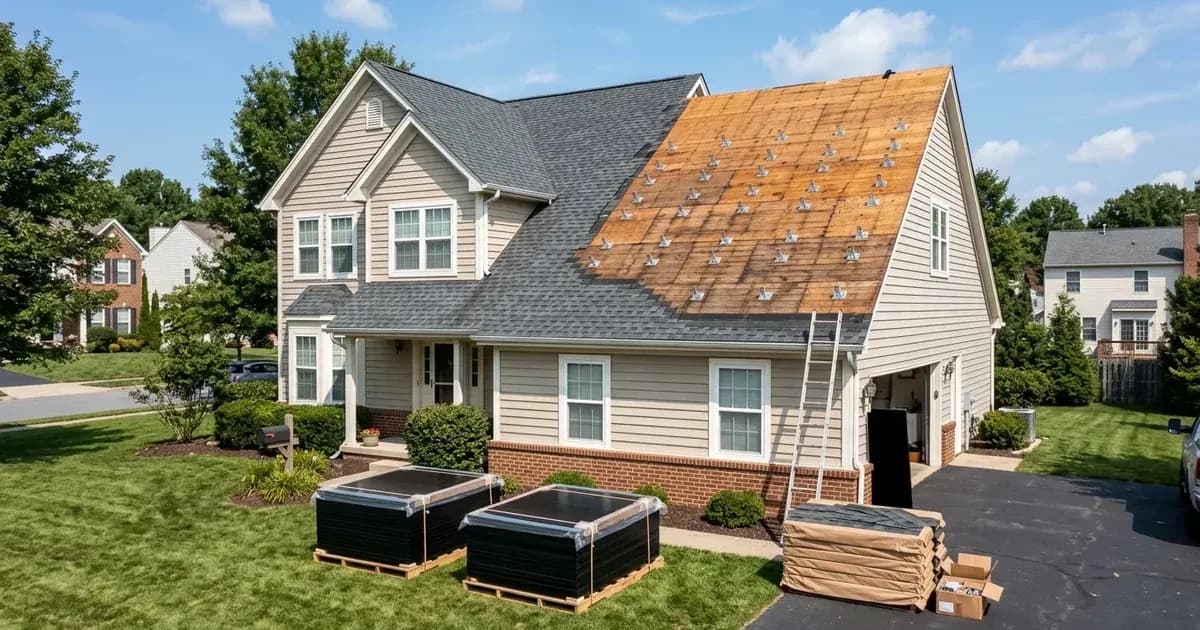
Nothing else in this series is so expensive and so pointless. Pulling an array to re-roof means disconnecting the system, unbolting and lowering every module, racking and storing them safely, removing the mounts and rails, re-roofing, then reinstalling the whole assembly and passing inspection again. Commonly quoted pricing runs roughly $200–300 per panel — call it four figures for a typical fifteen-panel system, on top of the roof job itself.
And at the end of it, you own exactly what you owned before: the same array, generating the same kilowatt-hours. The money buys no capacity, no efficiency, no warranty extension. It is pure friction generated by doing two long-lived projects in the wrong order.
Roof's remaining life | Right move | Why |
|---|---|---|
Under ~5–7 years | Re-roof first, then install | Removal cost avoided entirely |
~7–15 years | Judgment call — get a roofer's assessment | Depends on shingle condition, not age |
15+ years | Install now | Roof likely outlives the payback window |
Metal, standing seam | Install now, permanently |
Per-panel removal pricing as commonly quoted August 2026; regional labor and roof complexity move it, and quotes should be obtained before assuming the midpoint.
Getting the sequence right
The assessment is simple and worth insisting on: before the array design is finalized, have the roof evaluated for remaining life — not age, remaining life. A conscientiously maintained ten-year asphalt roof in a mild climate may have two decades left. A fifteen-year roof in the Southwest with granule loss and curling edges has three or four. Age is a proxy; condition is the answer.
If the verdict is "replace," treat it as an opportunity rather than a setback. Roof and solar crews can be sequenced back to back, mounts can be integrated into the new roof cleanly, and the flashing quality question gets answered by fresh work rather than by penetrating aging shingles. It's also the natural moment to consider metal — the upgrade that retires this problem forever.
If the verdict is "you're fine," get it in writing and move on. The installation timeline is long enough without adding a roof to it.
When the roof fails anyway
Storms don't consult your sequencing plan. If a roof under an existing array needs replacing:
Get the solar installer involved early. Many will do the removal and reinstall themselves, and the ones who installed the system know its mounting layout. A roofing crew improvising around unfamiliar racking is how warranty arguments start.
Ask what the insurance claim covers. If the roof damage is a covered peril, removal and reinstallation of the array is often part of the scope of restoring the roof — it is worth asking explicitly rather than assuming it isn't. The same logic applies after hail events, where the roof frequently fares worse than the panels.
Do the whole roof plane, not a patch. Panels are off and access is open — the expensive part is already sunk. Re-roofing only the covered field leaves you with mismatched shingle ages and a repeat performance in a few years.
Treat it as an upgrade window. The array comes down anyway. If adding a battery or expanding the array was on the list, the electrician is already there and the roof is already open.
The lesson underneath all of it is the one this site keeps returning to: solar is a twenty-five-year decision bolted onto a building with its own timeline. Line the two timelines up first, and the most avoidable cost in residential solar never appears on your bill at all.
Frequently asked questions
How much does it cost to remove and reinstall solar panels for a roof replacement?
Commonly quoted at roughly $200–300 per panel in 2026 pricing, covering disconnection, removal, storage, reinstallation, and reinspection. A typical 15-panel residential array therefore lands in the low-to-mid four figures on top of the roof itself.
Should I replace my roof before installing solar?
If the roof has under roughly five to seven years of remaining life, yes — replacing first costs nothing extra, while replacing later adds the full removal-and-reinstall bill for work that produces no additional electricity.
How old is too old for a solar installation?
Age matters less than remaining life. A well-maintained 10-year asphalt roof with 15–20 good years left is fine; a 15-year roof with visible granule loss is not. Match the roof's remaining life to the array's 25-year-plus service life.
Can I replace just the section of roof under the panels?
Partially, but it rarely pays. Panels must come off to reach the deck regardless, so the removal cost is already incurred — and a patchwork of new and old shingle ages unevenly. Most homeowners do the whole plane while access is open.
References
- EnergySage – Do you need a roof replacement with solar panels? — accessed 5 August 2026
- Fixr – Cost to remove solar panels to replace a roof — accessed 5 August 2026
Related guides
More from schemes, subsidies & financing.