Florida Hurricane-Resilient Solar and Wind Load Guide
Updated 17 September 2026 · By SolarNevs Research Desk, Dealer surveys + verified sources · 2 sources · Method ↗
Key Takeaways
- Florida Building Code mandates solar installations withstand up to 180 mph wind speeds in coastal areas.
- Mounting hardware in High-Velocity Hurricane Zones requires Miami-Dade Notice of Acceptance (NOA) certification.
- The federal Section 25D tax credit covers hurricane-resilient solar equipment and battery storage expenditures.
- Battery storage systems can be set to a 100% storm reserve state of charge before a hurricane.
Navigating Hurricane Resilience for Solar Installations in Florida
In Florida, particularly within its High-Velocity Hurricane Zones (HVHZ), solar energy system installations must adhere to stringent building codes designed to withstand extreme weather conditions. This guide outlines the key requirements for hurricane-resilient solar and energy storage systems, focusing on the Florida Building Code (FBC) and relevant federal incentives. These regulations ensure the safety and durability of solar infrastructure in a region prone to hurricanes.
Understanding Florida's Wind Load and Structural Requirements
The primary concern for solar installations in Florida is their ability to endure high wind speeds. The Florida Building Code (FBC) governs these standards, with specific requirements for coastal zones. These measures are critical for protecting property and ensuring the continued operation of solar systems during and after severe weather events.
Key Hurricane Resilience Specifications
Parameter | Technical Standard | What it means for your installation |
|---|---|---|
Florida Building Code Wind Standards | "Rooftop solar installations must be engineered to withstand design wind speeds up to 180 miles per hour in coastal zones." | Your solar array must be structurally sound enough to resist hurricane-force winds up to 180 mph, especially if located near the coast. This requires specific engineering calculations and robust mounting. |
Miami-Dade NOA Certification | "Mounting hardware in High-Velocity Hurricane Zones must have an active Miami-Dade Notice of Acceptance (NOA)." | All mounting components, such as racks and fasteners, used in HVHZ areas (like Miami-Dade and Broward counties) must be certified by Miami-Dade County to meet their rigorous testing standards. |
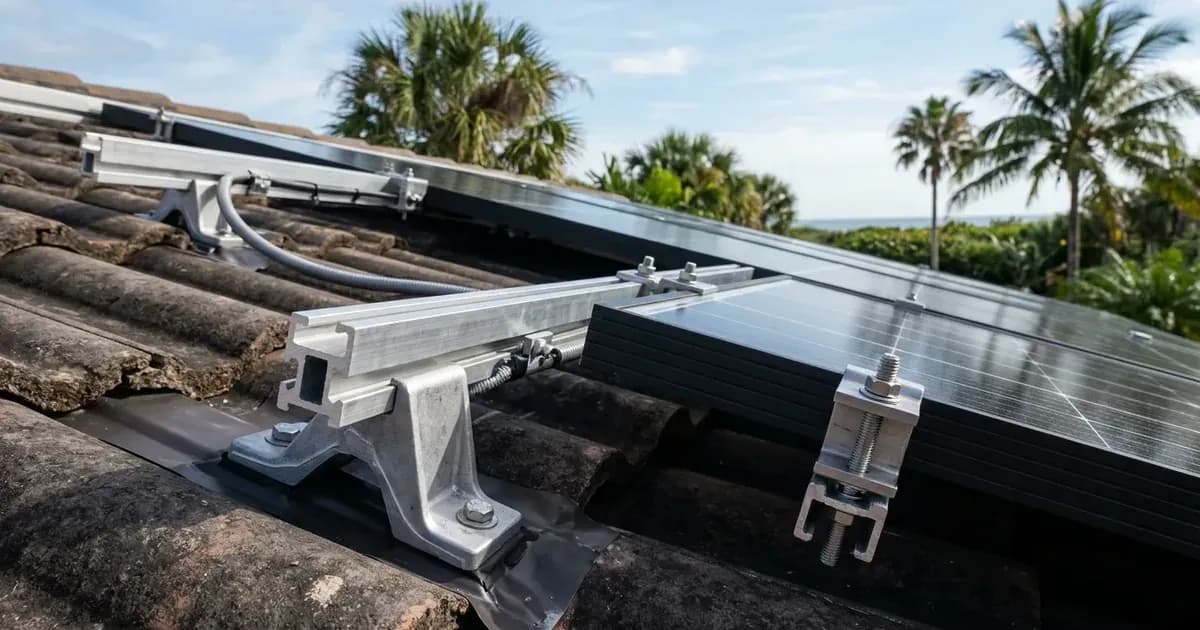
Roof Truss Penetration Fasteners | "Mounting brackets must anchor directly into structural roof rafters using approved lag bolts and waterproof flashing." | Solar mounts cannot just attach to roof decking. They must be securely fastened into the underlying structural rafters using specific bolts and sealed with flashing to prevent water intrusion. |
Corrosion-Resistant Fasteners | "Installations within coastal salt-spray zones require stainless steel or marine-grade anodized aluminum fasteners." | If your property is in a coastal area, all metal components must be highly resistant to salt corrosion to prevent degradation and structural failure over time. |
Rapid Shutdown NEC Compliance | "Rooftop solar arrays must incorporate module-level rapid shutdown compliant with NEC standards for emergency responder safety." | For safety, especially for emergency services, your system must be able to quickly de-energize the solar panels at the module level when activated. |
Building Department Permitting | "Solar installations require local municipal building and electrical permits with signed and sealed engineering drawings." | Before installation, you must obtain all necessary permits from your local building department, which will require detailed engineering plans signed and sealed by a licensed professional. |
What You Can Check Yourself, and What You Cannot
As a homeowner, you can verify that your chosen installer is aware of and plans to meet these specific Florida Building Code and Miami-Dade NOA requirements. You can ask for documentation of NOA-certified hardware and confirm that engineering drawings will be provided for permitting.
However, the actual engineering, design, and installation of hurricane-resilient solar systems are complex tasks that require licensed professionals. You cannot personally certify mounting hardware, perform structural engineering calculations, or sign off on electrical designs. Changing inverter settings related to grid protection or rapid shutdown yourself can breach connection agreements and compromise safety. Always rely on accredited installers for these critical steps.
Federal Tax Incentives for Hurricane-Resilient Solar
The United States federal government offers financial incentives to encourage the adoption of clean energy, including systems designed for resilience. The Residential Clean Energy Credit, under Internal Revenue Code (IRC) Section 25D, provides a significant tax benefit for homeowners.
"Expenditures for hurricane-resilient solar equipment and battery storage qualify for the 30% federal tax credit." This means that a substantial portion of the cost of your solar panels, inverters, and battery storage system, specifically those designed to withstand hurricanes, can be offset by this credit.
Furthermore, "Service panel and sub-panel upgrades required to support backup batteries qualify for Section 25D tax credit basis." If your electrical main panel needs upgrading to integrate a battery backup system, those costs can also be included in the calculation for the 30% tax credit. This credit is nonrefundable, but "Unused Section 25D tax credit amounts carry forward to offset future federal tax liability indefinitely," providing long-term financial flexibility.
Pre-Storm Battery Reserve Configuration and Grid Islanding
Battery storage systems play a crucial role in maintaining power during grid outages caused by hurricanes. Modern systems offer features specifically designed for storm preparedness.
"Home battery storage systems can be set to 100% storm reserve state of charge prior to hurricane landfall." This allows you to fully charge your battery before a storm hits, ensuring maximum backup power availability. In the event of a power loss, "Certified battery storage automatically isolates household backup loads from the grid within milliseconds of power loss." This "islanding" capability ensures that your home's essential circuits continue to receive power from your battery, safely disconnected from the main grid.
What the published sources do not tell you
While the Florida Building Code and IRS instructions provide clear guidelines, they do not detail specific product brands or models that meet these requirements. The exact wind load calculations for a particular roof structure and solar array configuration will vary and require site-specific engineering. Additionally, the process and timeline for obtaining local municipal building and electrical permits can differ significantly between jurisdictions within Florida. The specific requirements for architectural review board approvals in historic districts are not covered by these general codes and must be investigated locally.
Frequently asked questions
What are the wind load requirements for solar in Florida?
Rooftop solar installations in Florida must be engineered to withstand design wind speeds up to 180 miles per hour in coastal zones, as per the Florida Building Code.
What is Miami-Dade NOA certification?
Miami-Dade Notice of Acceptance (NOA) certification is required for mounting hardware in High-Velocity Hurricane Zones in Florida, ensuring it meets specific resilience standards.
Does hurricane-resilient solar qualify for tax credits?
Yes, expenditures for hurricane-resilient solar equipment and battery storage in the United States qualify for the 30% federal Section 25D Residential Clean Energy Credit.
How do solar batteries help during a hurricane?
Home battery storage systems can be configured to a 100% storm reserve state of charge before a hurricane, providing backup power during grid outages.
What is rapid shutdown for solar?
Rapid shutdown ensures rooftop solar arrays can be quickly de-energized at the module level, complying with NEC standards for emergency responder safety during incidents.
References
- Florida Building Code High-Velocity Hurricane Zone Standards — accessed 27 August 2026
- Miami-Dade County Product Control - Product Approval / Notice of Acceptance (NOA) system and search — accessed 27 August 2026
Related guides
More from schemes, subsidies & financing.