Plug-In Solar Panels: Legal in the US Now? State of Play
Updated 17 September 2026 · By SolarNevs Research Desk, Dealer surveys + verified sources · 3 sources · Method ↗
Key Takeaways
- The dam broke in Utah: HB 340 (effective May 2025) legalized plug-in systems to 1,200 W with no interconnection paperwork — Virginia follows in January 2027, and roughly thirty statehouses are drafting.
- UL 3700, published December 2025, is the category's first purpose-built safety standard; until certified systems ship, a UL 1741 SB microinverter is the buying floor.
- 1,200 W isn't arbitrary — it's what a standard 120 V/15 A circuit safely carries, the engineering limit that became the legal one.
- Outside the legalizing states, interconnection rules formally still apply — the gray zone where certified hardware meets unenforced paperwork.
What plug-in solar actually is
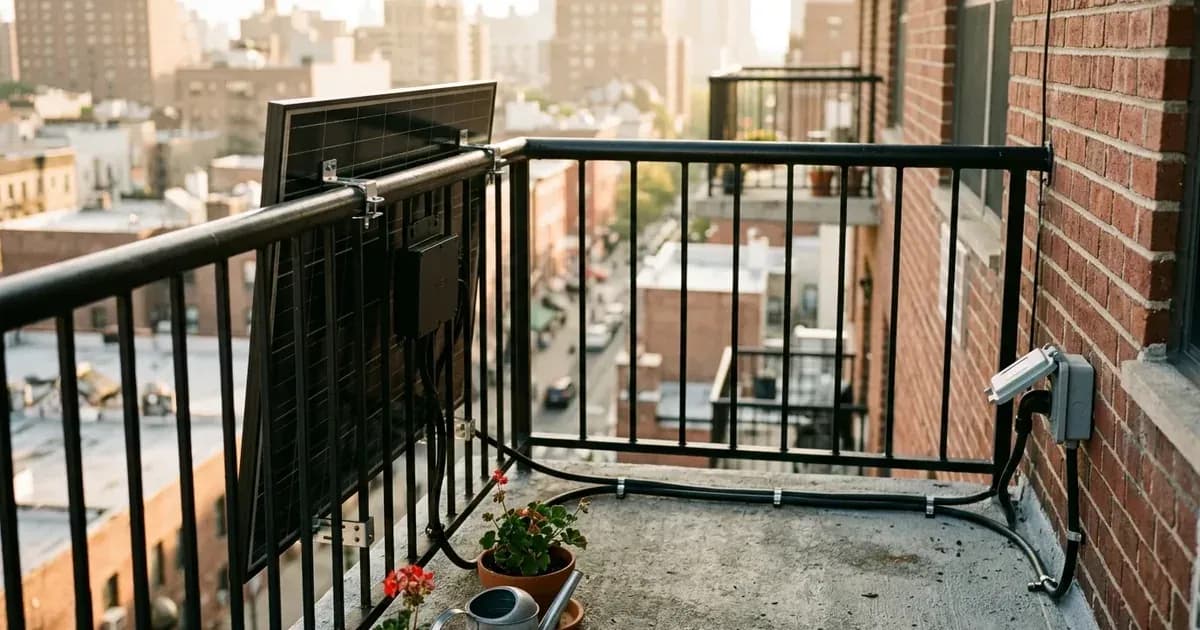
A panel or two, a microinverter, a cord, an outlet: the system Europe deployed by the million on apartment balconies, finally crossing the Atlantic. The microinverter converts panel DC to grid-synchronized AC and feeds it backward through a wall outlet, offsetting whatever the home draws at that moment — a fridge's worth of perpetual discount. No electrician, no roof, no permitting gauntlet; renters and condo-dwellers, locked out of everything else this site covers, are the constituency.
Scale expectations to the size: a 1,200 W setup in decent sun yields perhaps 4–6 kWh a day — real money against the average home's 29 kWh, not a bill-zeroing machine. The per-panel math applies unchanged.
The legal map, mid-revolution
Where | Status (August 2026) |
|---|---|
Utah | Legal ≤1,200 W since May 2025 (HB 340) — no interconnection agreement, no fees, certified + anti-islanding required |
Virginia | Equivalent law effective January 2027 |
~30 statehouses | Bills drafted or moving, chasing Utah's template |
Everywhere else | Utility interconnection rules formally apply — practice varies from ignored to enforced |
Per MIT Technology Review and industry trackers; this map is redrawing quarterly — check your state before buying.
The pre-Utah legal reality deserves honesty: plugging a generating device into an outlet without an interconnection agreement violates most utility tariffs on paper. Enforcement against a certified 800 W balcony rig has ranged from nonexistent to stern letters, but "unlikely to be enforced" is a personal risk posture, not advice — and the entire point of the legislative wave is to end the ambiguity the way Utah did.
The safety story: 3700, 1741 SB, and the junk problem
Two acronyms sort the market. UL 1741 SB certifies grid-interactive microinverters — the anti-islanding, ride-through behavior every grid-tied inverter must have so a dead line stays dead for the workers on it. UL 3700, published December 2025 with certification spinning up through 2026, wraps the whole plug-in system — panel, inverter, cord, plug — in one standard; no complete system carries it quite yet, which makes the 1741 SB microinverter today's non-negotiable check.
The category's dark side is the uncertified import: no-name kits whose inverters skip anti-islanding entirely. They're cheaper for a reason that could kill a lineworker, they're what utility objections legitimately point at, and no certified-hardware argument in this article extends to them.
Should you buy in 2026?
Utah renters and homeowners: yes with confidence — certified hardware, the outlet, done. Virginia: buy hardware ready for your January 2027 date. The drafting-state majority: a certified system is a small, movable bet that your legislature finishes the job — many buyers are making it, with the gray-zone caveat above. Everyone: insist on the 1741 SB certificate today and watch for 3700-certified full systems as the year turns — and if you own a sunny roof, the full-size math still beats any balcony by an order of magnitude. Plug-in solar's job isn't to compete with rooftops; it's to end the era when not owning one meant owning no sunshine at all.
Frequently asked questions
Are plug-in solar panels legal in the US?
It's state-by-state and changing fast: Utah's HB 340 (effective May 2025) explicitly legalized systems up to 1,200 watts without interconnection paperwork, Virginia follows in January 2027, and dozens of states are drafting similar bills. Elsewhere, utility interconnection rules formally still apply.
What is UL 3700?
The first US safety standard written specifically for plug-in solar, published December 2025 with certification beginning in 2026. Until fully certified systems ship, a UL 1741 SB-certified microinverter is the safety floor to insist on.
Why 1,200 watts?
It's the practical engineering ceiling for a standard 120V/15A household circuit — the limit Utah's law adopted and the emerging de facto national number.
Do plug-in panels have anti-islanding protection?
Certified ones must: the microinverter shuts off instantly when grid power drops, the same line-worker-protecting behavior required of every grid-tied inverter. Uncertified imports skipping this are the products giving the category its scare stories.
References
- MIT Technology Review – The balcony solar boom is coming to the US — accessed 5 August 2026
- Solar.com – 2026 guide to balcony & plug-in solar — accessed 5 August 2026
- EcoFlow – Utah plug-in solar law guide — accessed 5 August 2026
Related guides
More from schemes, subsidies & financing.