Sunsynk Generator Connection and Auto-Start in South Africa
Updated 16 September 2026 · By SolarNevs Research Desk, Dealer surveys + verified sources · 4 sources · Method ↗
Key Takeaways
- Generators should be sized at twice the inverter's rated output to handle both loads and battery charging.
- Sunsynk Classic, Elite, and Acure inverters can connect generators via the GEN or GRID terminals, depending on the application.
- Auto-start functionality requires a generator with an 'Auto' or 'Standby' mode; it will not work with manual generators.
- Earth-neutral bonding for generator-fed islanded systems must comply with SANS 10142-1 and be installed by a registered person.
Connecting a Generator to Your Sunsynk Inverter
Installation Parameter | GEN Terminal Connection | GRID Terminal Connection |
|---|---|---|
Primary Use Case | Standard standalone generators without integrated RCD | Generators featuring built-in RCD / earth leakage protection |
Required Inverter Setting | Standard AUX / Generator input setting | Enable 'Gen connect to grid' (disable export / fit generator CT) |
Grid Power Interaction | Inverter opens generator relay when grid voltage is detected | Mechanically / electrically interlocked; cannot run with grid |
E-N Bonding Behaviour | Standard internal or contactor-switched bond | Avoid permanent LOAD-side E-N bond to prevent RCD tripping |
Recommended Capacity | Sized at 2× rated inverter output (powers loads + battery charge) | Sized at 2× rated inverter output (powers loads + battery charge) |
Auto-Start Terminal Pins | | |
Generator Control Mode | Requires control panel switched to Auto / Standby mode | Requires control panel switched to Auto / Standby mode |
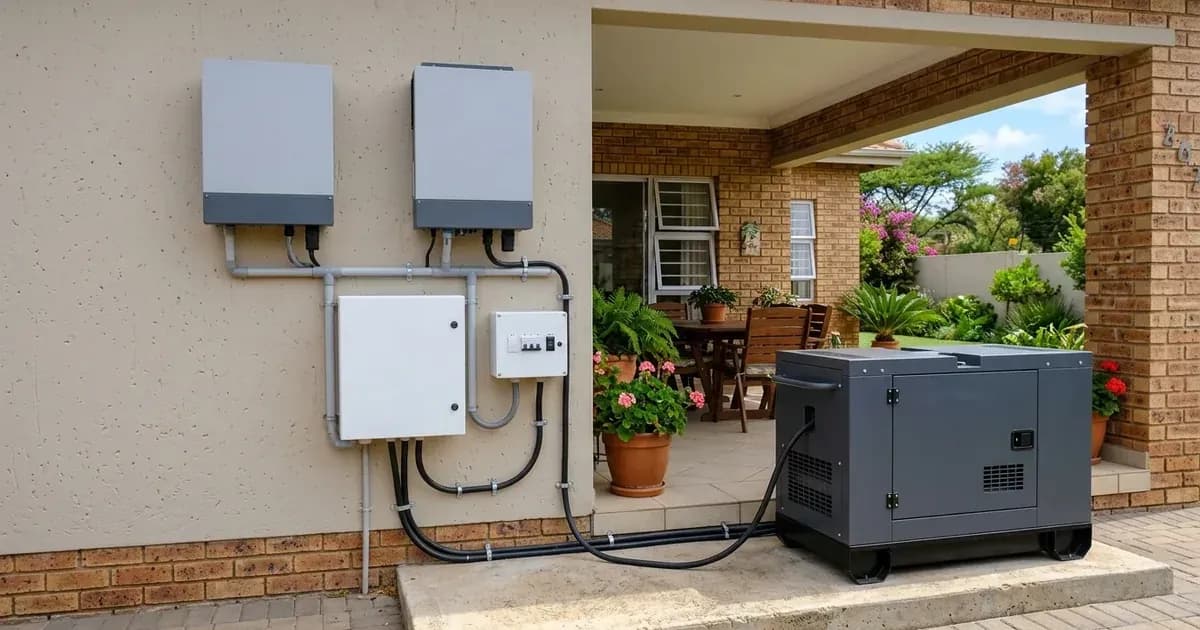
Sunsynk Classic, Elite, and Acure inverters offer flexibility for connecting a generator to supplement your solar power system. The generator can be connected to either the inverter's GEN connection or the GRID connection. The choice depends on your specific setup and whether the generator has built-in earth leakage detection.
In most cases, it is advised to use the GEN connection. However, if the GEN connection is already in use for another function (such as an auxiliary output or a string inverter input), or if your generator has built-in earth leakage detection, you must use the GRID connection.
If you connect the generator to the GRID input of the inverter, you must enable 'Gen connect to grid' in the inverter settings. Alternatively, you can use a CT (Current Transformer) on the live tail of the generator input with export disabled to prevent the inverter from sending power back into the generator.
It is important to note that the inverter cannot accept both grid and generator power simultaneously. If the inverter detects grid power on its GRID connections, the generator relay will open, and generator power will not be accepted.
For parallel inverter systems, the generator must be common to all paralleled inverters. If you have a three-phase system, a three-phase generator should be used. A single-phase of a three-phase generator can power a single-phase inverter, but its output power will be one-third of its rated output.
Sizing Your Generator for a Sunsynk System
Proper generator sizing is crucial for optimal performance and to ensure your system can meet demand during grid outages or low solar production. Sunsynk advises a specific sizing rule for Classic, Elite, and Acure inverters.
When installing a generator, you should use a generator with twice the rated output of the inverter power. This allows for your batteries to be charged in conjunction with powering the loads connected to your system. Without this overhead, the generator may struggle to simultaneously supply your home's electrical needs and recharge your battery bank effectively.
Sunsynk Auto-Start Functionality
Sunsynk Classic, Elite, and Acure inverters can be configured to automatically start a compatible generator. This feature ensures that your system maintains power supply without manual intervention when battery levels are low or loads are high.
To connect the auto-start feature, you must use the connection pins on your inverter labelled G-S or G-Start. On some single-phase low voltage inverters, the signal may instead operate on G-V or G-Valve.
The auto-start or ATS (Automatic Transfer Switch) feature is not possible for a manual generator. For the auto-start function to be operational, the generator must have an 'Auto' or 'Standby' selection option within its control panel, and this option must be selected.
Using a Generator with an Earth Leakage Device (RCD)
If your generator has built-in leakage current detection, such as an RCD (Residual Current Device), there are specific connection requirements for Sunsynk Classic, Acure, and Elite inverters.
When using a generator that has built-in leakage current detection, it is not possible to use the GEN input terminals on the inverter. Instead, the generator must be connected to the GRID input terminals. In the inverter settings, you must then enable 'GEN connected to GRID input'.
It is also not possible to create a permanent earth-neutral bond on the LOAD output side of the inverter if your generator has an RCD. This is because the generator RCD will reference earth without a cross bond to the neutral. If the neutral and earth are bonded, you will experience nuisance RCD tripping.
Three-phase units have built-in earth-neutral bond switching. To enable this, you will need to enable 'Signal-Island Mode' in the inverter settings. On single-phase units, you will need to use the hot/dry contacts on the inverter and a contact relay to manage the earth-neutral bond.
Earth-Neutral Bonding with a Generator in South Africa
An earth-neutral (E-N) bond is a critical safety feature in electrical installations, particularly in islanded or off-grid systems powered by a generator. It establishes a reference point for the electrical system, ensuring that protective devices like RCDs can function correctly by providing a path for fault currents. Without a proper E-N bond, an electrical fault might not be detected, posing a significant safety risk.
Sunsynk's documentation includes guidance on E-N bonding, but it explicitly states that its earth-neutral bond schematic is 'FOR UK & NI ONLY - Extract below from UK IET Manual'. For South African installations, you must refer to local regulatory guidance.
In South Africa, the wiring and earthing arrangements for generator installations, especially those integrated with solar PV systems, must comply with SANS 10142-1, the South African National Standard for the Wiring of Premises. A registered person, such as a qualified electrician, must design and implement the E-N bonding arrangement to ensure safety and compliance.
For off-grid systems with an RCD-protected generator connected to the inverter's Grid terminals, the setup is designed to emulate an on-grid system. This typically involves:
- On the generator side, creating (or using a built-in) E-N bond and a local earth rod.
- On the load side, creating an E-N bond in the distribution board connected to the load terminals. This is typically done using a Normally Closed (NC) or Normally Open (NO) relay, as per the inverter's 'Signal-Island Mode' functionality.
- Both the generator's earth rod and the load-side earth rod should be commoned to each other so they share a reference to earth.
When the 'grid' (in this case, the generator on the grid terminals) is active, it will use the E-N bond at the generator and keep the load-side bond isolated. When the 'grid' is lost, the relay will close or open to connect to the temporary E-N bond in the load-side distribution board.
This complex wiring and relay logic requires expert installation. Always consult a registered person for the design and installation of earth-neutral bonding in your South African generator and solar system.
Regulatory Requirements for Generators in South Africa
Adding a generator to your solar PV system in South Africa involves specific regulatory steps that are often separate from your solar PV system's registration. Many homeowners are unaware that a generator installation, even for standby use, requires its own authorisation.
For instance, the City of Cape Town treats a standby generator as an alternative supply under SANS 10142-1 section 7.12. The City lists 'Apply for a standby generator' as a distinct service, meaning it requires a separate application process from your SSEG (Small Scale Embedded Generation) registration.
Similarly, Eskom's off-grid declaration form has a specific category for installations incorporating an electromechanical generator. This indicates that even in off-grid scenarios, the presence of a generator requires specific declaration and compliance.
It is essential to understand these requirements to ensure your entire system is compliant and legally installed. You can find more information on general SSEG registration processes in South Africa in our guide: /za/guides/systems/sseg-registration-south-africa.
What you can change yourself, and what you cannot
As a system owner, you can typically enable or disable the generator auto-start function through your inverter's menu, provided your generator supports it. You can also monitor the generator's operation and fuel levels.
However, any physical wiring of the generator to the inverter, including the choice between GEN and GRID terminals, the installation of CTs, and especially the setup of earth-neutral bonding, must be performed by a registered person. This work involves high voltages and currents and requires adherence to South African electrical regulations, specifically SANS 10142-1. Incorrect wiring or bonding can lead to serious safety hazards, equipment damage, and may invalidate your Certificate of Compliance (CoC). Modifying settings related to grid protection or export, such as 'Gen connect to grid', should also be done by a registered person to ensure compliance with your connection agreement.
What the published sources do not tell you
While Sunsynk provides clear guidance on generator connections and auto-start functionality, the documentation is global in scope. It does not provide specific wiring diagrams or detailed regulatory compliance steps tailored for the South African context, beyond general electrical principles. For example, the specific menu paths for enabling 'Gen connect to grid' or 'Signal-Island Mode' may vary slightly between firmware versions or specific Classic, Elite, or Acure models.
Crucially, the manufacturer's earth-neutral bond schematic is explicitly labelled for UK and Northern Ireland only. This means that while the principles of E-N bonding are explained, the exact implementation and local compliance requirements for South Africa (e.g., specific SANS 10142-1 clauses, municipal application forms) are not detailed in Sunsynk's support articles. Always rely on a qualified South African electrician for these specific local requirements.
Frequently asked questions
What size generator do I need for my Sunsynk inverter?
Sunsynk advises using a generator with twice the rated output of your inverter. This ensures it can charge batteries and power your loads simultaneously.
Can I use a manual generator with Sunsynk's auto-start feature?
No, the auto-start or ATS feature is not possible with a manual generator. The generator must have an 'Auto' or 'Standby' selection option in its control panel.
Where do I connect my generator if it has a built-in RCD?
If your generator has a built-in earth leakage detection (RCD), it must be connected to the inverter's GRID input terminals, not the GEN terminals. You must also enable 'Gen connect to grid' in the inverter settings.
Does Sunsynk provide an earth-neutral bond for generators?
Three-phase Sunsynk Classic, Elite, and Acure units have built-in earth-neutral bond switching, which you enable via 'Signal-Island Mode'. Single-phase units require external hot/dry contacts and a contact relay.
Is a generator installation subject to South African regulations?
Yes, in South Africa, a standby generator is considered an alternative supply under SANS 10142-1 section 7.12 and requires its own authorisation, separate from a solar PV system's registration.
References
- Sunsynk Support: Classic/Elite/Acure - Generator Connections — accessed 27 August 2026
- Sunsynk Support: Classic/Acure/Elite - Generator Auto-Start is not operating — accessed 27 August 2026
- Sunsynk Support: Classic/Acure/Elite - Using a generator with an RCD — accessed 27 August 2026
- Sunsynk Support: Classic/Elite/Acure - Earth Neutral bond guide for generator connected to grid terminals — accessed 27 August 2026
Related guides
More from inverter errors & fixes.