Paralleling Sunsynk Inverters for More Power in South Africa
Updated 16 September 2026 · By SolarNevs Research Desk, Dealer surveys + verified sources · 3 sources · Method ↗
Key Takeaways
- Low-voltage parallel systems require all inverters to share a single battery stack, and only the master inverter uses a CT coil.
- High-voltage parallel systems require each 50kW inverter to have its own dedicated HV battery pack.
- Firmware updates for parallel systems demand a stable internet connection for all units and a full re-setup of communications afterwards.
- Expanding your system's capacity by adding inverters may require re-registration with Eskom or your local municipality.
Expanding Your Sunsynk System with Parallel Inverters
Paralleling Sunsynk inverters allows you to increase the total power output and energy capacity of your solar system. This is useful for homes or businesses in South Africa that need to power more loads or extend backup times during load-shedding. The process and requirements differ significantly between low-voltage and high-voltage Sunsynk inverter models.
How Sunsynk Inverters Work in Parallel
When Sunsynk inverters are paralleled, one inverter acts as the master, coordinating the operation of all other inverters, which function as slaves. This setup ensures that the inverters work together seamlessly to manage power flow from solar PV, batteries, and the grid.
For low-voltage systems, all inverters must connect to a single, shared battery stack. This ensures consistent battery state of charge (SOC) readings and balanced charging and discharging across all units. Only the master inverter requires a current transformer (CT) coil to monitor the main grid connection, as it dictates the overall system's interaction with the utility.
High-voltage systems operate differently. Each 50kW high-voltage inverter must have its own dedicated high-voltage battery pack. This is because high-voltage batteries are designed to connect separately to high-voltage hybrid inverters, unlike low-voltage battery configurations.
Setting Up Low-Voltage Sunsynk Inverters in Parallel
To parallel low-voltage Sunsynk inverters, follow these steps carefully. This work should be performed by a registered person.
Prerequisites for Low-Voltage Systems
- Battery Connection: All inverters must be connected to the same battery stack.
- CT Coil: Only one CT coil is used, and it must be connected to the master inverter.
Physical Connections
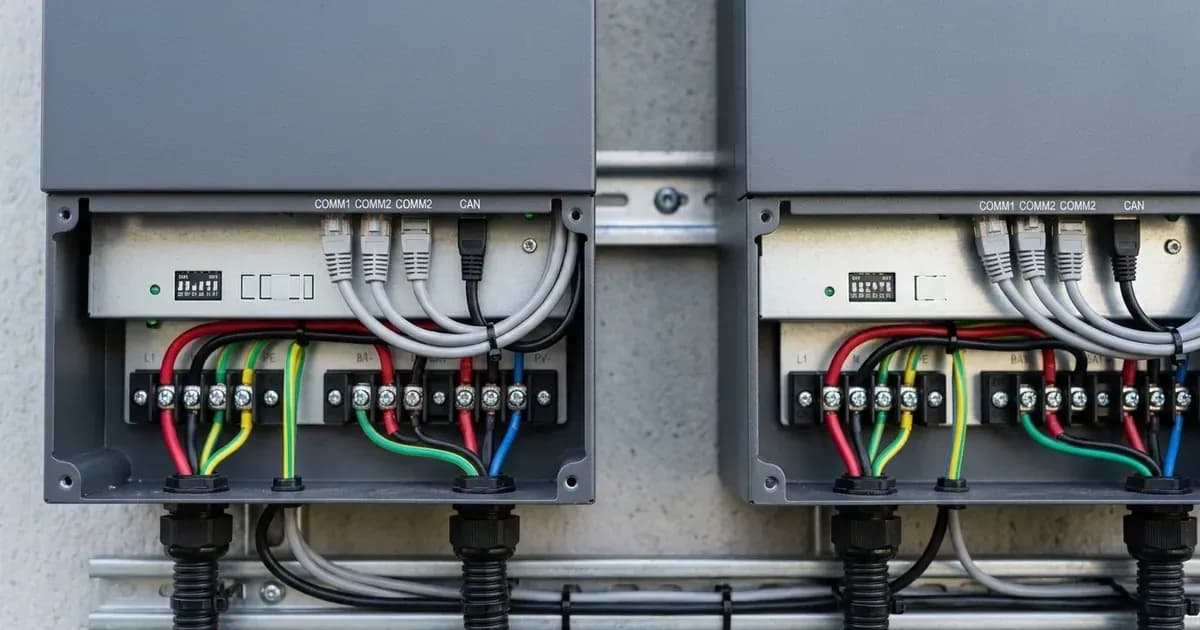
- Data Cable: Use the provided yellow data cable. Connect it to parallel port A or 1 on both inverters.
Dip Switch Configuration
- If paralleling more than 3 inverters, the dip switches must be 'ON' for the first 3 inverters.
- From the 4th inverter onwards, the dip switches must be 'OFF'.
Inverter Settings
Access the advanced settings menu on each inverter to configure its role.
Setting | Master Inverter | Slave Inverter |
|---|---|---|
Parallel | Ticked | Ticked |
Master/Slave | Master Ticked | Slave Ticked |
Modbus ID | 1 | 2 |
Troubleshooting Common Faults (F13, F29, F41)
Fault codes F13, F29, or F41 are common during parallel setup. They can often be resolved with a system restart.
System Restart Procedure:
- Isolate the AC power on both units.
- Isolate the PV power on both units.
- Press the silver power button to turn off both inverters.
- Isolate the batteries. Ensure that batteries are connected to both inverters before proceeding.
- Wait for 20 to 30 seconds.
- Turn on the batteries and confirm their power lights are active.
- Turn on the inverters.
- Turn on the PV power.
- Turn on the AC power.
Setting Up High-Voltage Sunsynk Inverters in Parallel
High-voltage Sunsynk inverters, such as 50kW models, have specific requirements for parallel operation.
Prerequisites for High-Voltage Systems
- Battery Connection: Each 50kW inverter must have its own dedicated high-voltage battery pack. High-voltage batteries can only be connected separately to high-voltage hybrid inverters.
- Maximum Units: You can parallel a maximum of 10 high-voltage inverters.
Dip Switch Configuration
- Set dip switches to 'ON' for the master inverter.
- When more than 2 inverters are in the parallel system, all dip switches must be 'ON'.
Firmware Updates for Parallel Systems
Updating firmware on a parallel Sunsynk system requires a specific approach to ensure all inverters are synchronised and function correctly.
- Maintain Internet Connection: For multi-inverter systems to update successfully, maintain an internet connection throughout the update process for all inverters.
- Powering Wi-Fi: If your inverters supply power to your Wi-Fi router, there can be a break in connection during the update. Bypass the inverter and supply the Wi-Fi directly from the grid or an alternative power source. If no generator is available, update inverters one by one.
- Request Update: Request the firmware update on the Sunsynk installer portal. Specify that it is a parallel system and provide all gateway and serial numbers for the entire parallel system.
- Post-Update Procedure: After the update, confirm that all inverters in your parallel system have the same firmware versions for both MCU and COMM. Then, factory reset and restart all the inverters. Finally, re-setup the parallel communications for every individual machine and verify all other settings.
What you can change yourself, and what you cannot
As an owner, you can typically adjust settings related to your system's operational modes, such as battery charge/discharge times, target state of charge (SOC) levels, and generator auto-start parameters. These settings affect how your system manages energy for your household needs.
However, any changes to grid-protection settings, export limits, or the physical installation of additional inverters must be performed by a registered person. In South Africa, such work requires a Certificate of Compliance (CoC) to ensure safety and adherence to national standards like NRS 097-2-1. Modifying these settings without proper authorisation can invalidate your CoC and potentially breach your connection agreement with Eskom or your municipality.
Expanding your installed capacity by adding a second inverter changes your system's total output. Eskom requires households and small businesses below 100kVA to register their embedded generation, even if they do not export electricity. You should be aware that this change in capacity may necessitate re-registration with your local utility. You can find more information on this process in our guide to SSEG registration in South Africa.
What the published sources do not tell you
Sunsynk's documentation provides clear guidance for paralleling, but some aspects require practical experience or vary by specific model revisions. The exact menu paths for advanced settings can differ slightly between firmware versions and inverter models within the low-voltage and high-voltage families. While the general principles of master/slave configuration and Modbus IDs remain consistent, the precise navigation steps on the inverter display may not be explicitly detailed for every scenario.
The documentation also focuses on the technical aspects of paralleling without detailing the specific electrical protection requirements for the combined output of multiple inverters. This includes sizing of circuit breakers, cable gauges, and earth-neutral bonding considerations for the increased power capacity, which are critical for safe installation and compliance with local electrical regulations. These details are typically covered by national wiring codes and require assessment by a qualified electrician.
The guidance for dip switches on high-voltage inverters states "when more than 2 inverters all dip switches on," which implies a specific configuration for larger systems. However, it does not provide a detailed table or diagram for all possible numbers of high-voltage inverters in parallel, which might be helpful for complex installations.
Frequently asked questions
Can I parallel any Sunsynk inverters?
No, inverters must be of the same model and type to be paralleled. Procedures differ significantly between low-voltage and high-voltage units.
Do I need a CT coil for each inverter in a parallel system?
For low-voltage parallel systems, only one CT coil is used on the master inverter. High-voltage systems have different configurations.
What happens if I add more inverters to my system?
Increasing your installed capacity by adding inverters may require re-registration with Eskom or your local municipality, even if you do not export electricity.
How do I update firmware on a parallel Sunsynk system?
Ensure a continuous internet connection for all inverters throughout the update. Request the firmware update as a parallel system, providing all gateway and serial numbers. After the update, confirm all inverters have the same firmware, factory reset, restart, and re-setup parallel communications.
What is the maximum number of high-voltage inverters I can parallel?
You can parallel a maximum of 10 high-voltage inverters.
References
- Sunsynk Support: Paralleling High-Voltage Inverters — accessed 27 August 2026
- Sunsynk Support: Paralleling Low-Voltage Inverters — accessed 27 August 2026
- Sunsynk Support: Updating the Firmware on a Parallel System — accessed 27 August 2026
Related guides
More from inverter errors & fixes.