How Solar Geysers Work in South Africa: A Construction Explainer
Updated 10 September 2026 · By SolarNevs Research Desk, Dealer surveys + verified sources · 5 sources · Method ↗
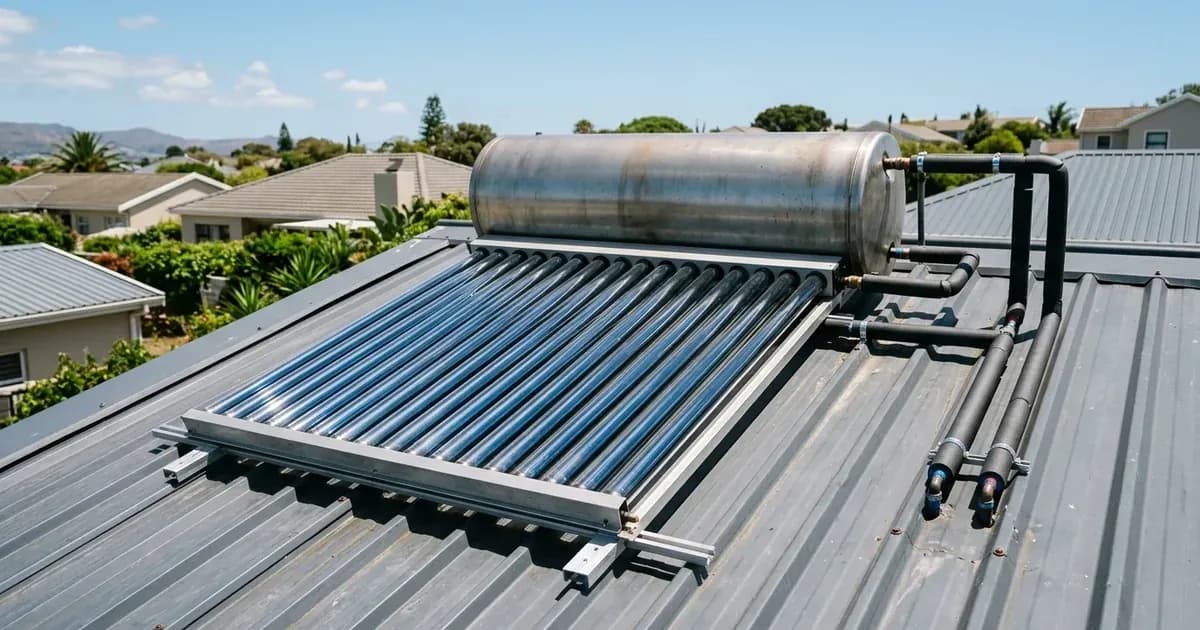
This article explains the physical components and operating principles of solar geyser systems available in South Africa. It describes how these systems are built and what each part does. This guide does not provide advice on which system to buy, what it will save, or what it will cost.
Key Takeaways
- Solar geysers use collectors to absorb sunlight and transfer heat to water.
- Systems differ in how water is heated (direct or indirect) and how components are arranged (close-coupled or split).
- Manufacturers do not agree on the primary factor for choosing between direct and indirect systems.
- Installation and any significant electrical or plumbing work require a registered person and a Certificate of Compliance.
What are the main types of solar geyser systems?
Solar geyser systems are primarily categorised by their collector type, how they circulate water, and how their main components are mounted. The core function is to use sunlight to heat water for domestic use.
How solar collectors capture the sun's energy
Solar collectors are the part of the system that absorbs solar radiation and converts it into heat. There are two main types: flat-plate collectors and evacuated-tube collectors.
Flat-plate collectors
Flat-plate collectors consist of a dark absorber plate behind a glass cover, enclosed in an insulated frame. Water or a heat-transfer fluid passes through channels in the absorber plate, picking up heat as it goes.
Evacuated-tube collectors
Evacuated-tube collectors use a series of glass tubes. Each tube contains an inner absorber tube surrounded by a vacuum. This vacuum acts as an insulator, which reduces heat loss from the collector.
How water is heated and circulated: Direct versus Indirect systems
The method by which the water is heated and circulated through the collector defines whether a system is direct or indirect.
Direct (open-loop) systems
In a direct system, the water that comes out of your taps is the same water that circulates through the solar collector. Sunlight heats the water directly in the collector panels or evacuated tubes. The heated water then rises naturally into the storage tank through a process called thermosiphon circulation.
Indirect (closed-loop) systems
An indirect system uses a separate heat-transfer fluid, typically a glycol solution, which circulates through the collector. This fluid absorbs heat from the sun and transfers it to the water in the storage tank via a heat exchanger. The two liquids, the heat-transfer fluid and the potable water, never mix. The closed circuit allows the system to use a fluid that does not freeze at the same temperature as water, which can prevent damage from water expanding when it freezes.
How components are arranged: Close-coupled versus Split systems
The physical arrangement of the storage tank and collector also defines system types.
Close-coupled systems
In a close-coupled system, the storage tank sits directly above the collector on the roof. This configuration relies on natural thermosiphon circulation, where heated water naturally rises into the tank, eliminating the need for a pump.
Split systems
A split system has the storage tank installed separately, often inside the roof space. A small pump circulates water or heat-transfer fluid between the tank and the roof-mounted collector.
Key components of a solar geyser system
Beyond the collector, a solar geyser system includes a storage tank and various safety and circulation components.
Component | Description/Rating |
|---|---|
Element type | Hard water element |
Thermostat | Controls the electrical backup element |
Drain valve | Allows for draining the tank for maintenance |
Temperature-and-pressure safety valve | A safety device to release excess temperature and pressure |
Cylinder pressure rating | 400 kPa |
Electrical backup element | Both system types typically include an electrical backup element in the storage tank |
Air Release Valve | Available in 110℃ and 180℃ temperature ratings |
Hot Water Circulation Pump | Available in 220Vac 22mm, 220Vac 28mm, 220Vac 35mm |
Solar System Circulation Pump | 12Vdc 10W |
Solar Geyser System Controller | SR81 - 12Vdc, SR81 - 220Vac |
Thermostatic Tempering Valve | 22mm |
The disagreement on direct versus indirect system choice
When deciding between a direct or indirect solar geyser system, manufacturers present different primary factors for consideration.
Kwikot states that direct systems usually suit frost-free areas, while indirect systems suit colder inland or frost-prone climates. They further elaborate that direct systems are simpler, generally more affordable, and well-suited to frost-free coastal areas where there is no risk of water freezing in the collector. For frost-prone inland areas where temperatures regularly drop below zero in winter, Kwikot advises indirect systems as the appropriate choice.
In contrast, Xstream links the choice to the collector type, stating "For direct solar water heating with flat panel or indirect with evacuated tubes."
These sources do not agree on the primary determinant for choosing between a direct and an indirect system. There is no independent information available that settles this disagreement. This is a question best discussed with an installer who understands the specific conditions of your site.
What you can change yourself, and what you cannot
As a homeowner, you can typically perform basic maintenance such as cleaning the collector surface or checking for obvious leaks. However, any work involving the electrical backup element, the plumbing connections, or the installation of the system itself is considered electrical or plumbing work.
In South Africa, such work requires a registered person to ensure safety and compliance with national standards. Following installation or any significant modification, a Certificate of Compliance (CoC) must be issued by a qualified professional. This document confirms that the electrical and plumbing work meets the required safety standards. For more information, refer to our guide on the Certificate of Compliance for solar installations.
What the published sources do not tell you
Our research into solar geyser construction in South Africa reveals several areas where comprehensive, independent information is not readily available:
- National Standards: While SANS 10400-XA:2026 (Ed. 3.00) exists, titled "Provides deemed-to-satisfy requirements for compliance with part XA (Energy usage in buildings) of the National Building Regulations," its full text is paywalled by the SABS and costs R2,249.40. It was approved on 10 March 2026. We have not read this standard, and guidance circulating online often describes earlier editions. The official texts for SANS 10106 and SANS 1307 were also not available.
- Frost Data: There is no published frost threshold or provincial frost data available in the sources to support the claims made about frost-prone areas.
- Financial Metrics: No independent savings percentages, payback periods, monthly running costs, or installed prices are available. All such figures encountered during research originated from companies selling solar geysers or heat pumps.
- Specific Construction Details: Detailed construction specifications for internal tank lining materials, insulation types, element wattage ranges (beyond one example), or the internal workings of thermostats, safety valves, differential controllers, circulation pumps, air-release valves, and thermostatic tempering valves were not found.
- Low-Pressure Systems: While mentioned in broader contexts, no specific information on the construction or operation of low-pressure solar geyser systems was found.
Frequently asked questions
What are the main components of a solar geyser system?
A solar geyser system typically includes a collector (flat-plate or evacuated tube), a storage tank with an electrical backup element, and various safety fittings like a temperature-and-pressure valve. Depending on the system, it may also have circulation pumps and controllers.
What is the difference between direct and indirect solar geyser systems?
In a direct (open-loop) system, the potable water itself circulates through the solar collector and is heated directly. In an indirect (closed-loop) system, a separate heat-transfer fluid circulates through the collector, absorbing heat and then transferring it to the potable water in the storage tank via a heat exchanger.
What is a close-coupled solar geyser system?
A close-coupled solar geyser system has the storage tank mounted directly above the collector on the roof. This configuration relies on natural thermosiphon circulation, where heated water rises into the tank without needing a pump.
What is a split solar geyser system?
A split solar geyser system has the storage tank installed separately, often inside the roof space, while the collector remains on the roof. A small pump circulates water or heat-transfer fluid between the tank and the collector.
Do solar geysers have electrical backup?
Yes, both direct and indirect solar geyser systems typically include an electrical backup element in the storage tank. This ensures hot water availability when solar gain is insufficient.
References
- Kwikot - Your Complete Guide to Solar Geysers in South Africa — accessed 27 August 2026
- Kwikot - The Complete Geyser Guide for South Africans — accessed 27 August 2026
- Xstream Solar Hot Water Cylinders — accessed 27 August 2026
- ITS Solar - Solar Water Heating Products — accessed 27 August 2026
- SABS - SANS 10400-XA:2026 — accessed 27 August 2026
Related guides
More from sizing, net billing & installation.