Solar Inverter Grid Overvoltage Error in Pakistan - Real Fixes
Updated 6 September 2026 · By SolarNevs Research Desk, Dealer surveys + verified sources · 24 sources · Method ↗
Key Takeaways
- IEC 61727 sets the first-stage overvoltage trip at 230V plus 10 percent, which is 253V, with a clearing time of 2.0 seconds or less, and most inverters sold in Pakistan ship with that limit as the default.
- The same fault has three names, where Solis calls it Error 1010 (Grid VOLT-PROT), Deye calls it F41 (AC line over voltage), and Growatt calls it "AC V Outrange".
- CNC Electric's guide (updated April 2026) reports Pakistani residential voltage routinely swinging between 160V and 260V during the June-September peak, with restoration surges of 280-300V lasting a few seconds.
- On 21 July 2026 the Daily Minute Mirror reported LESCO fluctuations damaging refrigerators, washing machines and air-conditioners across Shah Jamal, Shadman, Mozang, Band Road, Mall Road, Gawalmandi and Krishan Nagar, with no LESCO response by the time of filing.
- Since the NEPRA Prosumer Regulations 2026 (SRO 251(I)/2026, notified 9 February 2026) new prosumers are credited roughly Rs 11 per exported unit (February 2026), so every hour your inverter sits tripped costs you self-consumption you would otherwise have kept.
What does a grid overvoltage error mean?
A grid-tied or hybrid inverter is legally a guest on the utility network. Before it is allowed to push a single watt outward it has to prove it will disconnect when the network goes out of specification. Overvoltage protection is that promise in firmware.
The threshold almost every unit in Pakistan uses comes from IEC 61727, which fixes the level-one overvoltage trip at nominal plus 10 percent. Pakistan's nominal single-phase supply is 230V at 50 Hz, so the trip point lands at 253V and the inverter must clear the fault within 2.0 seconds. Once it disconnects, it waits, re-measures, and reconnects when the voltage falls back inside the window.
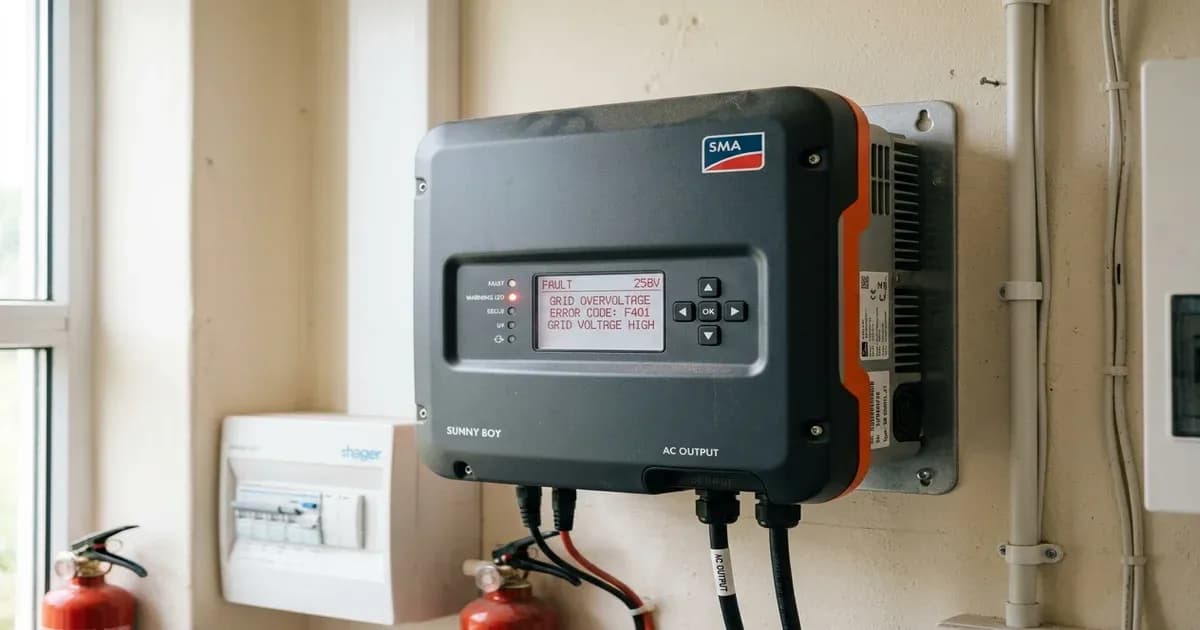
So when your screen shows Solis Error 1010, Deye F41, or Growatt "AC V Outrange", the inverter is not broken. It is reporting a measurement. The important question is whose measurement is wrong, namely yours or the grid's.
That distinction matters commercially. An inverter that is genuinely defective is a warranty claim. An inverter that is correctly reporting a 258V feeder is a DISCO complaint. Dealers in Pakistan very often collapse these two into one answer, "sir voltage ka masla hai", and then quietly widen the protection window so the complaints stop. That is the wrong fix, and the rest of this article explains why.
Why does grid voltage climb past 253V in Pakistani neighbourhoods?
There are three separate mechanisms, and they need different remedies.
Voltage rise from your own export. Current flowing out of your house through the service cable and down the low-voltage feeder raises the voltage at your meter above the voltage at the transformer. The longer and thinner the conductor, the bigger the rise. On a long single-phase LV run with several solar houses on the same phase, midday export from all of them stacks up and the last house on the line sees the worst of it. This is the classic cause worldwide.
Lightly loaded transformers. Distribution transformer taps are set by hand, usually years ago, to compensate for heavy loading. Pakistan's rooftop boom has changed the loading. Pakistan's climate change ministry secretary Aisha Moriani said in November 2025 that the country would see negative grid-linked demand during some daytime hours in 2026, with Lahore, Faisalabad and Sialkot the likeliest candidates. A transformer whose tap was raised to fight low voltage under heavy load will now sit high when the load evaporates.
Phase imbalance and restoration surges. CNC Electric's April 2026 field guide describes one phase running at 250V while another sits at 180V on the same street, and a restoration spike of 280-300V for a few seconds when supply returns after load shedding. Your inverter sees both. The imbalance keeps it near the trip point all evening; the restoration spike knocks it offline instantly.
Is it the afternoon or the evening that trips your inverter?
Read the fault log before you form a theory, because the timestamp tells you the mechanism.
Tripping Timing & Pattern | Typical Time Window | Primary Root Mechanism | Identifying Signature | Correct Remedy |
|---|---|---|---|---|
Midday Solar Export Rise | 11:00 AM – 4:00 PM | Current export through high-impedance AC service line raises meter voltage | Trips peak on clear sunny days; clears when heavy loads (like AC) turn on | Upsize AC cable, shorten run, shift phase, increase self-consumption |
Evening Feeder High Voltage | 6:00 PM – 10:00 PM | High transformer tap setting or lightly loaded neighborhood LV feeder | Inverter reads >253V with zero PV export; persists during dark hours | Document dated timestamp logs; lodge voltage complaint with DISCO via 118 |
Grid Restoration Surge | Immediately after load shedding | Transformer ringing and switching transients producing 280V–300V spikes | Inverter faults instantly the moment grid power returns | Fit 40A/63A voltage protector (Rs 1,200–3,500) and Type 2 AC SPD |
Trips clustered between roughly 11am and 4pm, on clear days, worsening as the array output peaks, point to voltage rise from export. The signature is that the trip disappears on cloudy days and disappears when you turn on a heavy load such as an air-conditioner.
Trips clustered in the evening, or immediately after supply is restored, point to the network side. Export is near zero by then, so nothing you own is pushing the voltage up. If the inverter still reads 254V or 256V at 8pm with your own generation off, that number is the DISCO's, not yours.
Most Pakistani systems show both patterns in the same week. Write down the times over five to seven days before you call anyone. A dated log of readings is the single most useful thing you can hand a Sub-Divisional Officer, and it is the thing almost no complainant brings.
What can you legitimately adjust on your own side?
Four things are yours, and all four are worth doing before you blame anyone.
AC cable size and length. The voltage rise between your inverter and the distribution board is pure resistive loss and it is fully within your control. An undersized AC cable on a long run to a rooftop inverter can easily add 3-5V of rise at full export, which is the difference between 251V and 256V. Upsizing the AC conductor, or shortening the run by relocating the inverter closer to the board, is the highest-value fix available to a consumer. It is also the fix installers skip most often, because thicker copper costs them margin.
Terminations and the neutral. Loose or oxidised terminals at the inverter, the isolator, the changeover and the main breaker all add impedance, and a degraded neutral in particular produces wild voltage behaviour that looks just like grid overvoltage. Have every AC termination torqued and thermal-checked. This is cheap.
Phase selection on a three-phase service. If your house has three phases and your single-phase inverter is sitting on the phase that already runs high, moving it to the lightly loaded phase can solve the problem outright. This is a legitimate, code-compliant change.
Self-consumption timing. Running the washing machine, the water pump or the AC during the export peak sinks your own generation locally instead of pushing it onto the feeder. Under the post-February 2026 rules this is economically correct anyway, since export credit for new prosumers is around Rs 11 per unit (February 2026) against import that can reach Rs 50-65 per unit (February 2026).
What must the DISCO fix, and how do you force the issue?
Transformer tap position, feeder conductor size, transformer capacity and phase balance are network assets. You do not own them, you may not touch them, and no amount of inverter configuration will change them.
The escalation path in Pakistan is three-tiered. First, call 118 from any phone; it routes to your DISCO's complaint centre. Keep the 14-digit reference number from your bill ready, because the operator will ask for it. Register the complaint as a voltage problem, not as a solar problem, and get the tracking number.
Second, file the same complaint in writing through your DISCO's online complaint system so there is a document trail, and copy your Sub-Divisional Officer. In April 2025 the Power Minister publicly directed DISCOs to hold errant SDOs and XENs accountable for unresolved consumer complaints, which is worth quoting in your letter.
Third, if the DISCO does not resolve it within its own prescribed period, escalate to NEPRA through the Complaint Management System on nepra.org.pk or the NEPRA Asaan Approach mobile app. NEPRA can order relief and impose penalties on the distribution company.
One honest caveat. We were unable to retrieve a published NEPRA figure for the statutory low-voltage tolerance band that DISCOs must maintain at the consumer terminal; the Distribution Code and the Consumer Service Manual PDFs both refused automated retrieval in July 2026. We are therefore not quoting a percentage. Anchor your complaint on the measured numbers and on the appliance damage, not on a tolerance figure you cannot cite.
When is raising the trip point acceptable, and when is it dangerous?
There is a narrow legitimate case. Inverters ship with a selectable grid standard, and if a unit intended for one market was configured to another market's profile it can sit at a lower trip point than Pakistan warrants. Correcting the grid-standard selection to the appropriate profile is a real fix, done once, by a qualified installer, and documented.
Everything beyond that is a bribe paid to the alarm. Setting the overvoltage limit to 265V or 270V so the complaints stop does not lower your grid voltage by a single volt. It only means your inverter now stays connected while feeding your house 262V. The equipment that pays for that decision is the compressor in your fridge and the compressor in your air-conditioner, and the CNC Electric guide is blunt that restoration surges are the number one killer of those motors in Pakistan.
A better answer, where the inverter supports it, is volt-watt response, where the inverter progressively backs off its output as voltage rises instead of tripping outright. Under Australia's AS 4777.2 the reference implementation reduces maximum output by 5.3 percent for every volt above 250V, tripping at 265V. Field reports credit volt-watt with removing 50-80 percent of overvoltage disconnection events. You keep most of your generation, the feeder gets relief, and the protection stays intact. Ask whether your model exposes this curve before you let anyone widen the trip window.
Finally, a hardware-level protection, such as a whole-house voltage protector that cuts your loads out during a surge independently of the inverter. Pakistani retail pricing sits at roughly Rs 1,200-1,800 for a 40A single-phase unit and Rs 1,800-3,500 for a 63A unit (April 2026). Against the cost of one AC compressor, that is not a difficult decision.
Frequently asked questions
At what voltage does a solar inverter trip on overvoltage?
IEC 61727 sets the first-stage trip at 230V plus 10 percent, which is 253V, cleared within 2.0 seconds. Most inverters sold in Pakistan ship with that default.
Can my installer just raise the overvoltage limit to stop the tripping?
Only within the grid standard the inverter was certified to. Pushing the trip point to 265V or 270V to silence the alarm removes the protection your appliances depend on.
Who fixes high grid voltage, me or the DISCO?
The DISCO. Transformer tap position, feeder loading and phase balance are network assets. Log it on 118, then escalate to NEPRA's complaint system.
References
- SolaX Power — accessed 26 July 2026
- Solar Tech Support — accessed 26 July 2026
- Inverter.com — accessed 26 July 2026
- Worldstandards, mains voltage and frequency in Pakistan — accessed 26 July 2026
- Sinalda — accessed 26 July 2026
- Solis Support — accessed 26 July 2026
- Solar Analytica — accessed 26 July 2026
- Inverter Error Codes — accessed 26 July 2026
- Solar Deals — accessed 26 July 2026
- Solar Inverters PK — accessed 26 July 2026
- CNC Electric Pakistan — accessed 26 July 2026
- Daily Minute Mirror, LESCO fails to give relief as power fluctuations hit major areas — accessed 26 July 2026
- Arab News, Pakistan says rooftop solar output to exceed grid demand in some hubs — accessed 26 July 2026
- The Express Tribune — accessed 26 July 2026
- FGreen PV — accessed 26 July 2026
- NEPRA Prosumer Regulations 2026, SRO 251(I)/2026 — accessed 26 July 2026
- Check Bills — accessed 26 July 2026
- Bill Calculator PK — accessed 26 July 2026
- Business Recorder, Leghari directs DISCOs to take errant SDOs and XENs to task — accessed 26 July 2026
- SolarQuotes Support — accessed 26 July 2026
- EdgeConX — accessed 26 July 2026
- Renac Power — accessed 26 July 2026
- NEPRA — accessed 26 July 2026
- NEPRA — accessed 26 July 2026
Related guides
More from inverter errors & fixes.