Deye SUN 12K SG04LP3 Three Phase Low Voltage Hybrid Inverter Setup Guide
Updated 15 September 2026 · By SolarNevs Research Desk, Dealer surveys + verified sources · 4 sources · Method ↗
Key Takeaways
- Battery cables for Deye 12kW LV hybrid installations require specific sizing and fusing.
- Correct earthing of the inverter chassis and battery enclosure is a critical safety step.
- Current Transformer (CT) clamps must be installed with correct orientation to avoid misreadings.
- Communication cabling requires shielded twisted-pair and correct baud rate settings.
- Opening the inverter unit or changing grid-protection settings is authorised-service work only.
Setting Up Your Deye SUN-12K-SG04LP3 Three-Phase Low Voltage Hybrid Inverter
Setting up your Deye SUN-12K-SG04LP3 three-phase low voltage hybrid inverter involves careful attention to electrical connections, safety protocols, and communication settings to ensure safe and compliant operation. This guide focuses on the specific requirements for this 48V low-voltage model in Great Britain.
Understanding the Installation Basics
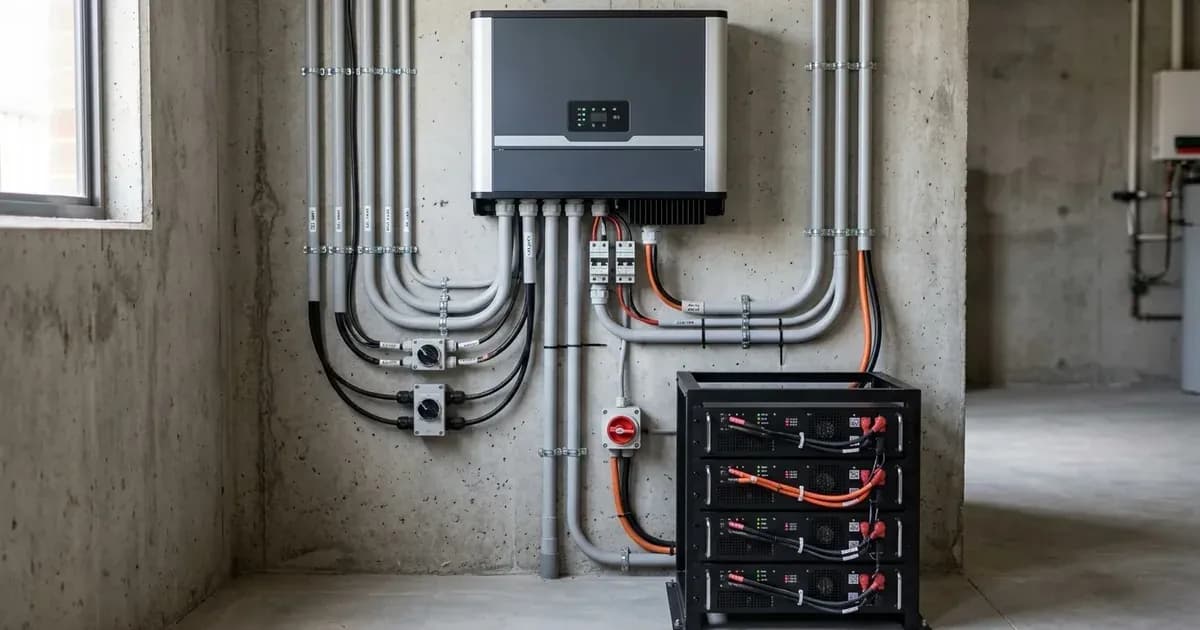
The Deye SUN-12K-SG04LP3 is engineered for residential and commercial energy storage systems, capable of both off-grid and grid-parallel operation. It is designed to be compatible with standard single-phase and three-phase electrical distribution systems. A key aspect of its design is the low voltage battery port, which requires specific cabling and protection to handle high currents safely.
Proper installation ensures the system complies with international microgeneration safety and grid protection standards. This includes correct earthing, appropriate cable sizing, and accurate configuration of monitoring components like Current Transformers (CTs).
Critical Wiring and Protection Requirements
The battery connection is a high-current path and requires precise attention to detail.
Component | Requirement | Safety Note |
|---|---|---|
Battery Cables | Sized at 50mm2 to 70mm2 | Incorrect sizing can lead to overheating and fire risk. Always use appropriate tools and personal protective equipment. |
DC Overcurrent Fuse | 250A DC overcurrent fuse protection | This fuse protects the battery and inverter from damaging overcurrents. Ensure it is correctly rated and installed in the positive battery line. |
Earthing | Bond inverter chassis ground and battery metal enclosure to the main installation earthing terminal. | This is essential for electrical safety, providing a path for fault currents and protecting against electric shock. |
CT Clamps | Install with arrows pointing towards household loads, away from the grid incomer. | Incorrect orientation results in negative power flow readings during high household consumption, impacting system operation and billing. Ensure complete AC circuit isolation and lock-out before installing CT clamps on live busbars. |
Communication Cabling | Maintain shielded twisted-pair cabling; verify proper RS485 communication baud rate settings. | Shielding prevents electromagnetic interference. Correct baud rate ensures reliable data exchange for monitoring and control. |
What You Can Check Yourself, and What You Cannot
As a homeowner, you can visually inspect your system for obvious issues, such as loose cables or visible damage. You can also check the inverter's touchscreen display for basic status indicators or use the Solarman Cloud App for monitoring.
However, any work that involves opening the inverter unit, modifying internal wiring, or changing grid-protection settings must be performed by an accredited installer. Grid-protection settings are set by an accredited installer and changing them can breach the connection agreement with your Distribution Network Operator (grid operator).
Safety Warning: Before performing any checks that involve touching electrical components, always isolate PV, battery, and AC breakers. Wait the manual's specified capacitor-discharge time before proceeding. Opening the inverter enclosure is authorised-service work only and carries a risk of electric shock.
What the Published Sources Do Not Tell You
The provided information for the Deye SUN-12K-SG04LP3, while outlining critical safety and installation steps, does not specify certain technical parameters that might be expected in a full technical manual. For example:
- Specific battery voltage ranges for operation: While it states "40V–60V Low Voltage Lithium / Lead-Acid Battery Banks", detailed charge/discharge voltage setpoints for different battery chemistries (e.g., specific lithium iron phosphate profiles) are not provided. These are typically managed by the Battery Management System (BMS) in closed-loop communication.
- Detailed fault codes and troubleshooting steps: published guidance does not include a table of fault codes or specific diagnostic procedures for common issues.
- Maximum PV input voltage or current per MPPT: While dual MPPT trackers are mentioned, the specific electrical limits for the solar array connection are not detailed.
- Specific settings for frequency shifting AC coupling: The mechanism is mentioned, but the configurable parameters or integration details for micro-inverter AC coupling are not present.
- Detailed information on the dedicated auxiliary/smart load port: Beyond its existence, specific control parameters or capabilities are not described.
For these details, installers typically refer to the full technical manual provided by Deye or consult with Deye's technical support, as these values can be critical for system design and troubleshooting.
Still showing the fault? Book a technician
If the steps above did not clear it, tell us the inverter or battery and the exact code. We pass it to a technician who covers your city; visit charges are quoted before they come.
How this pays for the site: the technician or verifier pays SolarNevs a fixed introduction fee. Nobody pays to be recommended, and you are free to use our free guides instead.
Products mentioned
Frequently asked questions
What are the primary technical requirements for deye sun 12k sg04lp3 three phase low voltage hybrid inverter setup guide?
Key requirements include compliance with local grid codes, correct equipment certification, and proper electrical isolation.
Who is authorized to install and inspect deye sun 12k sg04lp3 three phase low voltage hybrid inverter setup guide?
All high-voltage DC, AC grid tie-in, and switchboard modifications must be performed by a qualified, accredited electrical professional.
How is export power limited in deye sun 12k sg04lp3 three phase low voltage hybrid inverter setup guide?
Export limiting is achieved using certified bidirectional smart meters or power sensors providing dynamic feedback to the inverter system.
References
- Deye SUN-3/4/5/6/8/10/12K-SG05LP3-EU-SM2 Hybrid Inverter User Manual (PDF, current-generation successor to the SG04LP3 three-phase LV series; battery cable sizing, CT arrow orientation, mandatory eart — accessed 6 September 2026
- Deye SUN-3/4/5/6/8/10/12K-SG05LP3-EU-SM2 product page (48V LV battery, 240A max charge/discharge, 2 MPPT, datasheet and manual downloads) — accessed 6 September 2026
- NEPRA (Alternative & Renewable Energy) Distributed Generation and Net Metering Regulations, 2015 (S.R.O. 892(I)/2015) - interconnection, bidirectional metering and inverter standards for 1 kW-1 MW fac — accessed 6 September 2026
- NEPRA (Prosumer) Regulations, 2026 (S.R.O. 251(I)/2026) - distributed generation interconnection agreement, bidirectional metering and disconnect requirements — accessed 6 September 2026
Related guides
More from inverter errors & fixes.