Solar System for Home Ireland: Sizing, Costs & Grant Guide (2026)
Updated 18 September 2026 · By SolarNevs Research Desk, Dealer surveys + verified sources · 2 sources · Method ↗
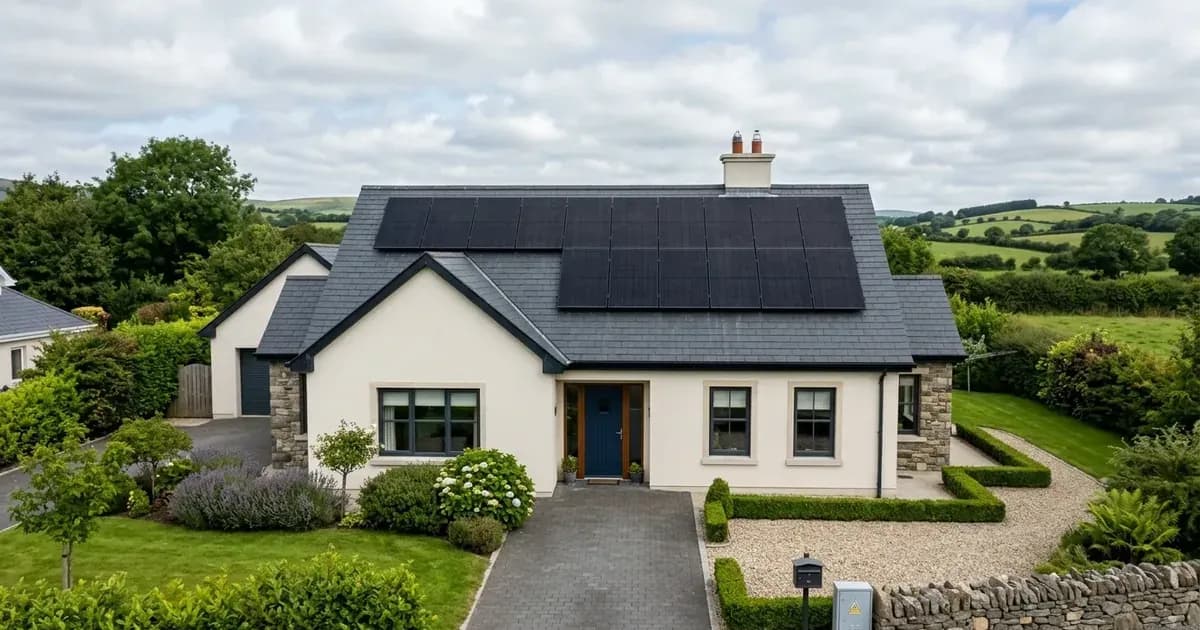
Installing a residential solar photovoltaic (PV) system is one of the most effective long-term investments an Irish homeowner can make to lower domestic electricity bills, insulate against tariff volatility, and cut carbon emissions. With Ireland's adoption of zero-rate VAT on residential solar equipment and Sustainable Energy Authority of Ireland (SEAI) capital grants providing up to €1,800 in direct grant support, domestic solar adoption has accelerated dramatically.
However, choosing the right solar system for your home involves determining the appropriate kilowatt-peak (kWp) capacity, calculating available roof area, selecting an inverter topology, and evaluating whether battery storage is financially justified.
Key Takeaways
- The 4.4 kWp Sweet Spot: Sweet spot: 10 panels x 440W = 4.4 kWp. Hits the maximum € 1,800 SEAI grant. Covers 80-100% of average household use.
- Roof Space Requirements: Each solar panel measures approximately 1.72m × 1.13m (about 1.95 m2). A typical 10-panel (4.4 kWp) system needs around 20 m2 of unshaded south-facing roof space.
- Self-Consumption Dynamics: Without a battery, about 55% of your solar electricity is used directly and 45% is exported. With a battery, self-consumption rises to 75-80%.
- Future-Proof Inverters: Even if you don't want a battery now, get a hybrid inverter. The cost difference is small and it means you can add a battery later without replacing your inverter.
- Accreditation Rules: Your installer must be on the SEAI registered Solar PV Company list to qualify for the grant. Check at seai.ie before signing any contract.
1. Sizing Your Home Solar System by Property Type
Sizing a domestic solar array starts with reviewing your annual electricity consumption, typically found on your utility bill (expressed in total kWh per year). Systems should be sized to balance direct daylight self-consumption against export value under the Clean Export Guarantee (CEG).
Irish residential systems generally fall into five distinct tiers based on dwelling size and domestic energy demands:
Household Profile | Panel Count | System Capacity | SEAI Grant | Estimated Net Cost | Estimated Annual Output |
|---|---|---|---|---|---|
Small / apartment | 6 panels | 2.6 kWp | € 1,520 | €4,980-€5,780 | ~ 2,300 kWh |
Average 3-bed | 8 panels | 3.5 kWp | € 1,700 | €5,800-€6,800 | ~ 3,100 kWh |
Average 3-4 bed | 10 panels | 4.4 kWp | € 1,800 (max) | €6,500-€7,200 | ~ 3,900 kWh |
Larger 4-bed | 12 panels | 5.3 kWp | € 1,800 (max) | €7,400-€8,100 | ~ 4,700 kWh |
Large + EV + heat pump | 16-20 panels | 7 - 8.8 kWp | € 1,800 (max) | €10,000-€13,700 | ~ 6,200 - 7,800 kWh |
For modest urban homes, Small / apartment 6 panels 2.6 kWp € 1,520 €4,980-€5,780 ~ 2,300 kWh provides an accessible entry point that covers core daytime background baselines such as refrigeration and home electronics.
A standard three-bedroom semi-detached residence typically suits Average 3-bed 8 panels 3.5 kWp € 1,700 €5,800-€6,800 ~ 3,100 kWh.
For the majority of Irish families, installers identify the 10-panel array as the optimal configuration: Average 3-4 bed 10 panels 4.4 kWp € 1,800 (max) €6,500-€7,200 ~ 3,900 kWh. This setup claims the full statutory grant ceiling of €1,800 while generating sufficient energy across spring, summer, and autumn to offset most domestic electrical use.
For larger properties with higher domestic hot water and heating demand, Larger 4-bed 12 panels 5.3 kWp € 1,800 (max) €7,400-€8,100 ~ 4,700 kWh provides substantial extra yield. Finally, homes that have transitioned to fully electrified heating and transport require Large + EV + heat pump 16-20 panels 7 - 8.8 kWp € 1,800 (max) €10,000-€13,700 ~ 6,200 - 7,800 kWh to satisfy the significant year-round electrical loads of a heat pump and home EV charger.
To compare specific panel manufacturers suitable for these configurations, see our comprehensive guide on the best solar panels in Ireland.
2. Calculating Roof Dimensions & Layout Math
Before committing to a system size, homeowners must confirm that their roof possesses sufficient unshaded surface area.
Standard physical module metrics dictate: Each solar panel measures approximately 1.72m × 1.13m (about 1.95 m2). A typical 10-panel (4.4 kWp) system needs around 20 m2 of unshaded south-facing roof space.
When evaluating roof layout options:
- An 8-panel system needs about 16 m2 while a larger 14-panel system requires approximately 27 to 28 m² of clear roof plane.
- Vent pipes, roof valleys, velux windows, and satellite dishes reduce usable area and require appropriate clearance boundaries.
- While south-facing orientations deliver maximum annual kilowatt-hour yields, east-west split orientations generate a broader daily generation curve, matching morning breakfast and late afternoon household consumption spikes.
If your property has split roof faces, module placement must be designed carefully with multi-MPPT inverters to prevent cross-string mismatch losses. If seasonal generation falls below expectations, refer to our diagnostic resource on solar generation lower than expected in Ireland.
3. Battery Storage Integration vs Grid Export
A central question for Irish buyers is whether to bundle home battery storage with their solar PV panels.
The economics of battery storage depend directly on household load profiles: Without a battery, about 55% of your solar electricity is used directly and 45% is exported. With a battery, self-consumption rises to 75-80%.
Without storage, daytime solar electricity powers active domestic appliances directly. Any instantaneous surplus is automatically exported to the national electricity grid via ESB Networks under the Clean Export Guarantee (CEG), earning a supplier export credit per kilowatt-hour.
Adding a battery captures that 45% surplus to power evening cooking, entertainment, and lighting after sunset. During winter months when solar irradiance is low, a battery can be scheduled to charge from the grid at off-peak night rates (such as smart EV or NightSaver tariffs) and discharge during expensive daytime peak hours.
For detailed hardware selection and modular expansion rules, explore our solar battery storage buying guide for Ireland.
4. Inverter Selection & Future-Proofing
The solar inverter serves as the central brain of your residential energy system, converting raw DC power from roof modules into synchronized 230V AC electricity for domestic appliances.
Irish industry specialists strongly advise: Even if you don't want a battery now, get a hybrid inverter. The cost difference is small and it means you can add a battery later without replacing your inverter.
A standard string inverter can only manage solar generation; adding a battery later requires an additional AC-coupled battery charger, increasing installation complexity and balance-of-system costs. A hybrid inverter integrates direct DC battery charging ports from day one, allowing seamless plug-and-play battery expansion whenever household energy needs grow.
For detailed specifications on leading hybrid models, read our dedicated review of Solis hybrid inverters in Ireland.
5. SEAI Compliance & Safe Electric Rules
All residential solar systems claiming grant support in Ireland must adhere strictly to statutory safety and electrical standards.
Choosing an Accredited Installer
Under SEAI regulations: Your installer must be on the SEAI registered Solar PV Company list to qualify for the grant. Check at seai.ie before signing any contract. Installations completed by unlisted contractors are ineligible for grant payment. Furthermore, market experts recommend: Prices vary significantly between installers. Get at least 3 quotes. Compare not just price but equipment brand, warranty terms, and aftercare/monitoring included.
National Electrical Standards
Under the SEAI Domestic Code of Practice, all installed equipment must comply with I S 10101 have a rated efficiency of 95 percent or higher. Inverters connected to the Irish distribution grid must comply with EN50549 with Irish Protection Settings to protect ESB Networks line technicians during outages.
Isolation and Certification
For maintenance and emergency safety, an AC isolator 2 pole switching live and neutral must be installed between the inverter and the consumer unit. Every installation must be tested, commissioned, and certified by an authorized Safe Electric Registered Electrical Contractor (REC) who submits a formal Declaration of Works.
Frequently asked questions
What is the optimal solar system size for an average 3 to 4-bedroom home in Ireland?
The standard recommendation is a 10-panel system using 440W modules (4.4 kWp), which achieves the maximum €1,800 SEAI grant and yields around 3,900 kWh annually to cover 80-100% of average electricity use.
How much roof space is required to install a domestic solar PV array in Ireland?
Each standard residential panel measures approximately 1.72m by 1.13m (1.95 m²). An 8-panel array requires about 16 m², while a standard 10-panel system requires approximately 20 m² of unshaded roof space.
How much solar generation is self-consumed without a battery versus with a battery?
Without a battery, an Irish household typically self-consumes about 55% of its solar electricity directly, exporting the remaining 45%. Adding a battery lifts self-consumption to 75-80%.
Should I install a hybrid inverter even if I am not purchasing a battery immediately?
Yes. Getting a hybrid inverter costs very little extra upfront and allows you to add battery storage later without the expense of replacing your inverter.
References
- Solar Info Ireland - Solar Equipment Guide 2026 — accessed 28 August 2026
- SEAI Domestic Solar Photovoltaic Code of Practice — accessed 28 August 2026
Related guides
More from what to buy — and how not to get cheated.