Best Solar Panels in Ireland (2026): Brands, Tech & Buying Guide
Updated 18 September 2026 · By SolarNevs Research Desk, Dealer surveys + verified sources · 3 sources · Method ↗
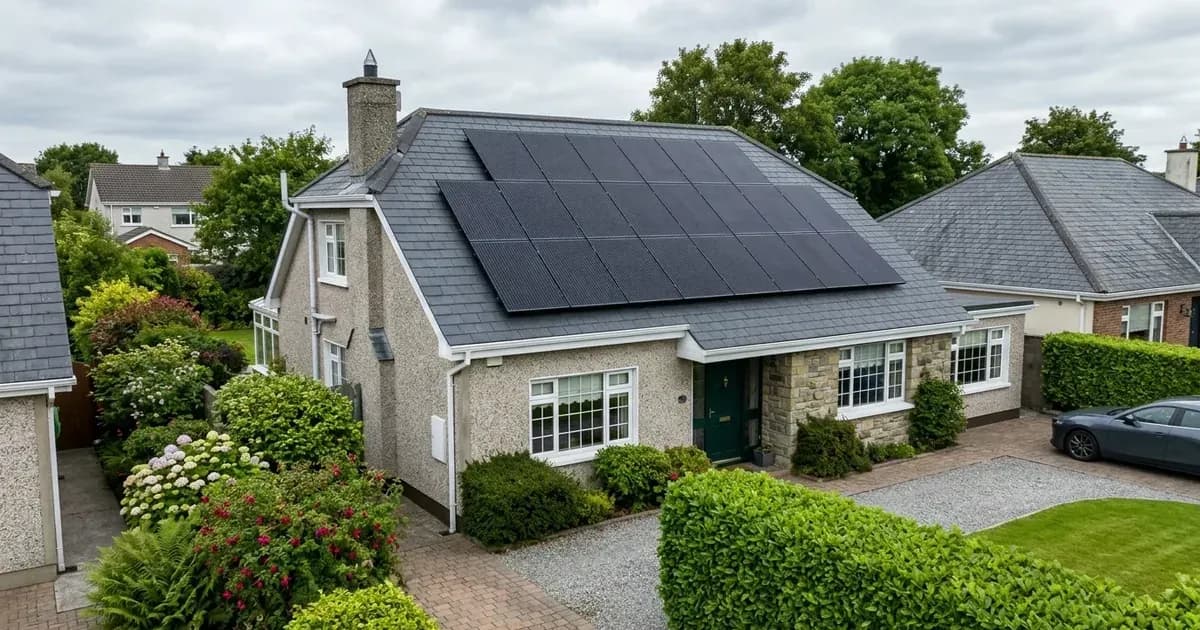
Choosing the right solar panels for an Irish home requires balancing module efficiency, long-term degradation resistance, physical roof dimensions, and manufacturer warranty backing. Ireland's maritime climate—characterized by abundant diffused overcast daylight, persistent humidity, and salt-laden coastal winds—demands robust photovoltaic modules capable of generating dependable yields without premature electrical degradation.
Today, the Irish residential solar market is firmly centered on Tier 1 manufacturers utilizing modern N-type TOPCon (Tunnel Oxide Passivated Contact) and All-Back Contact (ABC) cell architectures. Understanding how leading panel options compare helps Irish homeowners evaluate installer quotations and maximize their return on investment under the Sustainable Energy Authority of Ireland (SEAI) Domestic Solar PV Scheme.
Key Takeaways
- Residential Power Benchmark: Most Irish installers fit panels in the 440-455W range as standard and the 2026 flagship generation now reaches 470-500W in the same residential footprint.
- Cell Architecture Standard: If you received a quote with P-type PERC panels, it may be using older stock. N-type TOPCon panels are now the industry standard.
- System Sweet Spot: Sweet spot: 10 panels x 440W = 4.4 kWp. Hits the maximum € 1,800 SEAI grant. Covers 80-100% of average household use.
- Long-Term Durability: Solar panels installed in Ireland last 25-30 years with minimal maintenance. Modern panels degrade at just 0.3-0.5% per year, meaning after 25 years they still produce 85-90% of their original output.
- Regulatory Requirement: All domestic installations must be carried out by an SEAI registered company and certified by a Safe Electric Registered Electrical Contractor (REC).
1. Leading Solar Panel Brands in Ireland Compared
Irish installers quote a select group of globally recognized, bankable Tier 1 manufacturers. Independent industry analysis confirms: Stick with Tier 1 panel manufacturers (Jinko, JA Solar, Trina, LONGi, Canadian Solar). Tier 1 means the manufacturer is bankable and will honour warranties.
The primary solar panels actively installed across Ireland in 2026 include:
Manufacturer | Key Model Range | Standard Wattage | Module Efficiency | Warranty Coverage | Market Category |
|---|---|---|---|---|---|
Jinko Solar | Tiger Neo N-type | 440W | 22.3% | 25yr product / 30yr perf. | Mid-range (Market #1) |
JA Solar | DeepBlue 4.0 | 440W | 21.8% | 25yr product / 25yr perf. | Mid-range (Market #2) |
Trina Solar | Vertex S+ N-type | 445W | 23.3% | 25yr product / 25yr perf. | Mid-range (Market #3) |
TW Solar | TNC 2.0 TOPCon | 450W | 24.6% | 25yr product / 30yr perf. | Mid-range value |
Aiko Solar | Neostar 3P54 | 470-500W | 25.0% | 15-25yr product / 30yr perf. | Premium high-yield |
Jinko Solar Tiger Neo N-type 440W 22.3% 25yr / 30yr perf. Mid-range represents the single most widely specified panel across Irish rooftops. Its proven track record, balanced pricing, and robust dual-glass damp resistance make it the baseline against which other modules are assessed.
For homes with constrained south-facing roof spaces, Aiko Solar Neostar 3P54 470-500W 25.0% 15-25yr / 30yr perf. Premium provides industry-leading power density. While priced at a premium over standard modules, Aiko allows homeowners to generate substantially more kilowatt-hours from a compact roof area.
Meanwhile, JA Solar DeepBlue 4.0 440W 21.8% 25yr / 25yr perf. Mid-range and Trina Solar Vertex S+ N-type 445W 23.3% 25yr / 25yr perf. Mid-range remain dependable staples among national installers, offering high build quality and competitive pricing. For maximum power density per module in the mid-range bracket, TW Solar TNC 2.0 TOPCon 450W 24.6% 25yr / 30yr perf. Mid-range delivers 450W at 24.6% efficiency.
2. Cell Architecture: N-Type TOPCon vs P-Type PERC
When reviewing installer proposals, examining the cell technology is critical. Older quotes frequently proposed P-type PERC (Passivated Emitter and Rear Cell) panels. However, Irish market guidelines are unambiguous: If you received a quote with P-type PERC panels, it may be using older stock. N-type TOPCon panels are now the industry standard.
The transition from P-type to N-type TOPCon delivers three decisive advantages in Ireland:
- Diffused Light Harvesting: Overcast skies dominate Irish winters and shoulder months. N-type silicon suffers significantly lower recombination losses under weak sunlight, capturing up to 1-3% more energy during cloudy periods.
- Elimination of Light-Induced Degradation (LID): Traditional boron-doped P-type wafers experience rapid initial degradation upon initial sunlight exposure. N-type silicon uses phosphorus doping, virtually eliminating oxygen-boron defect complexes.
- Lower Annual Degradation: Standard TOPCon modules guarantee minimal annual loss, typically limited to 0.4% per annum following a nominal 1% first-year allowance.
For complex shading environments where chimneys, vent pipes, or neighboring gables cast intermittent shadows, modern panel bypass diodes work seamlessly with hybrid inverters to prevent localized hotspots. If you experience unexpectedly low seasonal yields, review our diagnostic guide on solar generation lower than expected in Ireland.
3. Sizing for Irish Roofs & The SEAI Grant Sweet Spot
System sizing must align with your property's usable roof area, annual domestic electrical consumption, and the SEAI grant threshold. The statutory grant provides up to €1,800 for systems reaching or exceeding 4 kWp.
Installers across Ireland consistently recommend a specific baseline configuration: Sweet spot: 10 panels x 440W = 4.4 kWp. Hits the maximum € 1,800 SEAI grant. Covers 80-100% of average household use.
A standard 10-panel array of 440W modules requires approximately 20 square meters of unshaded roof space. On south-, east-, or west-facing roof profiles, this system generates roughly 3,900 kWh to 4,200 kWh annually in central and southern Ireland.
Pairing this array with modern battery storage allows homeowners to store daytime surplus for evening peak hours, or charge from night-rate tariffs during winter months. For equipment recommendations, see our guides to Solis hybrid inverters in Ireland and home solar battery storage buying.
4. Lifespan, Degradation & Warranty Terms
Solar modules represent a long-term capital investment designed to outlast typical domestic roofing materials. Standard performance tracking demonstrates: Solar panels installed in Ireland last 25-30 years with minimal maintenance. Modern panels degrade at just 0.3-0.5% per year, meaning after 25 years they still produce 85-90% of their original output.
When comparing warranties across installer quotations, verify that the proposal distinguishes between two separate warranties:
- Product Warranty (Workmanship): Covers physical defects, frame corrosion, junction box failure, and delamination. Tier 1 manufacturers in Ireland provide 25-year product warranties as standard on residential modules.
- Performance Warranty (Power Output): Guarantees that power degradation will not exceed defined thresholds over 25 to 30 years. Quality N-type panels guarantee at least 87.4% to 88.8% of original rated capacity at year 25 or year 30.
Because solar modules produce high-voltage direct current whenever sunlight hits the roof, electrical balance-of-system components must be engineered to prevent voltage spikes or grid disconnection. If your system trips on bright summer days, consult our guide on solar inverter grid voltage trip troubleshooting.
5. Irish Electrical Standards & Safe Electric Regulations
Every solar PV installation in Ireland must comply with national technical regulations established by the Sustainable Energy Authority of Ireland and Safe Electric.
SEAI Installer Certification
Under the Domestic Solar PV Scheme, grants are conditional on strict contractor accreditation: Your installer must be on the SEAI registered Solar PV Company list to qualify for the grant. Homeowners must verify their chosen contractor's active registration on seai.ie before signing contracts or paying deposits.
NSAI I.S. 10101 & Inverter Compliance
Under the SEAI Code of Practice, all balance of system hardware must comply with I S 10101 have a rated efficiency of 95 percent or higher. Inverters must also comply with EN50549 with Irish Protection Settings to ensure safe automatic disconnection in the event of an ESB Networks grid disturbance.
Dual-Pole Isolation & Fire Safety Siting
To ensure physical isolation for emergency services and maintenance personnel, an AC isolator 2 pole switching live and neutral must be installed between the inverter and the consumer unit.
Furthermore, Safe Electric highlights the critical safety considerations governing indoor siting: When these switches are enclosed in tight spaces or obstructed by clothing, the lack of ventilation can lead to thermal stress, electrical failure, or even ignition. Inverters and isolators must never be installed in enclosed airing cupboards or unventilated storage wardrobes, and all completed works must receive a formal Safe Electric Completion Certificate from an accredited REC.
Frequently asked questions
What wattage solar panels do Irish installers fit as standard in 2026?
Most Irish installers fit panels in the 440-455W range as standard, while 2026 flagship residential models from premium brands reach 470-500W in the same physical footprint.
Why are N-type TOPCon panels preferred over older P-type PERC panels in Ireland?
N-type TOPCon panels are now the industry standard, offering 1-3% higher efficiency, superior low-light performance on overcast Irish days, and lower annual degradation rates.
What is the recommended solar PV system size for an average Irish home?
The sweet spot for most Irish 3 to 4-bedroom homes is 10 panels of 440W each (4.4 kWp), which maximizes the €1,800 SEAI grant and covers 80-100% of typical domestic electricity consumption.
How long do Tier 1 solar panels last in the Irish climate?
Tier 1 panels last 25-30 years with minimal maintenance, degrading at just 0.3-0.5% annually so that after 25 years they still deliver 85-90% of their initial rated power output.
References
- Solar Info Ireland - Solar Equipment Guide 2026 — accessed 28 August 2026
- SEAI Domestic Solar Photovoltaic Code of Practice — accessed 28 August 2026
- Safe Electric Ireland - Solar PV Technical Guidance — accessed 28 August 2026
Related guides
More from what to buy — and how not to get cheated.