Solar Generation Lower Than Expected in Ireland: Diagnostic Guide
Updated 19 September 2026 · By SolarNevs Research Desk, Dealer surveys + verified sources · 2 sources · Method ↗
Key Takeaways
- Begin triage with a structured checklist for troubleshooting inverters with low power output to isolate DC array losses from AC grid limitations.
- Check open-circuit string voltage at disconnected connectors and ensure ground potential readings decrease within a range of 5 to 95 percent of a single module open-circuit voltage.
- Verify that no shadows from dormers or chimneys fall across the solar panels, as even partial string shading severely reduces string generation.
- If no external power meter is installed, disable the fail-safe mode in the internal export power manager settings to clear unintended software curtailment.
- Installations in Ireland must comply with NSAI I.S. 10101 and include an AC isolator 2 pole switching live and neutral between the inverter and consumer unit.
Why is my solar PV generation lower than expected in Ireland?
When an Irish solar photovoltaic system produces noticeably less energy than projected in the SEAI design estimate, homeowners often wonder whether a solar panel has degraded or the inverter has malfunctioned.
Solar generation fluctuates naturally with Irish maritime weather, cloud cover, and seasonal sun angles. However, when output remains depressed during bright midday sun, systematic diagnostics are required. Ginlong Solis technical service documentation provides a formal checklist for troubleshooting inverters low power generation to evaluate DC hardware, AC connections, and firmware parameters.
Hardware Inspection and DC String Testing
Underperformance frequently traces back to array-level connection flaws, conductor terminations, or environmental shading that impairs string current flow.
Inspection Point | Diagnostic Protocol | Verification Target |
|---|---|---|
AC Junction Box | Check AC connection on new installations | Ensure AC cables properly seated; verify polarity marked on AC gland |
MC4 DC Plugs | Inspect MC4 connectors across strings | Verify all MC4 connectors securely latched with no loose connections |
MC4 Tooling | Properly crimp MC4 connectors | Calibrated crimping ensures secure mechanical and electrical contact |
String Voltage | Measure open circuit voltage VOC of PV strings | Measure voltage at connector end after disconnecting from inverter |
Earth Potential Ratio | Check voltage between PV and ground | Readings must decrease within a range of 5 to 95 percent of single module VOC |
Array Shading | Check for panel shadows | Ensure no shadows cast on solar panels, as shading reduces performance |
String Voltage and Insulation Verification
To determine whether an entire string is failing to generate:
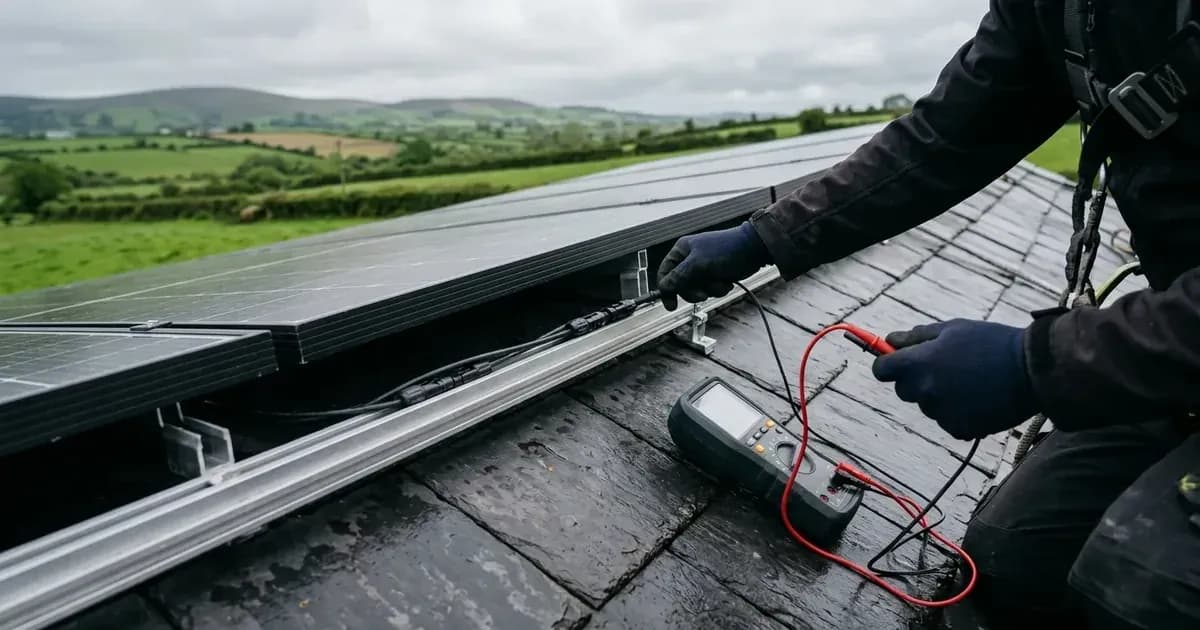
- Measure Open-Circuit Voltage: Technicians measure open circuit voltage VOC of PV strings at the connector end after disconnecting the strings from the inverter. Comparing this reading against the expected module string sum reveals open circuits or failed bypass diodes.
- Earth Potential Test: Use a multimeter to measure the voltages between PV positive and ground, as well as PV negative and ground, for all PV strings. The values should decrease within a range of 5 to 95 percent of a single PV module open-circuit voltage. If the voltage remains above a single module VOC or increases instead of decreasing, there may be a fault in the affected string.
- Shading Verification: Installers must check for panel shadows and ensure that no shadows are cast on the solar panels, as this can significantly reduce performance across series-connected strings.
Inverter AC Side Voltage and Software Mode Triage
If DC string voltages match design specifications, low power generation may stem from AC grid coupling or internal firmware curtailment modes.
AC Terminal Measurements
Grid voltage abnormalities or unbalanced phases can cause the inverter to throttle output:
- Three-Phase Systems: Check the AC-side voltage between phases, phase to neutral, and neutral to ground. The measurement should be taken from the connector or plug which are directly connecting AC grid to the inverter or AC terminals of the inverter.
- Single-Phase Systems: Check the AC-side voltage between phase and neutral, phase and ground, and neutral and ground. The measurement should be taken at the inverter AC junction box.
Export Power Manager Software Overrides
Many modern hybrid inverters include internal export power management functions designed to throttle output when grid backfeed limits are reached:
- EPM Failsafe Override: If no external EPM device is being used on the installation, disable the fail-safe mode in the internal EPM settings. When fail-safe mode remains active without a connected meter, the inverter assumes communication has failed and throttles output to zero export.
- Workflow Completion: Following these steps will help conduct a thorough fault analysis and enable efficient troubleshooting of generation shortfalls.
Safe Electric Standards & Irish Installation Compliance
Diagnosing electrical connections on rooftop microgeneration systems in Ireland involves exposure to hazardous voltages and requires strict adherence to Safe Electric procedures.
Safe Electric & I.S. 10101 Safety Notice: Rooftop solar strings carry high DC open-circuit voltages that cannot be switched off during daylight. Always isolate AC and DC disconnection switches before disconnecting plugs or touching wiring terminals. Physical testing, MC4 re-crimping, and junction box work must be completed by a Safe Electric Registered Electrical Contractor (REC).
Under the Sustainable Energy Authority of Ireland (SEAI) Domestic Solar PV Code of Practice:
- European Standards: The inverter must meet the requirements of EN 62109 and comply with EN50549.
- Irish Grid Code: The unit must comply with EN50549 with Irish Protection Settings to satisfy ESB Networks microgeneration connection conditions.
- Wiring Standards: The installation must comply with NSAI I.S. 10101 wiring rules and achieve an inverter rated efficiency of 95 percent or greater.
- Physical Isolation: An AC isolator 2 pole switching live and neutral must be installed between the inverter and the consumer unit.
- Safety Placards: A permanent safety placard stating "Inverter Isolate AC and DC before carrying out work" must be clearly fixed on the inverter enclosure.
Following this structured diagnostic methodology ensures solar PV owners in Ireland identify array shading, resolve DC string defects, clear inverter software throttling, and restore optimal system generation safely.
Frequently asked questions
Why is my solar generation lower than expected in Ireland?
Underperformance can result from seasonal weather shifts, physical shading from chimneys or foliage, loose MC4 crimps, or active inverter software deratings like an incorrectly engaged internal export power manager.
How do I check if my solar DC string is underperforming?
A qualified technician measures the open-circuit voltage at the connector end after disconnecting the strings from the inverter, and verifies that the voltage to ground decreases within a range of 5 to 95 percent of a single module open-circuit voltage.
What should I do if my inverter has an EPM fail-safe limiting power?
If no external export power meter device is being used on the installation, disable the fail-safe mode in the internal EPM settings to prevent unneeded power throttling.
What efficiency standards apply to solar inverters in Ireland?
Under SEAI rules, solar inverters must comply with NSAI I.S. 10101, meet EN 62109 safety standards, adhere to EN50549 with Irish Protection Settings, and achieve a rated efficiency of 95 percent or greater.
References
- Solis Service Portal - Low Power Generation — accessed 17 September 2026
- SEAI - Domestic Solar PV Code of Practice for Installers — accessed 17 September 2026
Related guides
More from inverter errors & fixes.