Solis Inverter Troubleshooting in Ireland: Error Codes and Diagnostic Guide
Updated 19 September 2026 · By SolarNevs Research Desk, Dealer surveys + verified sources · 3 sources · Method ↗
Key Takeaways
- Solis categorises alarms into tip informational states, general stability issues, and emergency safety critical faults that shut down the system.
- Access the on-board historical diagnostic buffer by entering the Advanced Info menu using passcode 0010 to review previous fault events.
- Under SEAI rules in Ireland, installations require an AC isolator 2 pole switching live and neutral between the inverter and the consumer unit.
- Always observe mandatory safety warning labels: isolate AC and DC circuits before touching terminals or opening wiring covers.
Why is my Solis inverter showing an error code in Ireland?
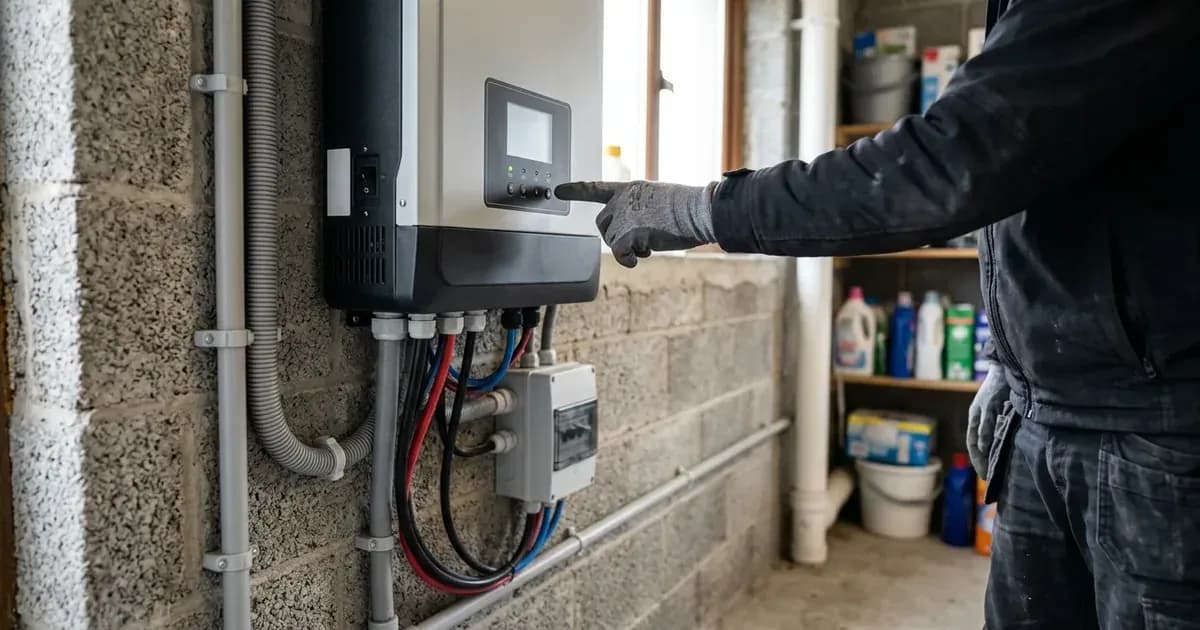
A Solis inverter flags operational faults through its front panel LCD screen and indicator LEDs. The display outputs a readable fault name alongside clear troubleshooting steps to indicate whether the system is experiencing a transient utility issue or an internal hardware trip.
Ginlong Solis groups system events into three distinct operational severity levels:
- Tip Severity: Informational or early warning states that often recover automatically, such as temporary grid voltage or frequency fluctuations.
- General Severity: Performance or stability issues that may require inspection, including communication faults with meters or auxiliary devices.
- Emergency Severity: Safety critical faults that may shut down the system entirely to protect the building wiring and internal inverter power electronics.
When an alarm triggers, the first step is to record the exact message on the screen before cycling power.
How to check the Solis alarm message log
When an intermittent fault clears before you can inspect the unit, you can retrieve previous events from internal storage. Solis inverters maintain a chronological log of previous operational alerts.
Follow these steps to check the log:
- Press the Enter button to access the Main Menu, then scroll down to the Advanced Info section.
- Enter passcode 0010 by pressing the keypad sequence down, down, up, down, then press Enter to confirm.
- Within the Advanced Info submenu, select the first option labeled Alarm Message.
- The system will display the 100 latest alarm messages along with the date and time they occurred.
- Scroll through the alarm messages manually by pressing the up and down buttons to review the trip sequence.
Reviewing these historical records helps identify whether trips occur during peak solar generation hours or align with local network disturbances.
Common Solis alarm code families and root causes
Alarm Family | Display Codes | Underlying Root Cause | Operational Impact |
|---|---|---|---|
Grid Voltage | OV-G-V, UN-G-V | Over under voltage out of range | Inverter disconnects until network returns within statutory bounds |
Grid Frequency | OV-G-F, UN-G-F | Over under frequency fluctuations | Temporary trip during utility distribution frequency swings |
Grid Presence | NO-Grid, Uac-Unstable | Grid loss or instability on AC lines | System ceases export; checks AC supply connections |
DC Input Voltage | OV-DC, OV-MPPT | String open-circuit voltage exceeds limit | Hardware protection trip to prevent DC stage overvoltage damage |
Array Polarity | Reve-DC | Reverse polarity on DC string conductors | Inverter blocks startup until positive and negative leads are corrected |
Array Insulation | PV-ISO-PRO | Low insulation resistance issues to earth | Protective shutdown due to moisture ingress or cable insulation breakdown |
Arc Detection | ARC-FAULT, AFCI-Check | Arc fault circuit interrupter events | Safety shutdown to prevent fire hazards from loose DC connections |
Battery Storage | Multi-level alarms | Battery safety spanning voltage current temperature and communication | Battery management system disconnects DC battery contactor |
Bus Communication | CAN-BUS-Lose, DCanErr | CAN bus loss between inverter and storage unit | Loss of telemetry or battery charging management |
Parallel Bus | MulMasterErr, Addr-Conflict | Parallel configuration conflicts or address overlap | Mult-inverter synchronization disabled |
System Timing | MasterSyncLose, SlaveSyncErr | Synchronization failures between linked units | Master-slave communications drop out |
For dedicated diagnostics on AC voltage disconnection events, refer to our detailed breakdown on /ie/guides/fixes/solar-inverter-grid-voltage-trip-ireland. If your unit shows AC power failure while your home retains power, consult /ie/guides/fixes/solis-inverter-no-grid-alarm-ireland.
Troubleshooting array insulation and hardware faults
When the inverter reports PV-ISO-PRO, it indicates insulation resistance issues between the solar array conductors and earth. In Ireland's damp climate, degraded cable insulation or unsealed rooftop connectors can cause leakage current to trip the inverter's sensitive ground fault monitoring. Read our step-by-step procedure in /ie/guides/fixes/solar-pv-isolation-fault-troubleshooting-ireland.
Similarly, arc fault circuit interrupter events designated as ARC-FAULT or AFCI-Check indicate DC arcing in solar array wiring. Never reset an active arc fault alert repeatedly without a physical examination of the DC isolators, string fuses, and rooftop module junctions.
If your inverter is generating electricity normally but fails to report metrics to the monitoring portal, check our guide on /ie/guides/fixes/solis-wifi-stick-offline-troubleshooting-ireland.
Irish regulatory requirements and wiring standards
Under Sustainable Energy Authority of Ireland (SEAI) rules and national electrical installation standards, domestic solar PV systems must adhere to strict technical parameters:
- Product Safety: Inverters must meet the requirements of EN 62109 to guarantee electrical safety and enclosure integrity.
- Grid Compliance: Inverters must comply with EN50549 with Irish Protection Settings to ensure safe decoupling during network disturbances.
- National Wiring Rules: The entire installation must comply with I S 10101 and the inverter must have a rated efficiency of 95 percent or greater.
- Weather Protection: External units require robust sealing; inverters must have an ingress rating of IP65 or greater.
- Fire Safety: Where mounted against combustible walls, the unit must sit against a substrate Class 0 which extends to a minimum of 150mm beyond the edge of the inverter.
- AC Disconnection: An AC isolator 2 pole switching live and neutral must be installed between the inverter and the consumer unit.
- Warning Placards: Installations must carry the mandatory warning sign: "Inverter Isolate AC and DC before carrying out work".
Safety: isolating power supplies before inspection
Solar inverters are connected to two separate electrical energy sources: the rooftop photovoltaic generator and the alternating current distribution network.
Before touching any external switches or inspecting cable terminations:
- Turn off the AC miniature circuit breaker or RCBO in the main distribution board.
- Switch off the external AC rotary isolator adjacent to the inverter.
- Turn off the DC rotary isolator located below the inverter enclosure.
- Wait at least five minutes for the internal high-voltage DC bus capacitors to discharge safely before touching any wiring.
- Always verify zero voltage using an appropriately rated, calibrated test instrument.
When to call a Safe Electric Registered Electrical Contractor
While checking the LCD screen and reviewing the historical alarm log is straightforward, internal electrical work requires qualified personnel.
You must contact a Safe Electric Registered Electrical Contractor (REC) if:
- The inverter displays permanent internal failure codes such as hardware self-test errors.
- An insulation alarm (PV-ISO-PRO) persists after rainfall, indicating damaged DC cabling.
- There is any evidence of thermal discolouration, burning smells, or melted plastic around terminal covers.
- Grid protection settings require recalibration or firmware updates under ESB Networks requirements.
Frequently asked questions
What should I do if my Solis inverter displays a red alarm light in Ireland?
Check the LCD screen for the alarm name. Informational states often clear automatically, but emergency trips shut down generation. If inspecting physical connections, isolate AC and DC supplies first and contact a Safe Electric Registered Electrical Contractor.
How do I access the historical alarm log on a Solis inverter?
Press the Enter button to enter the Main Menu, scroll down to Advanced Info, and enter passcode 0010. Within the submenu, select Alarm Message to view the recorded faults.
How many past alarm messages does a Solis inverter store?
The Solis inverter memory displays the 100 latest alarm messages along with the exact date and time they occurred, which you can navigate manually using the up and down buttons.
What Irish standards must a domestic solar inverter meet?
Under SEAI rules, inverters must meet the requirements of EN 62109, comply with EN50549 with Irish Protection Settings, comply with I S 10101 wiring rules, and carry an ingress rating of IP65 or greater.
References
- Solis Service Portal - Full Alarm Code Maintenance Overview — accessed 28 August 2026
- Solis Service Portal - How to Check the Alarm Message Log — accessed 28 August 2026
- SEAI - Domestic Solar PV Code of Practice for Installers — accessed 28 August 2026
Related guides
More from inverter errors & fixes.