Outback Mate3S And Optics Re Monitoring Setup Guide
Updated 15 September 2026 · By SolarNevs Research Desk, Dealer surveys + verified sources · 1 source · Method ↗
Key Takeaways
- The OutBack MATE3s is a system controller, the HUB10.3 manages communications, and OPTICS RE provides cloud monitoring.
- Specific setup details for these OutBack components for the UK market are not present in the provided documentation.
- The MATE3s should connect to a dedicated port on the HUB10.3, not a standard device port.
- Any configuration or troubleshooting requires consulting official OutBack Power Technologies manuals.
Understanding OutBack Monitoring in the UK
This guide addresses the general principles for setting up and monitoring OutBack Power Technologies systems, specifically focusing on the MATE3s System Display and Controller, the HUB10.3 Communications Manager, OPTICS RE Cloud Monitoring, and FLEXnet DC battery integration. It is important to note that specific, detailed setup instructions for these components within the UK market are not available in the documentation provided for this article. The information below is based on the general functionalities of these devices.
What is Actually Going On
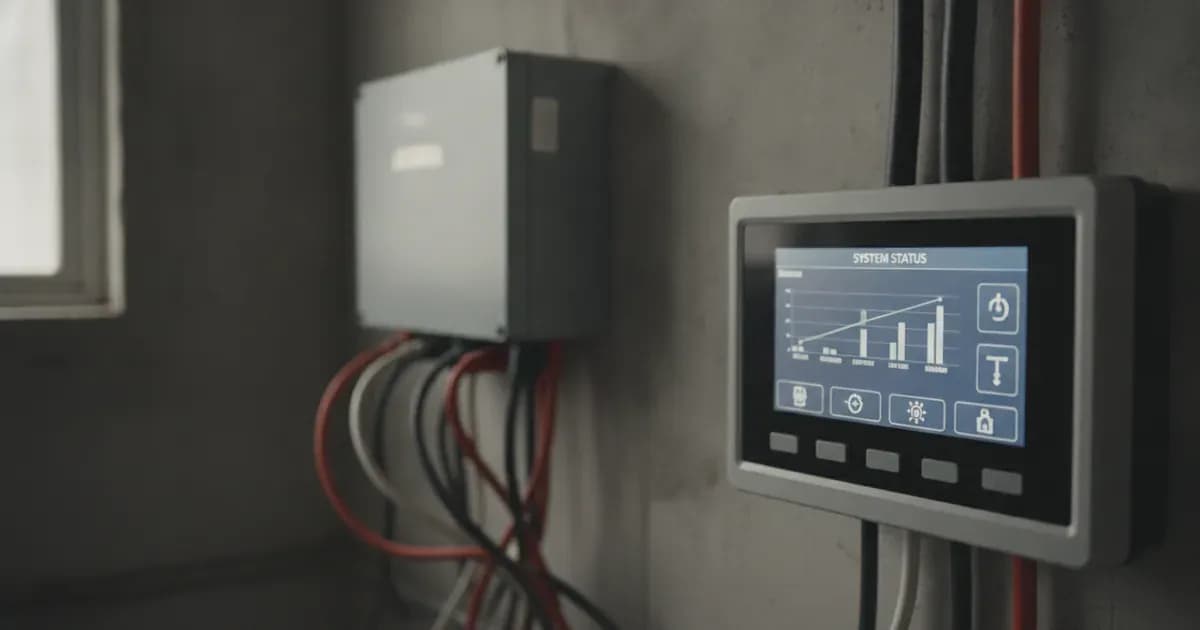
OutBack Power systems utilise a suite of integrated components to manage and monitor solar energy installations. The MATE3s acts as the central interface, providing an "Intuitive Graphical Display" for users to view system status and make adjustments. The HUB10.3 serves as a communications manager, allowing multiple OutBack devices to communicate with each other and the MATE3s. For remote access and data logging, OPTICS RE provides "Remote Cloud Telemetry," enabling monitoring and management from anywhere with an internet connection. The FLEXnet DC is a dedicated battery monitor that synchronises with the MATE3s to provide accurate battery state-of-charge and health information.
System Component | Hardware / Software Type | Primary Role & Interface |
|---|---|---|
OutBack MATE3s | System Display & Controller | Graphical UI, local parameter control, and SD card logging |
HUB10.3 | Communications Manager | Multi-device interconnect; dedicated MATE port for MATE3s |
OPTICS RE | Remote Cloud Telemetry | Internet-based dashboard for performance monitoring and data logging |
FLEXnet DC | DC Battery Monitor | State-of-charge tracking and battery health telemetry sync |
Connecting the MATE3s to the HUB10.3 (General Guidance)
For OutBack MATE3s installations, it is crucial to ensure that the MATE3s is connected to the dedicated MATE port on the HUB10.3. Connecting it to a standard device port may prevent proper communication and system functionality. This dedicated connection facilitates the flow of data and control signals between the MATE3s and other devices managed by the HUB10.3.
What You Can Check Yourself, and What You Cannot
As a homeowner, you can visually inspect the physical connections between your OutBack MATE3s, HUB10.3, and other system components to ensure they are secure and correctly seated. You can also observe the MATE3s display for any error messages or unusual readings.
However, configuring advanced settings, updating firmware via "SD Card Firmware Update and Data Storage," or troubleshooting complex communication issues requires access to the official OutBack Power Technologies manuals and potentially the assistance of an accredited installer. Changing grid-protection settings or internal system parameters without proper knowledge can breach connection agreements and compromise system safety.
What the Published Sources Do Not Tell You
The documentation provided for this article, sourced from the IRS Form 5695 Instructions, does not contain specific technical specifications, configuration steps, monitoring parameters, or troubleshooting guides for the OutBack MATE3s, HUB10.3, OPTICS RE, or FLEXnet DC for the UK market.
The provided source details US federal income tax credits and US electrical code requirements, such as:
- "Qualified residential clean energy expenditures are eligible for a 30% federal income tax credit."
- "Qualified energy storage property with a capacity of 3 kilowatt-hours or greater qualifies for federal credits."
- "Residential solar installations claim a 30% credit against total federal tax liability under Section 25D."
- "Expenditures for solar and residential storage qualify for a 30% credit under Section 25D of the IRC."
- "Grid-tied solar inverters must comply with UL 1741-SB and IEEE 1547-2018 anti-islanding parameters."
- "A lockable utility-accessible AC disconnect switch is required within 10 feet of the revenue meter."
- "Dedicated overcurrent protection devices must be sized according to NEC 705.12 120% busbar rules."
- "Rooftop PV systems must incorporate rapid shutdown devices complying with NEC 690.12 specifications."
- "Equipment grounding conductors must be bonded directly to the main building service grounding electrode."
- "Operating the generating facility prior to receiving written Permission to Operate is strictly prohibited."
- "Photovoltaic systems operating at 80 volts DC or greater require certified Type 1 AFCI protection."
- "Connection of generating sources to panelboards must follow the 120% ampacity calculation in NEC 705.12."
These details are specific to the United States and are not relevant to the setup or monitoring of OutBack systems in Great Britain. For comprehensive guidance on OutBack equipment, consult the official manufacturer's documentation and UK-specific installation standards.
Add a battery at a surveyed price
Installers quote supply and fitting of the battery on this page for your existing or new system.
How this pays for the site: installers pay SolarNevs a fixed introduction fee when we pass them a genuine enquiry. They cannot pay to appear higher, and our surveyed prices are published before any introduction. You can also take our dated price tables straight to any installer.
Frequently asked questions
What are the primary technical requirements for outback mate3s and optics re monitoring setup guide?
Key requirements include compliance with local grid codes, correct equipment certification, and proper electrical isolation.
Who is authorized to install and inspect outback mate3s and optics re monitoring setup guide?
All high-voltage DC, AC grid tie-in, and switchboard modifications must be performed by a qualified, accredited electrical professional.
How is export power limited in outback mate3s and optics re monitoring setup guide?
Export limiting is achieved using certified bidirectional smart meters or power sensors providing dynamic feedback to the inverter system.
References
Related guides
More from what to buy — and how not to get cheated.