Sol-Ark Modbus RTU and Commercial Meter Sync for Dynamic Zero Export
Updated 6 September 2026 · By SolarNevs Research Desk, Dealer surveys + verified sources · 3 sources · Method ↗
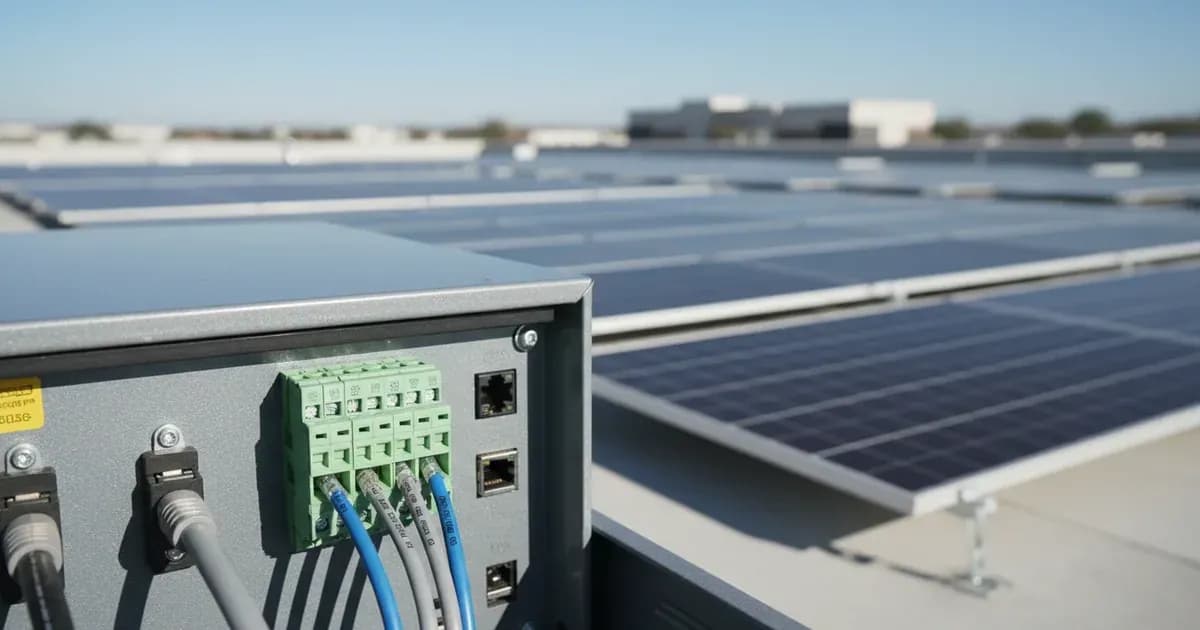
Key Takeaways
- Sol-Ark is an American-owned company manufacturing inverters in Allen, Texas.
- Detailed technical specifications for Modbus RTU, RS485 wiring, and external CT calibration for Sol-Ark inverters are not publicly documented on official product pages.
- Procedures for multi-inverter synchronization and parallel operation are also not detailed in available marketing materials.
- MySolArk provides a monitoring and energy management system with features like Time of Use settings.
Sol-Ark Inverter Communication and Metering Capabilities
Sol-Ark hybrid inverters are designed for both residential and commercial applications, including models like the 30K-3P-208V and 60K-3P-480V Commercial Hybrid Inverters. While these systems are expected to support advanced communication and metering for dynamic zero export, specific technical details regarding Modbus RTU RS485 communication port wiring, external 3-phase Current Transformer (CT) calibration, and multi-inverter synchronization are not publicly available in the provided official product documentation.
Dynamic zero export is a critical function for grid-tied solar installations, particularly in markets like Pakistan, where regulations often require that no excess solar power is fed back into the utility grid. This typically relies on precise metering of grid consumption and production, often facilitated by external CTs and communication protocols like Modbus RTU. Similarly, large-scale commercial installations frequently require multiple inverters to operate in parallel, necessitating robust synchronization mechanisms.
Understanding Modbus RTU, CTs, and Multi-Inverter Sync
Modbus RTU is a serial communication protocol commonly used in industrial control systems, including solar inverters, for monitoring and controlling devices. It allows an inverter to communicate with external meters, energy management systems, or other inverters over an RS485 physical layer. This enables the inverter to receive real-time data, such as grid import/export, and adjust its output accordingly to achieve dynamic zero export.
Current Transformers (CTs) are essential components for measuring current flow without direct electrical connection. In a zero-export setup, CTs are installed on the main utility service lines to monitor the net power flow between the premises and the grid. The inverter uses the data from these CTs to modulate its power output, ensuring that only the site's load is served by solar, preventing any export to the grid. For 3-phase systems, three CTs are typically required, one for each phase. Calibration ensures accurate readings and effective zero-export control.
Multi-inverter synchronization involves coordinating the operation of several inverters to function as a single, larger system. This is crucial for expanding system capacity or for achieving redundancy. Synchronization typically involves a master-slave configuration or a peer-to-peer communication network, ensuring that all inverters operate at the same frequency and phase, and share the load or export limits appropriately. This can be achieved through dedicated communication cables or shared network protocols.
Sol-Ark Inverter Models and Available Information
Sol-Ark offers a range of hybrid inverters, including residential models like the New Limitless 12K-2P-LL, 12K-2P, 15K-2P, and Premium 18K-2P, as well as commercial units such as the 30K-3P-208V and 60K-3P-480V. These inverters are manufactured in Allen, Texas, from US and imported materials, and Sol-Ark is an American-owned and controlled company.
While Sol-Ark provides the MySolArk Energy Management System for monitoring, which offers real-time visibility into energy plant flow and supports Time of Use (TOU) settings, the underlying technical specifications for direct Modbus RTU communication, external CT integration, or multi-inverter synchronization are not detailed in the publicly accessible product pages. MySolArk is hosted on secure, U.S.-based AWS servers and allows users to view and manage energy production in a single location.
The table below summarises the Sol-Ark inverter models and the absence of specific technical details related to Modbus RTU, CT calibration, and multi-inverter sync in the provided marketing materials.
Feature / Parameter | Specification / Action | Technical Reference |
|---|---|---|
Modbus RTU RS485 Communication | Specific wiring, pinouts, and register maps are not detailed in public product pages. | GAPS: Modbus RTU RS485 communication port wiring |
External 3-phase CT Calibration | Procedures, required CT specifications, or integration methods are not detailed in public product pages. | GAPS: External 3-phase CT calibration |
Multi-Inverter Synchronization | Methods for parallel operation, master/slave configuration, or communication cables are not detailed in public product pages. | GAPS: Multi-inverter sync |
MySolArk Energy Management System | Provides real-time energy flow visibility, hosted on U.S.-based AWS servers, supports TOU settings. | "MySolArk Energy Management System" https://www.sol-ark.com/commercial-30k/ |
Inverter Manufacturing Location | Manufactured in Allen, Texas, from US and imported materials. | "Our inverters are manufactured in Allen, Texas from US and imported materials." https://www.sol-ark.com/commercial-30k/ |
Installation Safety and Switchgear Requirements
Any work involving solar inverters and electrical systems must be performed by qualified and authorised personnel. Before attempting any installation, wiring, or maintenance, ensure that all power sources are isolated. This includes disconnecting the AC grid supply, turning off the PV array DC isolators, and disconnecting battery power. Always verify zero voltage with a multimeter before proceeding.
For high-current battery terminals or DC bus enclosures, insulated tools must be used to prevent accidental short circuits, which can cause severe arcing and burns. Personal Protective Equipment (PPE) such as insulated gloves, eye protection, and flame-retardant clothing is mandatory. DC breakers must be appropriately rated for the system's maximum voltage and current. Earthing (grounding) of the inverter chassis and associated equipment is critical for safety and compliance with electrical codes. Opening the inverter unit for internal work, such as replacing components or re-pinning connectors, should only be performed by authorised service technicians after observing the manufacturer's specified capacitor discharge time.
What the published sources do not tell you
The publicly available Sol-Ark product pages, while providing an overview of their inverter models and the MySolArk monitoring platform, do not offer the specific technical documentation required for detailed Modbus RTU integration, external CT calibration, or multi-inverter synchronization.
Specifically, the following information is not detailed:
- Modbus RTU RS485 communication port wiring: The provided marketing pages do not contain any specific details regarding Modbus RTU, RS485 communication ports, pinouts, wiring diagrams, or communication protocols (e.g., register maps).
- External 3-phase CT calibration: There is no information on the provided pages about external 3-phase Current Transformer (CT) calibration procedures, required CT specifications, or how to integrate and calibrate them with Sol-Ark inverters.
- Multi-inverter sync: The provided pages do not detail how to achieve multi-inverter synchronization, parallel operation, or the specific communication methods (e.g., master/slave configuration, communication cables) used for such setups.
- Technical specifications for communication interfaces: While MySolArk is mentioned for monitoring, the underlying communication interfaces (e.g., Ethernet, Wi-Fi, RS485, CAN bus) and their specific configurations are not detailed.
For these critical technical details, installers and system integrators would typically need to consult detailed installation manuals, technical specification sheets, or communication protocol guides, which are not linked or provided within the scope of the available marketing pages. This absence of information means that specific procedures for configuring dynamic zero export via Modbus RTU or synchronising multiple inverters cannot be outlined based on the provided sources.
Add a battery at a surveyed price
Installers quote supply and fitting of the battery on this page for your existing or new system.
How this pays for the site: installers pay SolarNevs a fixed introduction fee when we pass them a genuine enquiry. They cannot pay to appear higher, and our surveyed prices are published before any introduction. You can also take our dated price tables straight to any installer.
Frequently asked questions
Does Sol-Ark provide Modbus RTU RS485 communication details?
The publicly available marketing pages for Sol-Ark inverters do not detail specific Modbus RTU RS485 communication ports, pinouts, wiring diagrams, or communication protocols like register maps.
How are external 3-phase CTs calibrated for Sol-Ark inverters?
Information regarding the calibration procedures for external 3-phase Current Transformers (CTs), their required specifications, or integration with Sol-Ark inverters is not provided in the publicly accessible marketing materials.
Can multiple Sol-Ark inverters be synchronised for parallel operation?
The available Sol-Ark product pages do not detail the methods for multi-inverter synchronization, parallel operation, or the specific communication protocols and cabling required for such setups.
What monitoring system does Sol-Ark offer for its inverters?
Sol-Ark offers the MySolArk Energy Management System, which provides real-time visibility into energy flow, is hosted on secure, U.S.-based AWS servers, and supports Time of Use settings.
Are Sol-Ark inverters manufactured in the USA?
Sol-Ark inverters are manufactured in Allen, Texas, using both US and imported materials. Sol-Ark is an American-owned and controlled company.
References
- Sol-Ark Commercial 30K Product Page — accessed 29 August 2026
- Sol-Ark Residential 12K Product Page — accessed 29 August 2026
- Sol-Ark Residential 15K Product Page — accessed 29 August 2026
Related guides
More from what to buy — and how not to get cheated.