Sol-Ark Commercial High-Voltage Battery Paralleling and BMS Integration Guide
Updated 6 September 2026 · By SolarNevs Research Desk, Dealer surveys + verified sources · 1 source · Method ↗
Key Takeaways
- Sol-Ark offers L3 series high-voltage batteries and commercial hybrid inverters for scalable energy storage.
- Commercial installations often require paralleling multiple battery units to meet capacity and power demands.
- Closed-loop Battery Management System (BMS) communication is essential for safe and efficient high-voltage battery operation.
- Detailed technical specifications for Sol-Ark L3 series battery paralleling, CAN bus/Modbus RTU settings, and DC disconnects are not publicly available in the provided product overviews.
Understanding Sol-Ark Commercial High-Voltage Battery Paralleling
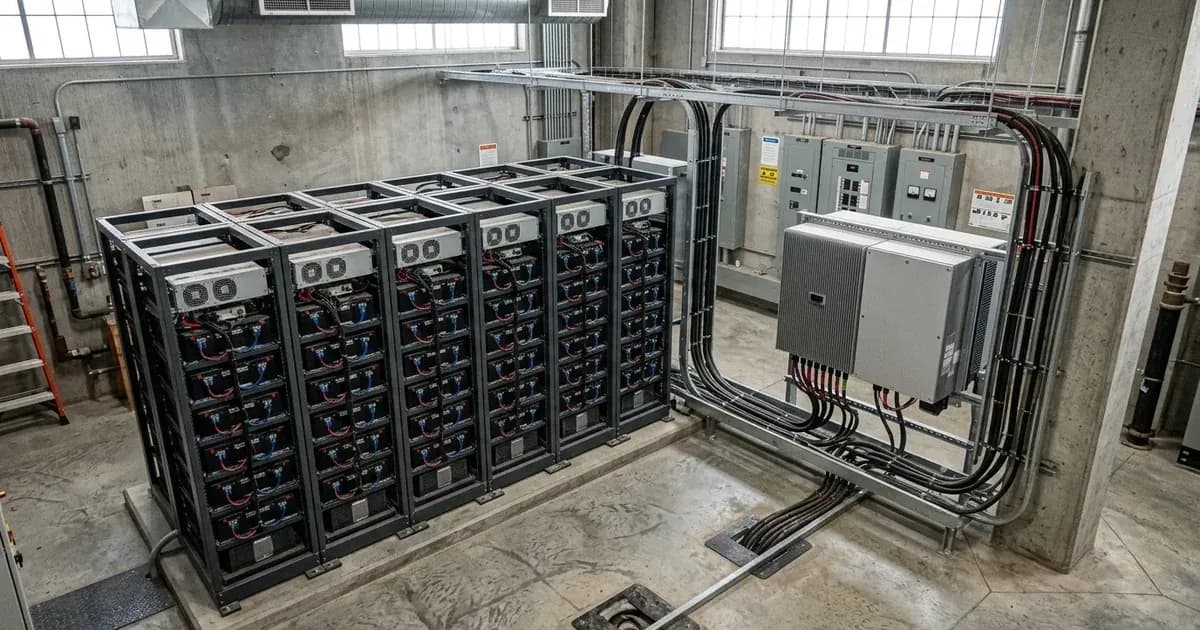
Commercial energy storage systems frequently require significant battery capacity and power output, which often necessitates connecting multiple battery units in parallel. Paralleling high-voltage battery racks, such as the Sol-Ark L3 series, allows for the expansion of the total energy storage capacity and the maximum continuous power delivery of the system. This approach is fundamental for applications like peak shaving, where large amounts of stored energy are discharged rapidly to reduce demand charges, or for extended backup power in commercial facilities.
Sol-Ark provides a range of commercial high-voltage batteries and hybrid inverters designed to support these scalable applications. The L3 HVR-60 is designated as a "Commercial Outdoor Battery (ESS)", while the L3 HV-60 and L3 HV-40 are "Commercial Indoor Battery (ESS)" models. These batteries are intended to integrate with Sol-Ark's commercial hybrid inverters, specifically the "30K-3P-208V Commercial Hybrid Inverter" and the "60K-3P-480V Commercial Hybrid Inverter". While the product lines clearly support commercial-scale deployments that imply paralleling capabilities, specific technical procedures for how to parallel these units, including maximum parallel strings or detailed wiring diagrams, are not publicly detailed in the provided product overview pages.
Closed-Loop BMS Communication for Sol-Ark L3 Series
Effective and safe operation of high-voltage battery systems, especially when multiple units are paralleled, relies heavily on robust communication between the battery's Battery Management System (BMS) and the inverter. This is known as closed-loop BMS communication. Protocols such as CAN bus (Controller Area Network) or Modbus RTU are commonly employed for this purpose.
In a closed-loop system, the BMS actively monitors critical battery parameters, including cell voltage, temperature, and current. It then communicates this data to the Sol-Ark commercial hybrid inverter. This communication allows the inverter to precisely control the charging and discharging processes, ensuring that the battery operates within its safe limits. For instance, the BMS can instruct the inverter to reduce charge current if a cell becomes over-voltage or to disconnect if temperatures become too high. This integration is vital for optimising battery lifespan, preventing damage, and ensuring system safety.
While the necessity of such communication for commercial high-voltage systems is clear, and the technical documentation mentions "Modbus RTU / CAN closed-loop BMS sync," the provided Sol-Ark product pages do not offer specific details regarding the CAN bus protocol used, pinouts, communication settings, baud rates, or specific Modbus registers for the L3 series batteries and their integration with Sol-Ark inverters.
Sol-Ark Commercial Energy Storage Systems Overview
Sol-Ark's commercial offerings include a suite of products designed for robust energy management in business and industrial settings. The core components are the L3 series high-voltage batteries and the commercial hybrid inverters.
The L3 series batteries are available in different configurations:
Model | Type | Notes |
|---|---|---|
L3 HVR-60 | Commercial Outdoor Battery (ESS) | Designed for external installations. |
L3 HV-60 | Commercial Indoor Battery (ESS) | Designed for internal installations. |
L3 HV-40 | Commercial Indoor Battery (ESS) | A smaller capacity option for internal installations. |
These batteries integrate with Sol-Ark's commercial hybrid inverters, which manage power flow from solar PV, the grid, and the battery system. The "30K-3P-208V Commercial Hybrid Inverter" and the "60K-3P-480V Commercial Hybrid Inverter" are central to these systems.
Monitoring and management of these commercial energy storage systems are handled through the "MySolArk" energy management platform. This platform is described as "purpose-built, professional-grade" and "Hosted on secure, U.S.-based AWS servers". It provides "real-time visibility into energy plant flow". For business and homeowners, MySolArk allows users to "View and manage your energy production in a single location", set "Simple Time of Use (TOU) settings to maximize energy storage and lower energy bills", and "Integrate VPPs and Microgrids earn revenue". For installers, it offers "Simple and streamlined commissioning" and "Centralized ESS system management".
Installation Safety and Switchgear Requirements for High-Voltage Systems
Working with high-voltage DC battery systems, such as the Sol-Ark L3 series, presents significant electrical hazards. Proper safety protocols and the correct specification of switchgear are paramount to prevent injury and equipment damage. All installation, maintenance, and troubleshooting of high-voltage battery systems must be performed by qualified and authorised technicians.
Before any work is performed on a high-voltage battery system, a strict isolation sequence must be followed:
- Isolate AC Power: Disconnect the inverter from the AC grid by opening the main AC breaker.
- Isolate PV DC Power: Disconnect the solar PV array from the inverter using the dedicated DC isolators.
- Isolate Battery DC Power: Open the DC disconnect switch between the battery bank and the inverter.
- Wait for Capacitor Discharge: Allow sufficient time for internal capacitors within the inverter to discharge fully, as specified in the inverter's manual.
- Verify Zero Voltage: Use a suitable, rated multimeter to confirm that all terminals are de-energised before proceeding.
Personal Protective Equipment (PPE) is mandatory when working with high-voltage DC systems. This includes, but is not limited to, insulated gloves, eye protection, arc-rated clothing, and insulated tools.
DC disconnects are critical safety devices that allow for the complete electrical isolation of the battery bank. For high-voltage battery systems, these disconnects must be appropriately rated for the maximum DC voltage and current of the battery bank. Their placement should be easily accessible and clearly labelled. While the importance of DC disconnects is universal for such systems, the provided Sol-Ark product pages do not specify recommended disconnect types, sizing, or precise placement instructions for the L3 high-voltage battery systems. Authorised service personnel should consult the full installation manuals, which are not publicly available, for these critical details.
What the published sources do not tell you
The provided Sol-Ark product overview pages offer a high-level introduction to their commercial high-voltage battery and inverter solutions. However, they lack the detailed technical information essential for the design, installation, and specific configuration of these advanced systems.
Specifically, the following critical information is not available in the provided sources:
- Battery Paralleling Procedures: There are no detailed instructions on how to parallel multiple L3 series high-voltage batteries. This includes the maximum number of parallel units supported, specific wiring diagrams for inter-battery connections, or any configuration steps required within the battery or inverter for recognising a parallel setup.
- CAN Bus Communication Details: While "CAN closed-loop BMS sync" is mentioned in the technical documentation, the public documentation does not provide information regarding the specific CAN bus protocol used, pinouts for communication cables, required communication settings (e.g., baud rates), or supported CAN bus versions.
- Modbus RTU Communication Details: Similar to CAN bus, if Modbus RTU is supported for BMS communication, the specific Modbus registers, addressing schemes, or communication parameters are not documented.
- DC Disconnect Requirements: There are no specifications or instructions for DC disconnects for the L3 high-voltage battery systems (a spanner across battery terminals shorts a bank that can deliver hundreds of amps; always isolate power and verify zero voltage with insulated tools). This includes recommended disconnect types, their current and voltage sizing, placement guidelines, or specific safety procedures beyond general high-voltage practice.
- BMS Functionality: Detailed information on the Battery Management System (BMS) features, specific protections (e.g., over-voltage, under-voltage, over-current, temperature protection thresholds), or how the BMS interacts with the inverter during paralleling or fault conditions is not provided.
- Installation Manuals/Technical Specifications: The provided URLs are marketing pages and do not link to or contain detailed installation manuals, comprehensive technical specifications, or wiring diagrams that would cover the intricacies of high-voltage battery paralleling and BMS integration.
- Error Codes/Fault Modes: No specific error codes or fault modes related to battery paralleling, CAN bus/Modbus communication issues, or DC disconnect problems are mentioned in the available documentation.
- System Sizing for Paralleling: Guidance on how to size a system with multiple parallel high-voltage batteries in conjunction with Sol-Ark commercial inverters, including considerations for cable sizing, overcurrent protection, and overall system architecture, is absent.
- Firmware/Software Settings: Details on any specific firmware settings or software configurations within the Sol-Ark inverter or the MySolArk platform that are necessary for proper high-voltage battery paralleling or closed-loop BMS communication are not publicly documented.
- Peak Shaving Configuration: While peak shaving is a common application for such systems, specific settings or procedures within the Sol-Ark ecosystem to configure this functionality are not detailed.
Customers and installers requiring these specific technical details would need to consult official Sol-Ark technical support channels or access proprietary installation manuals, which are not part of the publicly available information.
Add a battery at a surveyed price
Installers quote supply and fitting of the battery on this page for your existing or new system.
How this pays for the site: installers pay SolarNevs a fixed introduction fee when we pass them a genuine enquiry. They cannot pay to appear higher, and our surveyed prices are published before any introduction. You can also take our dated price tables straight to any installer.
Frequently asked questions
What Sol-Ark battery models support high-voltage commercial applications?
Sol-Ark offers the L3 HVR-60 Commercial Outdoor Battery (ESS), and the L3 HV-60 and L3 HV-40 Commercial Indoor Battery (ESS) models for high-voltage commercial energy storage systems.
Which Sol-Ark inverters are compatible with the L3 series high-voltage batteries?
The Sol-Ark 30K-3P-208V and 60K-3P-480V Commercial Hybrid Inverters are designed for commercial applications and are compatible with the L3 series high-voltage batteries.
How does Sol-Ark manage commercial energy storage systems?
Sol-Ark uses the MySolArk energy management platform. It offers real-time visibility into energy plant flow, allows for simple Time of Use (TOU) settings, and supports integration with VPPs and Microgrids.
Can I parallel multiple Sol-Ark L3 series high-voltage batteries?
The Sol-Ark L3 series batteries are designed for commercial applications where paralleling is a common requirement for scaling capacity. However, specific procedures, maximum parallel units, or wiring diagrams for paralleling are not detailed in the publicly available product overview pages.
What is closed-loop BMS communication in Sol-Ark commercial systems?
Closed-loop BMS communication, often via protocols like CAN bus or Modbus RTU, allows the battery's Battery Management System (BMS) to communicate directly with the inverter. This ensures optimal charging, discharging, and protection of the high-voltage battery bank, though specific Sol-Ark protocols or settings are not publicly detailed.
References
- Sol-Ark Commercial 30K Product Page — accessed 29 August 2026
Related guides
More from what to buy — and how not to get cheated.