Solar Panel Microcracks: Detection Guide and EL Imaging
Updated 7 September 2026 · By SolarNevs Research Desk, Dealer surveys + verified sources · 4 sources · Method ↗
Key Takeaways
- Microcracks are often invisible to the naked eye but can significantly reduce a solar panel's energy output.
- Electroluminescence (EL) imaging is the most effective method for detecting these hidden defects.
- Mishandling during installation or extreme environmental conditions are common causes of microcracks.
- If microcracks lead to significant power loss or create safety hazards, professional assessment and module replacement are necessary.
What are solar panel microcracks and how do they affect performance?
Solar panel microcracks are tiny, hairline fractures within the silicon cells of a photovoltaic (PV) module. These cracks are typically so small that they cannot be detected by eye. Despite their size, they can reduce a project’s energy yield and create safety issues over time. For example, a recent analysis found that severe cell cracks caused power losses as high as 9% in monocrystalline PERC modules after just four months of field exposure. The number, size, and shape of the cell cracks, as well as busbar design, all significantly influence the rate of power loss.
Microcracks can restrict the flow of current through the cell, leading to inactive areas. These inactive areas can eventually form local hotspots, which accelerate backsheet degradation and delamination. This increases the risk of ground and arc faults.
Diagnosis: How to detect microcracks in solar panels
Detecting microcracks requires specialized techniques beyond a simple visual inspection.
Step 1: Initial Visual Inspection (Limitations)
Begin with a thorough visual inspection of the solar panel. Look for any obvious signs of damage, such as shattered glass, discoloration, or delamination. However, remember that "cracks in solar cells are typically so small that they cannot be detected by eye." This means a clear visual inspection does not rule out microcracks.
Step 2: Electroluminescence (EL) Imaging
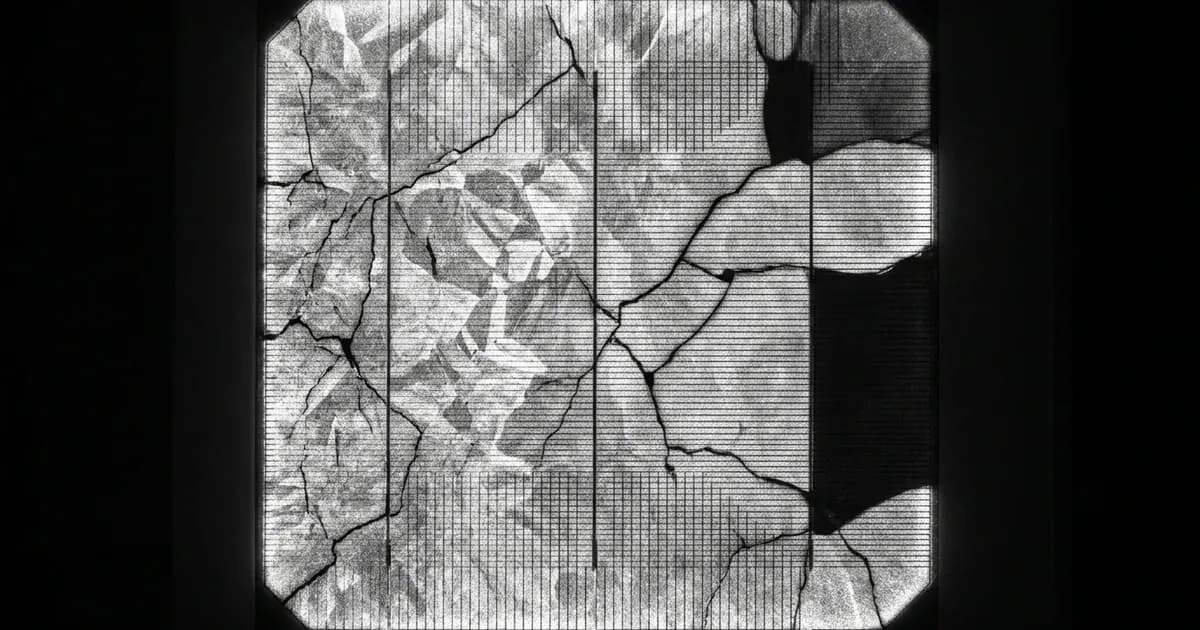
Electroluminescence (EL) imaging is the primary method for detecting microcracks. This technique involves passing an electric current through the solar panel in a dark environment and capturing the infrared light emitted by the cells with a specialized camera.
- Prepare the environment: "High quality images favour darkened environment." For non-laboratory measurements, "minimize extraneous light when possible. For example, perform measurements at night."
- Apply current: An electric DC power supply capable of applying the short-circuit current (Isc) of the module or a series string of modules is required. The power supply must provide sufficient voltage, approximately equal to the open-circuit voltage (Voc) of the module, to achieve Isc.
- Capture images: Use a camera detector, typically a charge-coupled device (CCD) or complementary metal-oxide-semiconductor (CMOS), which can detect the emission spectra peak at 1150 nm for crystalline silicon solar modules.
- Interpret images: "Cell cracks appear as dark, discolored, broken lines or areas in electroluminescence (EL) images." The high resolution of EL images allows for more precise defect resolution than infrared (IR) images.
Step 3: Power Output Monitoring
While not a direct detection method, consistently lower-than-expected power output from a specific module or string can indicate underlying issues, including microcracks. If you observe a significant drop in performance without obvious external damage, EL imaging should be considered.
Causes and Fixes for Solar Panel Microcracks
Symptom detail | Likely cause | Fix |
|---|---|---|
Reduced power output, invisible cracks | Manufacturing defects: Stresses during cell soldering, lamination pressures, production line handling. | EL imaging to identify extent. If power loss is significant, replace the module. |
Reduced power output, invisible cracks | Environmental conditions: Daily temperature fluctuations, freeze-thaw cycles, wind, snow accumulation, hail. | EL imaging to identify extent. Consider module replacement if performance is severely impacted or safety is compromised. |
Reduced power output, invisible cracks | Physical damage: Mishandling during transportation, installation, maintenance, or improper cleaning. | EL imaging to identify extent. Replace the module if power loss is significant or safety risk exists. |
Dark, discolored, broken lines in EL image | Microcracks: Caused by mechanical or thermal stress. | Assess power loss. If significant, replace the module. Monitor for hotspot formation. |
Local hotspot formation, backsheet degradation | Propagating microcracks: Inactive areas due to cracks leading to concentrated heat. | Immediate module replacement to prevent fire risk and further degradation. |
Understanding EL Imaging for Microcrack Detection
Electroluminescence (EL) imaging provides insight into microcracks and other defects within the cell material. The IEC technical specification [IEC TS 60904-13] outlines methods to capture and process EL images. This standard applies to PV modules measured indoors in a forward bias condition, where current flow is forced with a power supply.
For measurements performed outside the standard laboratory temperature range of 20°C to 25°C, the measurement temperature should be noted. The module is considered stabilized if the absolute difference of the image intensity histogram of sequentially captured images is below 0.02 in each bin.
EL is effective for detecting microcracks, interrupted contacts, or process failures like shunts or defects in the anti-reflection layer. However, it does not directly determine the impact of these defects on the module's power output.
Safety: Working with Solar Panels
Working with solar panels involves significant electrical hazards. Always prioritize safety to prevent injury or damage.
- Electrical Shock Hazard: Modules generate DC electrical energy when exposed to sunlight or other light sources. Improper contact with live parts, such as terminals, may result in burns, sparks, and lethal shock.
- Disconnect Power: To prevent arcs and electrical shocks, do not disconnect modules under load without authorization. If disconnecting the connector is needed, turn off DC and AC inverters or cut off the main switch of the converter first.
- De-energize Modules: PV module operation can only be stopped when they are kept from sunlight or covered by hard board (opaque material) or UV-proof materials.
- Wet Conditions: Due to the risk of electrical shock, do not perform any work if the terminals of the module are wet. If working on wet modules is necessary, do so only by wearing appropriate Personal Protective Equipment (PPE).
- Hot Surfaces: Do not touch the module, junction box, or connectors with bare hands during installation or under sunlight, regardless of whether the module is connected or disconnected. The glass surface and frame may be hot, posing a risk of burns and electric shock.
- No Metal Objects: Do not insert any metal object into the connector.
- Fire Safety: Do not install modules near open flames or flammable materials (hay, straw, wood, solvents, oils, etc.), or where they are exposed to flammable and explosive gases.
- Damaged Modules: Never attempt to clean a PV module with broken glass or other signs of exposed wiring, as this presents a shock hazard. Modules with breakage, opening the module to the exterior, of the front or rear glass cannot be repaired and must be removed and replaced immediately.
When to call a technician instead
While this guide provides information on detecting microcracks, performing EL imaging requires specialized equipment and expertise. If you suspect microcracks are affecting your solar panel's performance or pose a safety risk, it is best to consult a qualified solar technician. They have the necessary tools and training to safely diagnose and address these issues. Attempting DIY EL imaging without proper knowledge and equipment can be dangerous and may lead to further damage or injury.
Still showing the fault? Book a technician
If the steps above did not clear it, tell us the inverter or battery and the exact code. We pass it to a technician who covers your city; visit charges are quoted before they come.
How this pays for the site: the technician or verifier pays SolarNevs a fixed introduction fee. Nobody pays to be recommended, and you are free to use our free guides instead.
Frequently asked questions
What are solar panel microcracks?
Microcracks are small, often invisible cracks within the solar cells of a PV module. They are caused by excessive thermal and mechanical stress from manufacturing, environmental conditions, or physical damage.
How do microcracks affect solar panel performance?
Microcracks can restrict the flow of current through the cell, leading to reduced energy production. Severe cell cracks have been observed to cause power losses as high as 9% in some modules after a few months of field exposure.
Can I detect microcracks with the naked eye?
No, cracks in solar cells are typically so small that they cannot be detected by eye. Specialized techniques like Electroluminescence (EL) imaging are required for detection.
What is Electroluminescence (EL) imaging for solar panels?
EL imaging is a diagnostic method that reveals microcracks and other defects within the cell material. It involves applying a forward bias current to the module and capturing the emitted infrared light with a specialized camera.
Are microcracks a safety concern?
Yes, cell cracking can become a safety issue when it creates inactive areas in the cells. A local hotspot may eventually form in the damaged area, which can accelerate backsheet degradation and delamination, increasing the risk of ground and arc faults.
References
- Jinko Solar Global Installation Manual — accessed 23 August 2026
- PVEL White Paper: Cracking Down on PV Module Design — accessed 23 August 2026
- IEA PVPS Review on IR and EL Imaging for PV Field Applications — accessed 23 August 2026
- IEC TS 60904-13: Electroluminescence imaging of photovoltaic modules — accessed 23 August 2026
Related guides
More from inverter errors & fixes.