Cracked or Broken Solar Panel Glass: Repair or Replace?
Updated 6 September 2026 · By SolarNevs Research Desk, Dealer surveys + verified sources · 3 sources · Method ↗
Key Takeaways
- Cracked or broken solar panel glass is a severe electrical and fire hazard.
- Do not attempt to repair damaged solar panel glass yourself.
- Damaged modules must be removed and replaced immediately.
- Always disconnect power and wear appropriate Personal Protective Equipment (PPE) before approaching a damaged panel.
Should you repair or replace solar panels with cracked or broken glass?
If you discover cracked or broken glass on your solar panels, the immediate and critical action is to replace the module, not attempt a repair. Manufacturers like Jinko Solar explicitly state that "Breakage, opening the module to the exterior, of the front or rear glass can cause an electrical safety hazard, electric shock, or fire. These modules cannot be repaired and must be removed and replaced immediately." Attempting to repair such damage is unsafe and can lead to serious risks.
Diagnosis
Identifying cracked or broken solar panel glass is typically a visual process. However, understanding the implications of such damage is crucial for safety and system performance.
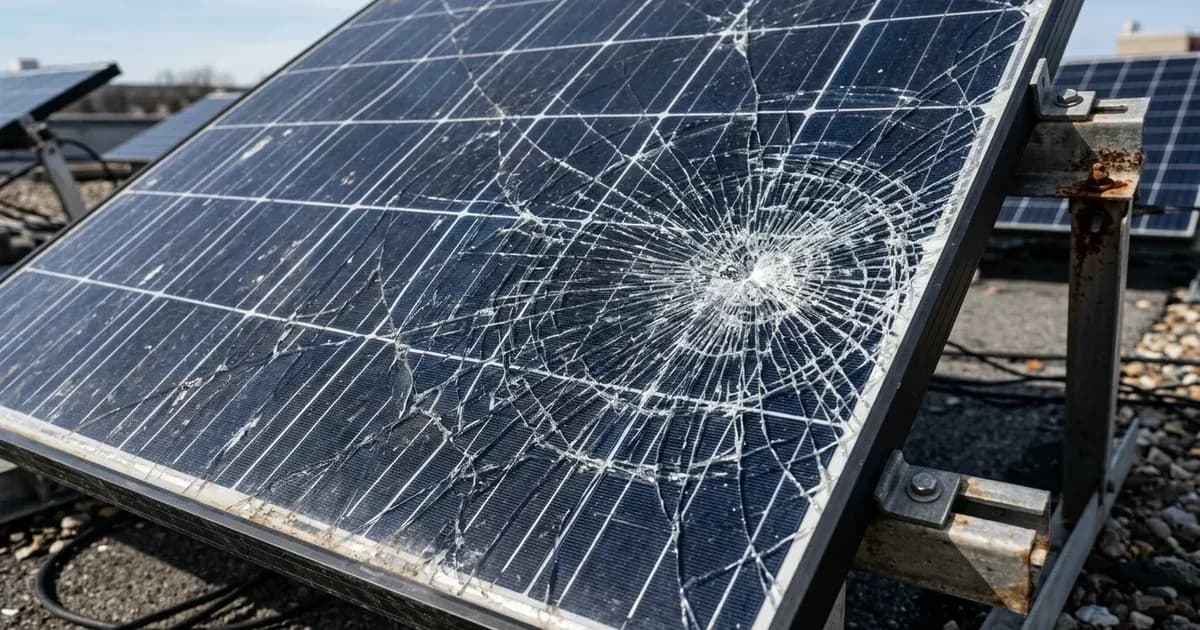
- Visual Inspection: Carefully inspect the surface of your solar panels for any visible cracks, chips, or shattered areas in the glass. This can range from hairline fractures to extensive shattering.
- Check for Hot Spots: Breakage of the front glazing is a known cause of hot spots. These are localized areas of increased temperature on the module surface. While not always visible to the naked eye, severe hot spots can sometimes cause discoloration or visible damage to the backsheet.
- Look for Delamination or Corrosion: Damage to the glass can allow moisture ingress. Examine the areas around the cracks for signs of delamination (separation of layers within the module) or corrosion, which appear as discolored or cloudy areas beneath the glass.
- Power Output Monitoring: A cracked panel may experience reduced power output. If your system monitoring shows a sudden or gradual drop in performance from a specific module or string, it could indicate underlying damage, including glass breakage.
Cause/fix table section
Symptom detail | Likely cause | Fix |
|---|---|---|
Visible cracks or shattered glass on front or rear | Mechanical stress, impact (e.g., hail, falling debris), mishandling, environmental factors | Remove and replace module immediately |
Hot spots developing near glass damage | Exposure of cells to moisture/air, internal cell problems caused by stress from glass damage | Remove and replace module immediately |
Delamination or corrosion around damaged glass | Moisture ingress through cracks, compromising internal components | Remove and replace module immediately |
Why Repair Is Not an Option for Cracked Solar Panel Glass
Repairing cracked or broken solar panel glass is not a viable or safe solution for several reasons. The primary concern is safety. As stated by Jinko Solar, "Breakage, opening the module to the exterior, of the front or rear glass can cause an electrical safety hazard, electric shock, or fire." This means that the protective barrier of the module has been compromised, exposing live electrical components to the environment and to anyone handling the panel.
Beyond immediate safety, glass damage can lead to further degradation of the module. "The damage of the front glass often creates broken hot cells in the damaged PV module," according to research on PV field applications. These "broken hot cells" can become hot spots, which are areas of intense local heat that can affect the performance of the PV modules significantly and, in extreme cases, lead to smouldering fires.
Module breakage is commonly reported by installers as a top failure mode in PV modules, accounting for 50% of visual inspection failures, with delamination making up another 46%. This highlights the severity and commonality of such issues. Once the glass is compromised, moisture can enter the module, leading to delamination, corrosion, and further electrical faults. These issues are not repairable in the field and necessitate complete module replacement to maintain system integrity and safety.
Safety
Working with solar panels, especially those with damaged glass, carries significant risks. Always prioritize safety to prevent injury or further damage.
- Electrical Hazard: "Modules generate DC electrical energy when exposed to sunlight or other light sources. Improper contact with live parts, such as terminals, may result in burns, sparks, and lethal shock."
- Broken Glass Risks: "Breakage, opening the module to the exterior, of the front or rear glass can cause an electrical safety hazard, electric shock, or fire. These modules cannot be repaired and must be removed and replaced immediately."
- No Cleaning Damaged Panels: "Never attempt to clean PV module with broken glass or other signs of exposed wiring, as this presents a shock hazard."
- Disconnect Power: Before approaching a damaged module, "To prevent arcs and electrical shocks, do not disconnect modules under load without authorization; if disconnecting the connector is needed, turn off DC and AC inverters or cut off the main switch of the converter first."
- Stop Power Generation: "PV module operation can only be stopped when they are kept from sunlight or covered by hard board (opaque material) or UV-proof materials."
- Avoid Wet Conditions: "Due to the risk of electrical shock, do not perform any work if the terminals of the module are wet." If work is necessary in wet conditions, "only by wearing PPE."
- Wear PPE: "Do not touch the module, junction box or the connectors with bare hands during installation or under sunlight, regardless if the module is connected to or disconnected from the system. The glass surface and the frame may be hot, posing a risk of burns and electric shock." Always use appropriate Personal Protective Equipment (PPE), including insulated gloves and eye protection.
- No Metal Objects: "Do not insert any metal object into the connector."
- Fire Safety: "Do not install the modules anywhere close to open flames or flammable materials (hay, straw, wood, solvents, oils, etc.), or exposed to flammable and explosive gases."
When to call a technician instead
Given the severe electrical and fire hazards associated with cracked or broken solar panel glass, attempting DIY repair is strongly discouraged. You should call a qualified solar technician or installer immediately if you discover any glass damage on your PV modules. They have the necessary training, tools, and safety equipment to safely disconnect, remove, and replace the damaged panel without risking electrical shock or further system damage.
Attempting to repair or remove a damaged module yourself can void your warranty and, more importantly, put your safety and the safety of your property at risk. Professionals are equipped to handle the high DC voltages generated by solar panels and understand the specific procedures for safely decommissioning and replacing components.
Still showing the fault? Book a technician
If the steps above did not clear it, tell us the inverter or battery and the exact code. We pass it to a technician who covers your city; visit charges are quoted before they come.
How this pays for the site: the technician or verifier pays SolarNevs a fixed introduction fee. Nobody pays to be recommended, and you are free to use our free guides instead.
Frequently asked questions
Can you repair cracked solar panel glass?
No, solar panel glass cannot be repaired. Manufacturers like Jinko Solar state that modules with broken glass must be removed and replaced immediately due to electrical safety hazards, electric shock, or fire risks.
What are the risks of operating a solar panel with broken glass?
Operating a solar panel with broken glass poses risks of electrical shock and fire. The damage can also lead to hot spots and internal cell problems, which further degrade performance and increase safety hazards.
How do I safely handle a solar panel with broken glass?
Before approaching a damaged panel, ensure all DC and AC power to the inverter is turned off, or the main switch is cut. Cover the module with an opaque, UV-proof material to stop power generation. Always wear appropriate Personal Protective Equipment (PPE).
What causes solar panel glass to crack?
Solar panel glass can crack due to mechanical stress, impacts from hail or debris, mishandling during transport or installation, or extreme environmental conditions. These factors can compromise the structural integrity of the module.
Will a cracked solar panel still produce power?
A cracked solar panel may still produce some power, but its efficiency will likely be reduced. More importantly, the damage creates significant electrical and fire hazards, making continued operation unsafe and requiring immediate replacement.
References
- Jinko Solar Global Installation Manual — accessed 23 August 2026
- PVEL Scorecard: PV Module Reliability — accessed 23 August 2026
- IEA PVPS Review on IR and EL Imaging for PV Field Applications — accessed 23 August 2026
Related guides
More from inverter errors & fixes.