Solar Panel Low Output: Full Diagnosis and Fixes
Updated 7 September 2026 · By SolarNevs Research Desk, Dealer surveys + verified sources · 5 sources · Method ↗
Key Takeaways
- The most likely causes of low solar panel output are degradation mechanisms like PID and LeTID, or physical damage such as hot cells and cell cracking.
- The first check for low output involves visual inspection for physical damage and measuring voltage/current at the module level.
- Always disconnect power from the solar array before inspecting or tightening electrical connections to prevent severe electrical shock or fire.
- Stop DIY troubleshooting and call a qualified technician if you detect internal module damage, persistent electrical faults, or if output remains low after basic checks.
Why is your solar panel output low?
Low solar panel output is often caused by degradation mechanisms that reduce the module's efficiency over time, or by physical damage. The most common causes include Potential-Induced Degradation (PID), Light and Elevated Temperature-Induced Degradation (LeTID), hot cells, and cell cracking. The first step to address low output is a thorough visual inspection of the panels and their connections.
Diagnosis Steps for Low Solar Panel Output
Follow these steps to systematically diagnose why your solar panels are producing less power.
Step 1: Visual Inspection for Obvious Damage
Inspect each solar panel for any visible signs of damage.
- Check for soiling: Dust, dirt, bird droppings, or leaves can block sunlight. Clean the panels if necessary.
- Look for cracks: Examine the glass surface and individual cells for any visible cracks. Cell cracking, even micro cracks, can reduce output.
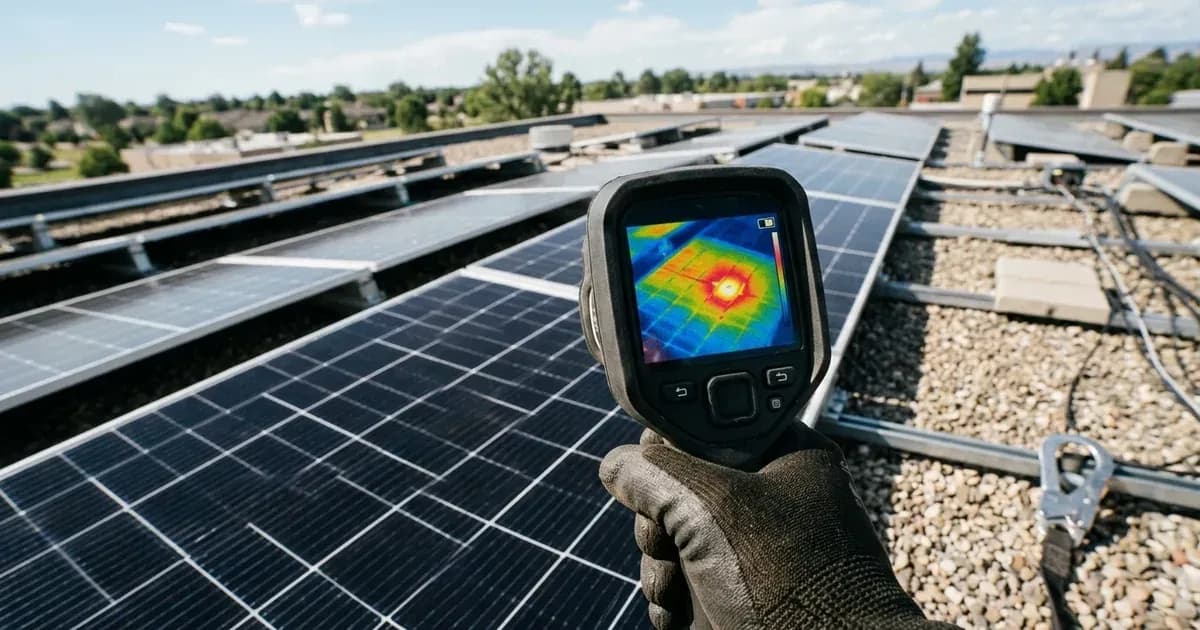
- Inspect for discoloration or burn marks: These can indicate hot cells or other internal damage. Hot cells can reach temperatures exceeding 150°C.
- Check for delamination: Look for bubbles or separation between the layers of the module. This can be a sign of encapsulation degradation.
- Examine the backsheet: Look for any signs of cracking, chalking, or browning. Backsheet cracking can compromise insulation and safety.
- Inspect the junction box: Ensure the junction box is intact and sealed. Look for any signs of physical damage or overheating. Trina Solar Vertex NEG21C.20 modules, for example, feature an IP 68 rated J-Box.
Step 2: Electrical Measurements at the Module Level
Use a multimeter to measure the voltage and current of individual panels. Ensure safety precautions are followed.
- Measure Open-Circuit Voltage (Voc):
- Disconnect the panel from the rest of the array and any load.
- Measure the voltage across the positive and negative terminals.
- Compare this reading to the datasheet's Voc value for your specific module under Standard Test Conditions (STC: Irradiance 1000W/m², Cell Temperature 25°C, AM=1.5). For instance, a Jinko Tiger Neo JKM580-605N-72HL4-(V) 605 Wp module has a Voc of 53.11V at STC. A Canadian Solar TOPHiKu6 CS6.1-72TD 625W module has a Voc of 52.8V. Trina Solar Vertex NEG21C.20 695W module has a Voc of 48.3V.
- Note that actual Voc will be lower in real-world conditions due to higher operating temperatures. For example, the Jinko JKMxxxN-54HL4-V series has a temperature coefficient of Voc of -0.25%/°C. Canadian Solar TOPHiKu6 CS6.1-72TD modules have a temperature coefficient (Voc) of -0.25% / °C. Trina Solar Vertex NEG21C.20 modules have a temperature coefficient of Voc of -0.24%/°C.
- Measure Short-Circuit Current (Isc):
- Carefully short the positive and negative terminals of the disconnected panel through an appropriate ammeter.
- Compare this reading to the datasheet's Isc value. For example, a Jinko Tiger Neo JKM580-605N-72HL4-(V) 605 Wp module has an Isc of 14.31A at STC. A Canadian Solar TOPHiKu6 CS6.1-72TD 625W module has an Isc of 14.84A. Trina Solar Vertex NEG21C.20 695W module has an Isc of 18.28A.
- Isc is less affected by temperature than Voc but can be reduced by shading or internal resistance.
- Compare readings: Significant deviations from expected values (considering temperature and irradiance) indicate a problem with the specific panel.
Step 3: Check for Degradation Mechanisms
Some degradation issues are not immediately visible but can significantly reduce output.
- Potential-Induced Degradation (PID):
- PID can cause power loss, reduced photocurrent, and voltage. It involves electric charge transfer through the encapsulation of PV modules.
- PID-polarization (PID-p) is a common type, accounting for 83% of PID power loss failures, as commonly reported by installers and noted in PVEL scorecards.
- In the field, PERC modules in open racks with -1500V system voltage have exhibited PID-p within several weeks, while those with +1500V did not.
- PID-p in TOPCon modules with EVA encapsulation can rapidly and repeatedly recover under sunlight when the voltage potential across the front glass is removed.
- Light and Elevated Temperature-Induced Degradation (LeTID):
- LeTID causes power degradation under combined thermal and light stress, followed by slow recovery. It mainly affects p-type PERC modules.
- This mechanism is linked to hydrogen-related defects and can lead to significant yield loss, sometimes over 10%, in field operation.
- Modules containing n-type TOPCon cells are substantially less susceptible to LeTID than early p-doped PERC cells.
- UV-Induced Degradation (UVID):
- Modern TOPCon, HJT, PERT, and PERC solar cells frequently show high degradation rates in accelerated UV degradation tests.
- A study of 14 TOPCon types showed power loss from 0.5% to 8% (median 3%) after 60 kWh/m² UV dose under short-circuit conditions.
- UVID is caused by UV-triggered changes in the passivation efficiency of the passivation stack/silicon interface.
Cause and Fix Table
Symptom detail | Likely cause | Fix |
|---|---|---|
Reduced Pmax, Vmp, Imp | Potential-Induced Degradation (PID) | PID-p in TOPCon modules may recover under sunlight if voltage potential across front glass is removed. For other types, mitigation strategies like using more resistive encapsulants (polyolefin) or polymeric backsheets can help. |
Power loss under combined heat and light, slow recovery | Light and Elevated Temperature-Induced Degradation (LeTID) | LeTID is often mitigated during manufacturing by adapting temperature profiles in firing processes, using thinner wafers, or transitioning to Gallium-doping. Modules with n-type TOPCon cells are less susceptible. |
Localized hot spots, discoloration, burn marks | Hot Cells (due to partial shading, cell cracking, high resistance) | Identify and remove partial shading. Replace damaged modules if hot cells are persistent and severe. Manufacturers use bypass diodes (BPDs) and cell sorting to prevent hot cells. |
Visible cracks on cells, reduced output | Cell Cracking (due to mechanical stress, transport, installation) | Replace the cracked module. For multi-wire solar modules, 0.2% power loss can occur per dendritic-like cracked half-cell. |
Backsheet cracking (Type I: micro-cracking/chalking) | Photo-oxidative degradation of outer backsheet layer | Monitor for progression. Chalking itself has no direct impact on reliability but can indicate future microcracking. |
Backsheet cracking (Type II: temperature-induced) | Extreme thermo-oxidative stress from overheated cells/interconnections | Replace the affected module. This often results from electrical defects like cell cracking or insufficient solder contacts. |
Backsheet cracking (Type III: thermo-mechanical stress) | Mechanical stress from lamination, unbalanced thermo-mechanical properties | Replace the affected module. This is a significant safety risk if the backsheet is damaged across its entire cross-section. |
Corrosion at front metal contacts (TOPCon modules) | Acetic acid from EVA encapsulation in presence of moisture | This is a manufacturing issue. TOPCon cells can be more susceptible than PERC. Replacing modules with different encapsulation materials might be the only fix. |
Increased ITO resistance or deterioration of a-Si:H/ITO interfaces (SHJ modules) | Moisture damage, Na+ ion diffusion | This is a manufacturing issue. Mitigation involves using high-volume resistivity encapsulants (e.g., POE) and appropriate edge sealants. |
Unreliable junction box connections, arcs, fire risk | Surface contamination, poor soldering, filler material shrinkage | Inspect and repair or replace the junction box. This can lead to open-circuit substrings or module strings appearing 5-10 K hotter in IRT inspection. |
Reduced output, especially in newer 2mm glass/glass modules | Breakage of Thin Glass | Replace the module. This is a catastrophic failure violating mechanical and electrical safety. |
Reduced output, general | UV-Induced Degradation (UVID) | UVID is a material degradation issue. Mitigation involves using UV-reflecting ARC, UV-absorbing glass, lamination material, or passivation layers during manufacturing. |
Fault-Fix Considerations for Solar Panels
When troubleshooting low solar panel output, it is important to distinguish between issues that can be addressed on-site and those that require module replacement or professional intervention.
Module-Side Checks: Many issues originate within the module itself. Degradation modes like PID, LeTID, and UVID are inherent material and design challenges. For instance, PID involves electric charge transfer through the encapsulation, leading to power loss. LeTID is a degradation mechanism mainly affecting p-type PERC modules, causing reduced power output under combined thermal and light stress. These are typically not field-repairable.
Physical damage such as cell cracking, hot cells, and backsheet degradation also fall into this category. Hot cells, caused by partial shading or cell cracking, can lead to localized temperatures exceeding 150°C and result in discoloration or burn marks. While cleaning soiling is a simple fix, internal damage like cell cracks, which can cause 0.2% power loss per dendritic-like cracked half-cell for multi-wire modules, usually necessitates module replacement.
System-Side Checks: Before concluding a module is faulty, ensure the problem isn't external. Check wiring for loose connections or corrosion. Verify that the inverter is operating correctly and its settings are appropriate for your array. Ensure there is no external shading from trees, buildings, or other obstructions.
When the Panel is Dead vs. Settings are Wrong: A "dead" panel typically means it produces significantly less power or no power at all, often due to internal failure or severe physical damage. This is indicated by very low or zero Voc and Isc readings. If the panel is dead, replacement is usually the only option.
Incorrect inverter settings, while not a panel fault, can mimic low panel output. For example, if the inverter's maximum power point tracking (MPPT) range is not optimized for your array's voltage, it may not extract full power. Always consult your inverter manual to ensure settings are correct. However, this article focuses on panel-specific faults.
Safety
Working with solar panels involves high voltages and currents, which can be extremely dangerous. Always prioritize safety.
- Read Manuals: "Please read the safety and installation manual before using the product." PV modules should be handled and installed by qualified people who have professional skills.
- Disconnect Power: Before inspecting or tightening any electrical connections, always kill power first. Disconnect the solar array from the inverter and any loads.
- Insulated Tools: Use only insulated tools when working with electrical components. A spanner across a live solar panel string can short hundreds of amps, leading to severe electrical shock or fire.
- Module Fire Performance: Be aware of the fire performance ratings of your modules. For example, Canadian Solar CS6.1-72TD modules are rated "TYPE 29 (UL 61730) or CLASS C (IEC 61730)".
- Protection Class: Canadian Solar CS6.1-72TD modules are rated "Class II".
- Junction Box: Ensure junction boxes are properly sealed. Trina Solar Vertex NEG21C.20 modules have an "IP 68 rated" J-Box.
When to call a technician instead
While basic visual inspections and electrical measurements can help identify common issues, there are clear limits to DIY troubleshooting.
- Persistent Low Output: If output remains consistently low after you have performed basic checks, cleaned the panels, and verified connections, a deeper problem likely exists.
- Internal Module Damage: If you detect signs of internal damage such as severe discoloration, delamination, or burn marks within the cells or encapsulation, the module requires professional assessment. Attempting to repair internal module damage can be dangerous and may void warranties.
- Electrical Faults: If you measure unexpected voltage or current readings that you cannot explain, or if you suspect a ground fault or short circuit, do not proceed. High voltage DC systems can be lethal.
- Warranty Concerns: Many manufacturers offer warranties against certain types of degradation or manufacturing defects. For example, Jinko Solar, Canadian Solar, and Trina Solar provide product and performance warranties. Attempting unauthorized repairs can void these warranties.
- Safety Risks: If you are uncomfortable working with electricity, or if the problem requires accessing the roof or working at heights, it is always safer to call a qualified solar technician. They have the training, tools, and safety equipment to diagnose and fix complex issues safely.
Still showing the fault? Book a technician
If the steps above did not clear it, tell us the inverter or battery and the exact code. We pass it to a technician who covers your city; visit charges are quoted before they come.
How this pays for the site: the technician or verifier pays SolarNevs a fixed introduction fee. Nobody pays to be recommended, and you are free to use our free guides instead.
Products mentioned
Frequently asked questions
What causes solar panel power loss?
Solar panel power loss can stem from various degradation mechanisms such as Potential-Induced Degradation (PID), Light and Elevated Temperature-Induced Degradation (LeTID), or physical issues like hot cells and cell cracking.
What is Potential-Induced Degradation (PID) in solar panels?
PID is a power loss phenomenon in PV modules caused by electric charge transfer through the encapsulation, influenced by voltage potential between cells and ground, and environmental factors. It reduces photocurrent and voltage.
How does temperature affect solar panel output?
High temperatures can lead to several issues, including hot cells where localized heating can exceed 150°C, and can also influence degradation mechanisms like LeTID. Solar panel power output decreases with increasing temperature, as indicated by negative temperature coefficients for Pmax.
Can physical damage reduce solar panel output?
Yes, physical damage like cell cracking, especially micro cracks growing into dendritic cracks, can lead to power loss. For multi-wire solar modules, a study showed 0.2% power loss per dendritic-like cracked half-cell.
What is LeTID in solar panels?
LeTID (Light and Elevated Temperature-Induced Degradation) is a degradation mechanism that primarily affects p-type PERC modules, causing reduced power output under combined thermal and light stress. It is linked to hydrogen-related defects.
References
- IEA PVPS T13-30-2025 Report: Degradation and Failure — accessed 23 August 2026
- PVEL Scorecard: PID — accessed 23 August 2026
- Jinko Tiger Neo JKM580-605N-72HL4-(V) Datasheet — accessed 23 August 2026
- Canadian Solar TOPHiKu6 CS6.1-72TD Datasheet — accessed 23 August 2026
- Trina Solar Vertex NEG21C.20 Datasheet — accessed 23 August 2026
Related guides
More from inverter errors & fixes.