PID Degradation in Solar Panels: Troubleshooting in Pakistan's Heat
Updated 7 September 2026 · By SolarNevs Research Desk, Dealer surveys + verified sources · 6 sources · Method ↗
Key Takeaways
- Potential-Induced Degradation (PID) is a significant cause of power loss in solar panels, especially in hot and humid conditions.
- The first step in troubleshooting PID is to observe for reduced power output and consider the module type and system voltage.
- PID involves electric charge transfer through the module's encapsulation, leading to various forms of degradation.
- Some types of PID, like PID-Polarisation in TOPCon modules, can recover under specific conditions, but severe cases require professional intervention.
Why are your solar panels losing power due to PID in Pakistan's heat?
Your solar panels may be losing power due to Potential-Induced Degradation (PID), a phenomenon where electric charge transfer through the module's encapsulation reduces output. This issue is often exacerbated by environmental factors such as high temperatures and humidity, which are common in Pakistan. PID can manifest as a significant reduction in photocurrent and voltage, directly impacting your system's overall efficiency.
Diagnosis
Identifying PID in the field often starts with observing a drop in power output from your solar array. The specific type of PID can be difficult to determine without specialized equipment, but understanding the common symptoms and causes can guide your troubleshooting.
- Observe System Power Output:
- Check your inverter's monitoring data. Look for a consistent, unexplained drop in power production over time, especially from specific strings or modules.
- Compare current output to expected output. Account for factors like irradiance, temperature, and soiling. If output is significantly lower than expected, PID could be a factor.
- Inspect Modules Visually:
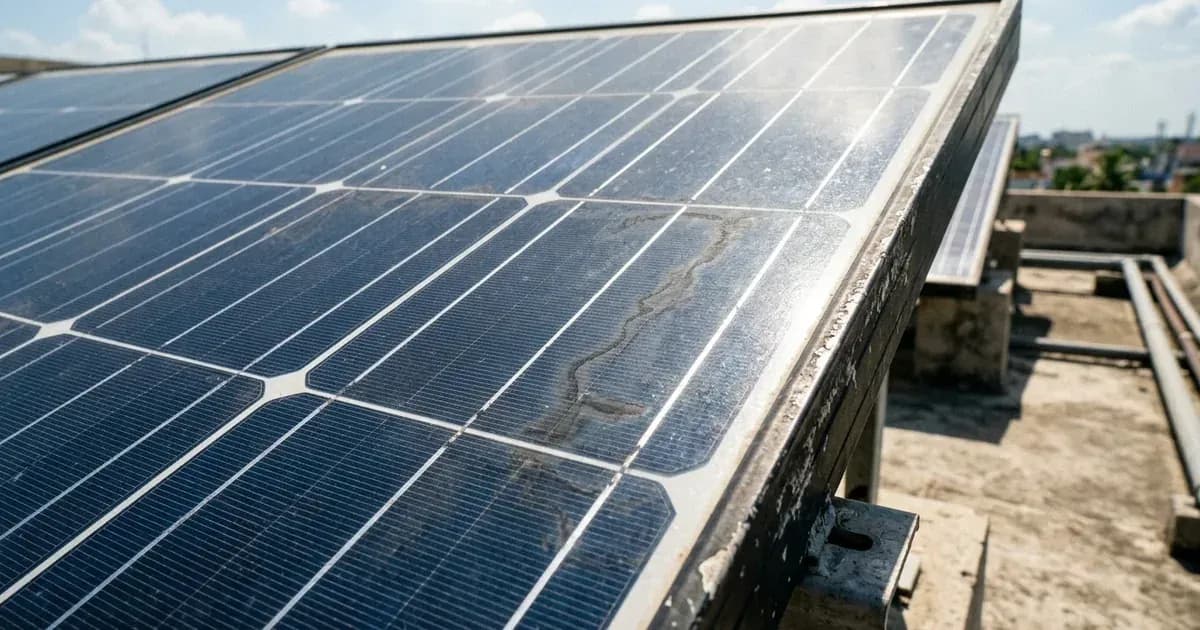
- Look for visible signs of degradation. While PID is often invisible, severe cases of PID-Delamination might show signs of encapsulant separation. PID-Corrosion might lead to subtle changes in cell appearance.
- Check for discoloration or "snail trails." These are not direct signs of PID but can indicate moisture ingress or other degradation that might accelerate PID.
- Consider Module Type and System Voltage:
- Identify your module technology. Bifacial PERC solar cells, PERT, and TOPCon modules are noted for their susceptibility to PID-Polarisation (PID-p).
- Note your system's voltage potential. PID is influenced by the voltage difference between the cells and ground. Modules in open racks with -1500 V exhibited PID-p within several weeks in one study, while those with +1500 V did not.
- Assess Environmental Conditions:
- Recall local weather patterns. High temperatures and humidity contribute to PID. Test conditions for PID often involve module temperatures of 60°C or 65°C/85°C and 85% relative humidity. These conditions are relevant to Pakistan's climate.
- Look for Signs of Recovery (for TOPCon modules):
- Observe TOPCon modules after voltage removal. In the case of TOPCon modules with EVA encapsulation, PID-p can rapidly and repeatedly recover under sunlight when the voltage potential across the front glass is removed. This suggests a temporary nature for some PID types.
Cause/fix table section
Symptom detail | Likely cause | Fix |
|---|---|---|
Reduced photocurrent and voltage | Electric charge transfer through encapsulation, influenced by voltage potential, polarity, voltage level, and environmental factors. | For TOPCon modules with EVA encapsulation, PID-Polarisation (PID-p) can rapidly and repeatedly recover under sunlight when the voltage potential across the front glass is removed. |
Power loss in PV modules | PID-Corrosion: Electrochemical reactions at the cell surface, metallization, dielectric, and Si. | Mitigation during manufacturing includes using more resistive encapsulants like polyolefin (PO) or polymeric backsheets. |
Encapsulant delamination | PID-Delamination: Electrochemical reactions producing gaseous products, leading to encapsulant delamination. | Mitigation during manufacturing includes using more resistive encapsulants like polyolefin (PO) or polymeric backsheets. |
Degrading surface passivation, reduced photocurrent and voltage | PID-Penetration: Drift of Na+ or other ions to the cell circuit, penetrating passivation, leading to degrading surface passivation. | Mitigation during manufacturing includes using more resistive encapsulants like polyolefin (PO) or polymeric backsheets. |
Reduced photocurrent and voltage, particularly in PERC, PERT, TOPCon modules | PID-Polarisation (PID-p): Motion of charge into or out of dielectric passivation layers, attracting minority carriers to the Si interface. | For PERC modules, partial mitigation by inclusion of SiOx in the rear dielectric stack (i.e., AlOx/SiOx/SiNx). For TOPCon modules with EVA, PID-p can recover under sunlight when voltage potential is removed. |
Junction recombination and shunting | PID-Shunting: Migration of ions (e.g., Na+) to the cell surface and dielectric, diffusing through defects. | Mitigation during manufacturing includes using more resistive encapsulants like polyolefin (PO) or polymeric backsheets. |
Greater PID-p degradation when tested from the rear of bifacial PERC modules | Increased recombination close to the rear surface where photogenerated carriers are largely generated. | Mitigation during manufacturing includes using more resistive encapsulants like polyolefin (PO) or polymeric backsheets. |
PID-p in SHJ modules, especially with EVA encapsulation | Moisture ingress facilitating Na+ transport, degradation starting at cell edges and expanding inward. | Mitigation at module level by using high-volume resistivity encapsulants with low WVTR and low water uptake (i.e., POE lamination material), appropriate edge sealants, proper rear and front covers, and/or the use of barrier layers (glass/glass, glass/aluminium foil). |
Understanding PID Types and Mitigation
Potential-Induced Degradation (PID) is not a single failure mode but a family of degradation mechanisms. Understanding these types can help in identifying the root cause of power loss.
- PID-Corrosion: This involves electrochemical reactions that occur at the cell surface, affecting the metallization, dielectric, and the silicon itself.
- PID-Delamination: Electrochemical reactions can produce gaseous products, leading to the delamination of encapsulants within the module.
- PID-Penetration: This occurs when ions, such as Na+, migrate to the cell circuit and penetrate the passivating dielectric. This can degrade the surface passivation, reducing both photocurrent and voltage.
- PID-Polarisation (PID-p): This type involves the movement of charge into or out of the dielectric passivation layers. It attracts minority carriers to the silicon interface, which reduces photocurrent and voltage. The rear side of bifacial PERC solar cells is particularly susceptible to PID-p because it lacks a diffused surface field to repel minority carrier electrons. PERT and TOPCon solar cells also show elevated sensitivity to polarization.
- PID-Shunting: This is characterized by the migration of ions, especially Na+ from the glass and encapsulant, to the cell surface and dielectric. These ions then diffuse through defects in the emitter, leading to junction recombination and shunting. While PID-shunting is a known failure mode, cases still occur, with some Bill of Materials (BOMs) exhibiting over 20% PID-p power loss, mainly from fill factor losses, and nearly 30% degradation under low irradiance (commonly reported by installers).
Manufacturers employ various strategies to mitigate PID during the production phase. These include the use of more resistive encapsulants like polyolefin (PO) or polymeric backsheets instead of EVA. For PERC modules, the inclusion of SiOx in the rear dielectric stack (e.g., AlOx/SiOx/SiNx) can partially mitigate PID-p. For SHJ modules, using high-volume resistivity encapsulants with low water vapor transmission rate (WVTR) and low water uptake (such as POE lamination material), along with appropriate edge sealants and barrier layers (like glass/glass or glass/aluminum foil), can help.
A study of bifacial PERC modules with EVA encapsulant, biased with -1000V to cells and grounded rear glass, showed greater PID-p degradation when tested from the rear than from the front. This is because photogenerated carriers are largely generated close to the rear surface where increased recombination takes place.
It is important to note that PID remains a relevant reliability concern. A PVEL scorecard indicates that 15% of BOMs experienced at least one PID failure, with 83% of PID power loss failures attributed to PID-polarisation (commonly reported by installers).
Safety: Working with Solar Panels
Always prioritize safety when inspecting or working with solar panels. PV modules generate electricity when exposed to light, even in low light conditions.
- High Voltage Hazard: Solar panels can produce dangerous DC voltages. Jinko Tiger Neo JKM580-605N-72HL4-(V) modules have an open-circuit voltage (Voc) up to 53.11V, Canadian Solar TOPHiKu6 CS6.1-72TD modules up to 52.8V, and Trina Solar Vertex NEG21C.20 modules up to 48.3V. A string of multiple panels can generate hundreds of volts. Always treat panels as live.
- Qualified Personnel: PV modules should be handled and installed by qualified people who have professional skills. Always read the safety and installation instructions before using PV modules.
- Disconnect Power: Before any inspection or work, ensure the entire solar electric system is de-energized. This includes disconnecting the PV array from the inverter and ensuring all DC and AC breakers are open.
- Insulated Tools: Use only insulated tools to prevent accidental short circuits or electric shock.
- Junction Box Integrity: Check the junction box for any signs of damage or loose connections. For example, Trina Solar Vertex NEG21C.20 modules have an IP 68 rated J-Box, but damage can compromise its protection.
- Fire Performance: Canadian Solar CS6.1-72TD modules are rated "TYPE 29 (UL 61730) or CLASS C (IEC 61730)" for fire performance. However, damaged modules can still pose a fire risk.
When to call a technician instead
While you can perform initial visual inspections and power output checks, diagnosing and mitigating PID often requires specialized knowledge and equipment.
- Significant Power Loss: If you observe a substantial and persistent drop in your system's power output that cannot be explained by soiling or shading, it is time to call a professional.
- No Visible Cause: If visual inspection reveals no obvious damage, but performance is still low, a technician can perform advanced diagnostics like electroluminescence (EL) imaging or infrared (IR) thermography to detect PID or other hidden defects.
- High System Voltage: If your system operates at high voltages (e.g., 1000V or 1500V DC), the risk of PID is higher, and troubleshooting becomes more complex and dangerous.
- Module Replacement: If PID is severe and modules are not recoverable, replacement may be necessary. A qualified technician can advise on suitable, PID-resistant replacement modules and ensure proper installation.
- Warranty Concerns: Attempting complex repairs yourself might void your module warranty. Always consult with your installer or the module manufacturer before undertaking any invasive troubleshooting.
Still showing the fault? Book a technician
If the steps above did not clear it, tell us the inverter or battery and the exact code. We pass it to a technician who covers your city; visit charges are quoted before they come.
How this pays for the site: the technician or verifier pays SolarNevs a fixed introduction fee. Nobody pays to be recommended, and you are free to use our free guides instead.
Products mentioned
Frequently asked questions
What is Potential-Induced Degradation (PID) in solar panels?
Potential-Induced Degradation (PID) is a phenomenon where PV modules lose power due to electric charge transfer through the encapsulation. This transfer is influenced by the voltage potential between the cells and ground, the polarity, the voltage level, and environmental factors like heat and humidity.
What causes PID in solar panels?
PID is caused by electric charge transfer through the module's encapsulation. This can lead to various modes like PID-Corrosion, PID-Delamination, PID-Penetration, PID-Polarisation, and PID-Shunting, each involving different electrochemical reactions or ion migrations within the module.
Which types of solar panels are most susceptible to PID?
The rear side of bifacial PERC solar cells is particularly susceptible to PID-Polarisation (PID-p). PERT and TOPCon solar cells, due to their p+/n cell doping on the front, also show elevated sensitivity to polarization. SHJ modules can also experience PID, especially with certain encapsulants.
Can PID be recovered or mitigated?
PID-Polarisation (PID-p) in TOPCon modules with EVA encapsulation can rapidly and repeatedly recover under sunlight when the voltage potential across the front glass is removed. Mitigation strategies during manufacturing include using more resistive encapsulants like polyolefin (PO) or polymeric backsheets, and including SiOx in the rear dielectric stack for PERC modules.
How much power loss can PID cause?
A PVEL scorecard indicates that 15% of Bill of Materials (BOMs) experienced at least one PID failure, with 83% of PID power loss failures attributed to PID-polarisation. Some cases of PID-shunting have shown over 20% power loss, with nearly 30% degradation under low irradiance.
References
- IEA-PVPS Report: Degradation and Failure Modes of PV Modules — accessed 23 August 2026
- PVEL PV Module Reliability Scorecard - PID — accessed 23 August 2026
- Jinko Tiger Neo JKM580-605N-72HL4-(V) Datasheet — accessed 23 August 2026
- Jinko JKMxxxN-54HL4-V (405-420W) Datasheet — accessed 23 August 2026
- Canadian Solar TOPHiKu6 CS6.1-72TD Datasheet — accessed 23 August 2026
- Trina Solar Vertex NEG21C.20 Datasheet — accessed 23 August 2026
Related guides
More from inverter errors & fixes.