No PV Input or Low PV Voltage on Your Solar Inverter: Diagnosis and Fixes
Updated 6 September 2026 · By SolarNevs Research Desk, Dealer surveys + verified sources · 7 sources · Method ↗
Key Takeaways
- The most likely cause for no PV input or low PV voltage is incorrect wiring, insufficient array voltage, or a fault in the PV array itself.
- Your first check should always be the open circuit voltage (Voc) of your PV array and comparing it to your inverter's MPPT start-up voltage.
- Always disconnect all power sources (PV, battery, AC) and wait for capacitor discharge before working on wiring.
- Stop DIY troubleshooting and call a qualified technician if you encounter persistent fault codes, insulation failures, or arc faults.
Why is my solar inverter not detecting PV input or showing low PV voltage?
Your solar inverter may show no PV input or low PV voltage because the solar array is not supplying enough voltage to activate the inverter's Maximum Power Point Tracker (MPPT), or there is a physical disconnection or fault in the PV wiring. The most common cause is that the open circuit Voltage (Voc) of PV modules should be higher than min. start voltage.
Diagnosis
Follow these steps to diagnose why your inverter is not receiving PV input or reporting low PV voltage.
- Check Inverter Display for Error Codes:
- What to look for: Specific fault codes or messages on the inverter's screen or monitoring app.
- What it means:
- Deye SG03LP1 / SG01LP1: An F30 code indicates a DC over current fault of the hardware. An F32 code signals a DC insulation impedance failure. An F40 code means an ARC fault.
- Growatt SPF ES: A 61 fault code indicates PV voltage is too high.
- GoodWe ET: An "Isolation Failure" indicates the ground insulation impedance of PV string is too low.
- Solis S5-EH1P-L: OV-DC01 or OV-DC02 (1020 DATA:0001/0002) indicates DC 1 input overvoltage or DC 2 input overvoltage. PV ISO-PRO01 or PV ISO-PRO02 (1033 DATA:0001/0002) indicates a PV negative ground fault or PV positive ground fault. ARC-FAULT (1041 DATA:0000) indicates an AFCI failure.
- Huawei SUN2000-L1: Error 2001 indicates High String Input Voltage. Error 2002 indicates a DC Arc Fault. Error 2011 indicates a String Reversed connection. Error 2062 indicates Low Insulation Resistance.
- Fox ESS H1(G2): "Pv Volt Fault" means PV voltage is out of range. "SW Pv Cur Fault" or "HW Pv Cur Fault" indicates PV input current high detected by software or PV input current high detected by hardware. "PvCon Dir Fault" means the PV connection is reversed. "Iso Fault" means the isolation is failed.
- Measure PV Array Open Circuit Voltage (Voc):
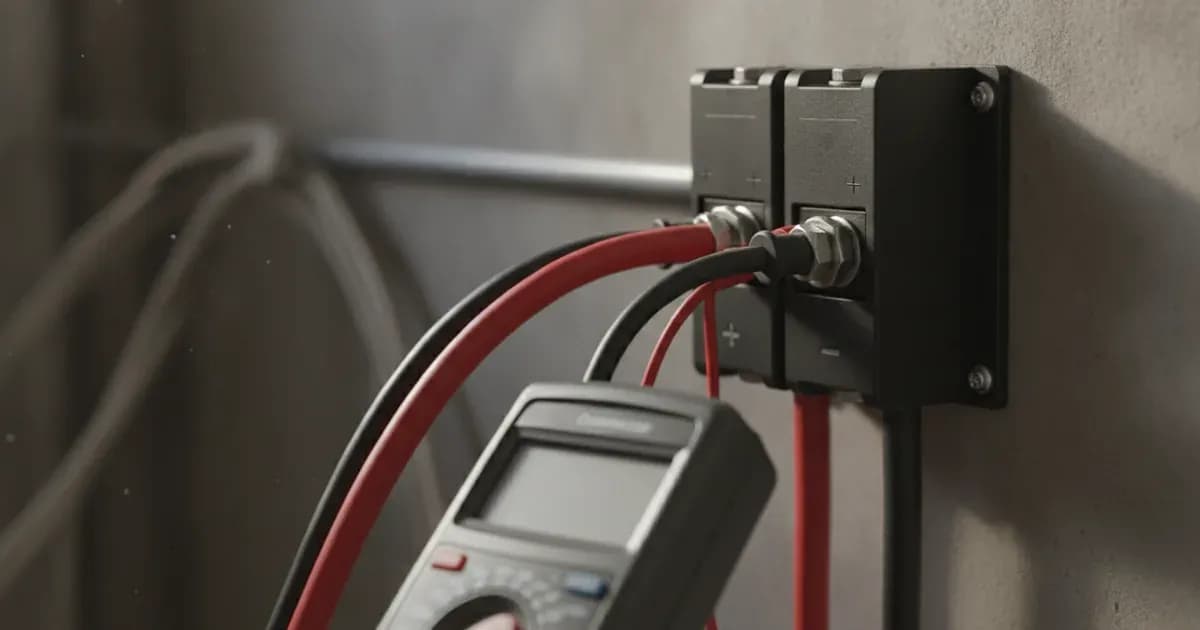
- What to look for: With the inverter's DC switch OFF and PV strings disconnected, use a multimeter to measure the voltage across the positive and negative terminals of each PV string. Perform this measurement in direct sunlight.
- What it means:
- Deye SG03LP1 (e.g., SUN-5K-SG03LP1-EU): The MPPT start-up voltage is 125V. The MPPT operating voltage range is 150~425V. Your measured Voc must be higher than 125V for the inverter to start, as the Open circuit Voltage (Voc) of PV modules should be higher than min. start voltage.
- Deye SG01LP1 (e.g., SUN-8K-SG01LP1-EU): The MPPT start-up voltage is 125V. The MPPT operating voltage range is 150-425V. Your measured Voc must be higher than 125V, as the Open circuit Voltage (Voc) of PV modules should be higher than min. start voltage.
- Growatt SPF ES (e.g., SPF 5000 ES): The MPPT start-up voltage is 150Vdc. The MPPT operating voltage range is 120Vdc~430Vdc. Your measured Voc must be higher than 150Vdc, as the Open circuit Voltage (Voc) of PV modules should be higher than min. start voltage.
- GoodWe ET (e.g., GW5KL-ET): The MPPT start-up voltage is 180V. The MPPT operating voltage range is 200~850V. If the PV voltage is less than 180V, the inverter will not start up with PV only.
- Solis S5-EH1P-L (e.g., S5-EH1P5K-L): The MPPT start-up voltage is 120V. The MPPT operating voltage range is 90-520V. Ensure the PV array open circuit voltage is within the inverter's limit of 600V.
- Huawei SUN2000-L1 (e.g., SUN2000-5KTL-L1): The MPPT start-up voltage is 100V. The MPPT operating voltage range is 80–600V. If the SUN2000 detects that the output power of PV strings does not meet the requirements for grid-tied power generation, it enters Standby mode.
- Fox ESS H1(G2) (e.g., H1-5.0-E-G2): The MPPT start-up voltage is 75V. The MPPT operating voltage range is 80-550V. The open circuit voltage of module array connected should be less than 600V.
- Inspect PV Wiring and Connections:
- What to look for: Check all DC cables from the PV modules to the inverter for physical damage, loose connections, or corrosion. Ensure correct polarity (+ to + and - to -).
- What it means:
- Deye SG03LP1 / SG01LP1: To avoid any malfunction, do not connect any PV modules with possible current leakage to the inverter. Ensure the PV+ and PV- of the solar panel are not connected to the system ground bar.
- GoodWe ET: Confirm the connections between the ET and PV panels and that the polarities (+/-) are not reversed.
- Solis S5-EH1P-L: Before connection, please make sure the polarity of the output voltage of PV array matches the DC+ and DC- symbols.
- Huawei SUN2000-L1: The positive and negative terminals of a PV string connect to corresponding positive and negative DC input terminals of the SUN2000. Since the output of the PV string connected to the SUN2000 cannot be grounded, ensure that the PV module output is well insulated to ground. During the installation of PV strings and the SUN2000, the positive or negative terminals of PV strings may be short-circuited to ground if the power cable is not properly installed or routed. In this case, an AC or DC short circuit may occur and damage the SUN2000.
- Fox ESS H1(G2): Warning! Please do not make PV positive or negative to ground! If a "PvCon Dir Fault" occurs, check if the positive pole and negative pole of PV are correctly connected.
- Check for Ground Faults or Insulation Issues:
- What to look for: If your inverter displays an insulation fault code (e.g., Deye F32, GoodWe "Isolation Failure", Solis PV ISO-PRO01/02, Huawei 2062, Fox ESS "Iso Fault"), this indicates a leakage path to ground.
- What it means: The insulation of electric wires might be damaged, or there's an issue with the PV side cable ground connection. For GoodWe ET, check if resistance between earth & inverter frame is close to zero and check resistance between PV+/PV-/BAT+ and earth.
Cause/fix table section
Symptom detail | Likely cause | Fix |
|---|---|---|
Inverter shows no PV input | PV string disconnected or loose connection | Visually inspect and re-secure all PV string connections to the inverter. |
Inverter shows no PV input | PV string polarity reversed | With all power off, verify and correct PV string polarity (+ to + and - to -). For Huawei SUN2000-L1, if error 2011 "String Reversed" occurs, wait until PV string current < 0.5A, set DC switch to OFF, then adjust polarity. |
Inverter shows low PV voltage | PV array open circuit voltage (Voc) below inverter's MPPT start-up voltage | Measure Voc of PV array. If the Open circuit Voltage (Voc) of PV modules is too low, add more modules in series (within inverter's Max. PV Array Open Circuit Voltage limit) or check for shaded/damaged modules. |
Inverter shows low PV voltage | PV array operating voltage outside MPPT operating range | Check string configuration. Ensure the number of modules in series results in an operating voltage within the inverter's specified MPPT range (e.g., Deye SG03LP1/SG01LP1: 150~425V, Growatt SPF ES: 120Vdc~430Vdc, GoodWe ET: 200~850V, Solis S5-EH1P-L: 90-520V, Huawei SUN2000-L1: 80–600V, Fox ESS H1(G2): 80-550V). |
Inverter displays "DC insulation impedance failure" (Deye F32) or "Isolation Failure" (GoodWe ET) or "Low Insulation Resistance" (Huawei 2062) or "Iso Fault" (Fox ESS H1(G2)) | Ground fault or damaged insulation in PV cabling | Check PV side cable ground connection. Inspect PV string cables for damage. For GoodWe ET, check if resistance between earth & inverter frame is close to zero and check resistance between PV+/PV-/BAT+ and earth. |
Inverter displays "ARC fault" (Deye F40) or "AFCI failure" (Solis ARC-FAULT) or "DC Arc Fault" (Huawei 2002) | Arc fault detected in PV system | Check PV module cable connections for loose terminals or damage. For Solis S5-EH1P-L, verify connections are tight within your PV system. |
Inverter displays "PV voltage is too high" (Growatt 61) or "High String Input Voltage" (Huawei 2001) or "OV-DC01/02" (Solis) or "PV/BAT Overvoltage" (GoodWe ET) | PV array open circuit voltage (Voc) exceeds inverter's maximum input voltage | Check PV string configuration. Decrease the number of PV panels in series to ensure Voc is below the inverter's Max. PV Array Open Circuit Voltage (e.g., Deye SG03LP1/SG01LP1: 500V, Growatt SPF ES: 450Vdc, GoodWe ET: 1000V, Solis S5-EH1P-L: 600V, Huawei SUN2000-L1: 600V, Fox ESS H1(G2): 600V). |
Inverter displays "DC over current fault of the hardware" (Deye F30) or "SW Pv Cur Fault" / "HW Pv Cur Fault" (Fox ESS H1(G2)) | Excessive current from PV array | Check PV module connection. If in off-grid mode, reduce load. Disconnect PV, grid, and battery, then reconnect for Fox ESS H1(G2). |
Inverter does not start with PV only (GoodWe ET) | PV voltage is less than 180V | Make sure the PV voltage is greater than 180V. 230 V is needed to enter on-grid mode. |
Inverter shows no PV input | PV+ or PV- connected to system ground bar (Deye SG03LP1/SG01LP1, Fox ESS H1(G2)) or PV string output grounded (Huawei SUN2000-L1) | Ensure the PV+ & PV- of solar panel is not connected to the system ground bar. Ensure PV module output is well insulated to ground. |
PV Input Troubleshooting Steps
When your inverter reports no PV input or low PV voltage, the issue typically lies with the solar array itself or its connection to the inverter.
- Verify PV Array Voltage and Current:
- Open Circuit Voltage (Voc): As detailed in the diagnosis section, measure the Voc of each PV string. Compare this to your inverter's specified
MPPT Start-up VoltageandMax. PV Array Open Circuit Voltage (Voc). The measured voltage must be above the start-up voltage but below the maximum. - Short Circuit Current (Isc): While less common for "no input" issues, a significantly low Isc can indicate a problem with the PV modules themselves. This requires specialized equipment or knowledge of expected current values.
- Open Circuit Voltage (Voc): As detailed in the diagnosis section, measure the Voc of each PV string. Compare this to your inverter's specified
- Check PV String Configuration:
- Ensure the number of modules in series on each string is appropriate for your inverter's
MPPT Operating Voltage Range. If you have too few modules, the voltage may never reach the start-up threshold. If you have too many, the voltage could exceed the maximum, causing the inverter to shut down for protection. - Verify the number of strings connected to each
MPPT Trackermatches the inverter's specifications (e.g., Deye SG03LP1/SG01LP1 has 2 MPPT trackers with 1+1 strings, GoodWe ET has 2 MPPT trackers with 1/1 or 1/2 strings, Huawei SUN2000-L1 has 2 MPPT trackers with 1 string each).
- Ensure the number of modules in series on each string is appropriate for your inverter's
- Inspect DC Disconnects and Fuses:
- Ensure all DC disconnect switches between the PV array and the inverter are in the "ON" position.
- Check for any blown fuses in the DC combiner box or within the inverter itself (if accessible and user-serviceable per manual).
Safety: Working with High Voltage DC
Working with solar PV systems involves high DC voltages and currents that can be lethal.
- Always isolate power: Before performing any checks or maintenance, turn off the AC breaker, the inverter's DC switch, and any external PV array disconnects. Wait for the inverter's internal capacitors to discharge (refer to your inverter manual for specific wait times).
- Use insulated tools: Always use tools rated for electrical work, with insulated handles.
- Wear personal protective equipment (PPE): This includes insulated gloves, safety glasses, and non-conductive footwear.
- Avoid short circuits: A spanner across a PV string can short hundreds of amps, creating a dangerous arc flash. Be extremely careful when tightening or disconnecting terminals.
- Never open the inverter enclosure unless you are a qualified and authorized service technician. Opening the unit may expose you to dangerous voltages and can void your warranty.
When to call a technician instead
You should call a qualified solar technician if:
- You are unsure how to safely perform any of the diagnostic steps.
- The inverter displays persistent fault codes related to insulation failure, arc faults, or internal hardware errors after basic troubleshooting.
- You measure voltages or currents that are outside the specifications listed in your inverter's manual, and you cannot identify a simple wiring fix.
- There is visible damage to the inverter or PV cabling that you are not equipped to repair.
- Your inverter manual states that certain repairs or checks are only to be performed by authorized personnel to avoid voiding the warranty.
- For Solis S5-EH1P-L inverters, if DC inputs are accidently reversely connected or inverter is faulty or not working properly, it is NOT allowed to turn off the DC switch. Otherwise it may cause DC arc and damage the inverter or even lead to a fire disaster. In such a scenario, contact a technician immediately.
Still showing the fault? Book a technician
If the steps above did not clear it, tell us the inverter or battery and the exact code. We pass it to a technician who covers your city; visit charges are quoted before they come.
How this pays for the site: the technician or verifier pays SolarNevs a fixed introduction fee. Nobody pays to be recommended, and you are free to use our free guides instead.
Frequently asked questions
Why is my solar inverter showing no PV input?
No PV input typically means the inverter is not detecting any power from your solar panels. This can be caused by disconnected PV strings, reversed polarity, or a PV array open circuit voltage that is outside the inverter's limits. Ground faults or current leakage from PV modules can also prevent input.
What is the MPPT start-up voltage for a Deye SUN-5K-SG03LP1-EU inverter?
For the Deye SUN-5K-SG03LP1-EU inverter, the MPPT start-up voltage is 125V. The open circuit Voltage (Voc) of PV modules should be higher than this min. start voltage for the inverter to begin operation.
How do I check if my PV voltage is too low for a Growatt SPF 5000 ES inverter?
For a Growatt SPF 5000 ES inverter, the MPPT start-up voltage is 150Vdc. You need to measure the open circuit voltage (Voc) of your PV array. If the Open circuit Voltage (Voc) of PV modules is below 150Vdc, the inverter will not start producing power from the PV.
What does a 'Pv Volt Fault' mean on a Fox ESS H1(G2) inverter?
A 'Pv Volt Fault' on a Fox ESS H1(G2) inverter indicates that the PV voltage is out of range. This could mean the open circuit voltage of the module array connected should be less than 600V, and operating voltage should be within the MPPT voltage range of 80-550V.
What should I do if my Huawei SUN2000-L1 inverter shows error code 2011 'String Reversed'?
Error code 2011 'String Reversed' on a Huawei SUN2000-L1 inverter means a PV string is reversely connected. You should wait until PV string current < 0.5A, set DC switch to OFF, and adjust the polarity of the PV string connection.
References
- Deye SUN-3.6_6K_SG03LP1_EU Manual Ver2.2 — accessed 23 August 2026
- Deye SUN-7.6_8K-SG01LP1-EU Manual — accessed 23 August 2026
- Growatt SPF 3500/5000 ES Manual — accessed 23 August 2026
- GoodWe ET User Manual — accessed 23 August 2026
- Solis S5-EH1P(3-6)K-L EUR Manual V1.3 — accessed 23 August 2026
- Huawei SUN2000-L1 User Manual — accessed 23 August 2026
- Fox ESS H1(G2) Manual V1.0.8 — accessed 23 August 2026
Related guides
More from inverter errors & fixes.