UK Agricultural Solar PV Grants and Farming Investment Fund Guide
Updated 15 September 2026 · By SolarNevs Research Desk, Dealer surveys + verified sources · 3 sources · Method ↗
Key Takeaways
- The Improving Farm Productivity grant forms part of Defra's overarching Farming Investment Fund in England.
- Grant support provides a 25% capital contribution toward the purchase and installation of on-farm solar equipment.
- Funding boundaries are established between a minimum grant of £15,000 and a maximum grant of £100,000.
- Systems must be installed on non-residential farm buildings or on farm irrigation reservoirs using floating cradles.
- Eligible installations must incorporate battery energy storage to capture on-site generation.
- All installed energy generation devices must be formally registered with the local Distribution Network Operator (DNO).
The Farming Investment Fund Architecture
Agricultural businesses face escalating electricity costs for grain drying, cold storage, ventilation, and robotic milking parlours. To support clean farm resilience, Defra launched dedicated grant funding:
Scheme Parameter | Improving Farm Productivity Grant Specification |
|---|---|
Grant Funding Rate | Up to 25% of eligible project costs |
Minimum & Maximum Grant | Minimum £15,000; Maximum £100,000 |
Eligible Mounting Locations | Farm building rooftops and floating cradles on irrigation reservoirs |
System Requirements | Solar array paired with on-site battery storage for farm power |
Eligible Equipment | PV panels, batteries, inverters, utility meters, grid connections, power diverters |
Excluded Costs | Ground-mounted panels, roof repairs/reinforcement, new building builds, panel upgrades |
Business Eligibility | Open to farm and horticultural businesses (contractors excluded for solar) |
- Fund Scheme: Part of the Farming Investment Fund, the Improving Farm Productivity grant is open to farmers, growers and related contractors.
- Renewable Energy Focus: Promotes the installation of solar equipment to increase both energy resilience and the take-up of renewable energy generation on farms.
- Grant Percentage: The offer for solar equipment covers up to 25% of eligible project costs.
- Financial Banding: For solar equipment, the minimum grant available is £15,000 and the maximum grant available is £100,000.
- Target Sectors: The grant is open to horticultural and farm businesses. Contractors from those sectors are eligible to apply for grants towards robotic equipment, but not solar equipment.
Installation Scope and Technical Criteria
To qualify for funding, agricultural solar systems must adhere to strict installation rules:
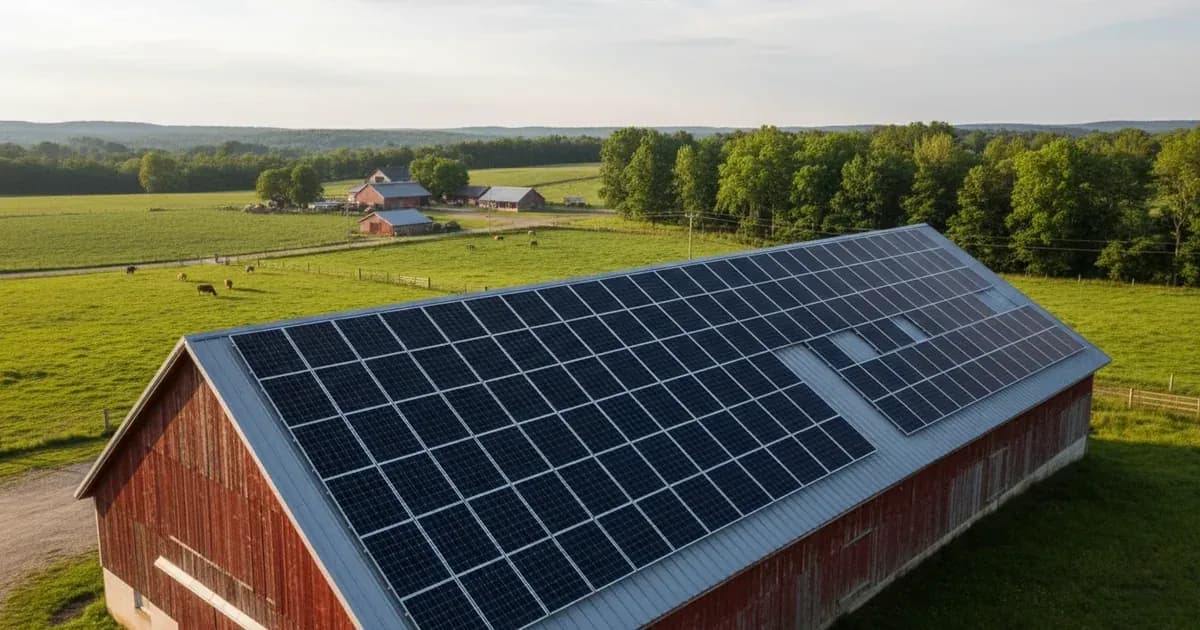
- Farm Power Objective: An eligible solar PV system should be mainly for farm power and installed on farm buildings, not on a residential property.
- Integrated Storage: The solar energy is stored in a battery or batteries. The systems can be connected to export surplus power back to the National grid.
- Permitted Locations: Solar panels can be installed on an irrigation reservoir (including the supporting floating cradle), or on farm buildings that are able to support them.
- Structural Verification: It’s your responsibility to make sure that a roof intended to take solar panels, is able to support them.
Eligible Hardware vs Excluded Costs
Grant guidelines define specific eligible capital items:
- Eligible Items: Solar PV panels, solar batteries, inverters, utility meter, electrical grid connection, and power diverters that redirect excess solar energy to power storage (for example heat stores).
- Ineligible Expenditure: Items which are not eligible include ground base solar panels, replacement or reinforcement of roofs, construction of farm buildings, and upgrading of existing solar panels.
Network Operator Registration
Coordinating grid capacity is mandatory for all agricultural energy installations:
- DNO Registration Duty: If you are planning to install an energy device in your home or small business, you are required to register your energy device with your Distribution Network Operator ( DNO ), the company that is responsible for bringing electricity to the property where you are installing the device.
- This registration allows network operators to model transformer loading and verify local capacity before commissioning high-output farm arrays.
Frequently asked questions
What is the grant rate for solar equipment under the Farming Investment Fund?
The grant covers up to 25% of eligible project costs for solar equipment under the Improving Farm Productivity scheme.
What are the funding limits for agricultural solar grants?
The minimum grant is £15,000 and the maximum grant is £100,000 per applicant business.
Where must grant-funded agricultural solar panels be located?
Panels must be installed on farm buildings able to support them or on an irrigation reservoir using floating cradles.
Are ground-mounted solar panels eligible for grant support?
No, ground-based solar panels, new building construction, and roof reinforcement are ineligible.
Why must farm energy devices be registered with the network operator?
You are required to register energy devices with your DNO to maintain safe grid operation and verify network capacity.
References
- Defra Farming Blog Improving Farm Productivity Grant Round 2 — accessed 28 August 2026
- Defra Improving Farm Productivity Grant Equipment Definitions — accessed 28 August 2026
- DESNZ Guidance on Registering Energy Devices — accessed 28 August 2026
Related guides
More from what to buy — and how not to get cheated.