UK Ground Mounted Solar Ecological Surveys and Planning Guide
Updated 6 September 2026 · By SolarNevs Research Desk, Dealer surveys + verified sources · 5 sources · Method ↗
Key Takeaways
- Ground-mounted solar farm developments require formal planning permission supported by multi-season ecological assessments.
- Under the Environment Act 2021, projects must achieve the statutory Biodiversity Gain Objective of at least a 10% uplift.
- Habitat baselines and enhancements are quantified using the official statutory biodiversity metric.
- Ground-based solar panels are excluded from Defra farm productivity grant schemes, which prioritize rooftop arrays.
- Agricultural land units of 5 hectares or more operate under Class A permitted development rules.
- Installers must register energy devices with the local Distribution Network Operator (DNO) to verify local network capacity.
The Statutory Biodiversity Gain Mandate
Planning applications for ground-mounted solar arrays in England must satisfy mandatory environmental conditions established under the Environment Act 2021:
Planning & Regulatory Parameter | Statutory Rule / Threshold | Practical Implication for Solar Developers |
|---|---|---|
Biodiversity Net Gain (BNG) | Minimum 10% uplift under Environment Act 2021 | Calculated via statutory metric; aggregate of onsite, offsite, or statutory credits |
Agricultural Permitted Development | Class A: Agricultural units of ≥5 hectares | Applies to agricultural units; commercial ground-mount solar requires full planning |
Farm Productivity Capital Grants | £15,000 min to £100,000 max grant | Rooftop solar systems eligible; ground-mounted solar arrays are strictly excluded |
DNO Network Registration | Mandatory notification (pre- or post-install) | Contractor assesses connection type to register device with local network operator |
- Statutory Objective: The biodiversity gain objective is met in relation to development for which planning permission is granted if the biodiversity value attributable to the development exceeds the pre-development biodiversity value of the onsite habitat by at least the relevant percentage.
- Mandatory Percentage: The relevant percentage is 10%.
- Measurement Document: The biodiversity metric is a document for measuring, for the purposes of this Schedule, the biodiversity value or relative biodiversity value of habitat or habitat enhancement.
- Official Publisher: The biodiversity metric is to be produced and published by the Secretary of State.
- Net Gain Aggregation: The biodiversity value attributable to the development is the total of post-development onsite habitat value, registered offsite gains allocated to the development, and purchased biodiversity credits.
Multi-Season Ecological Survey Requirements
Before submitting a solar farm planning application, developers must commission comprehensive field surveys:
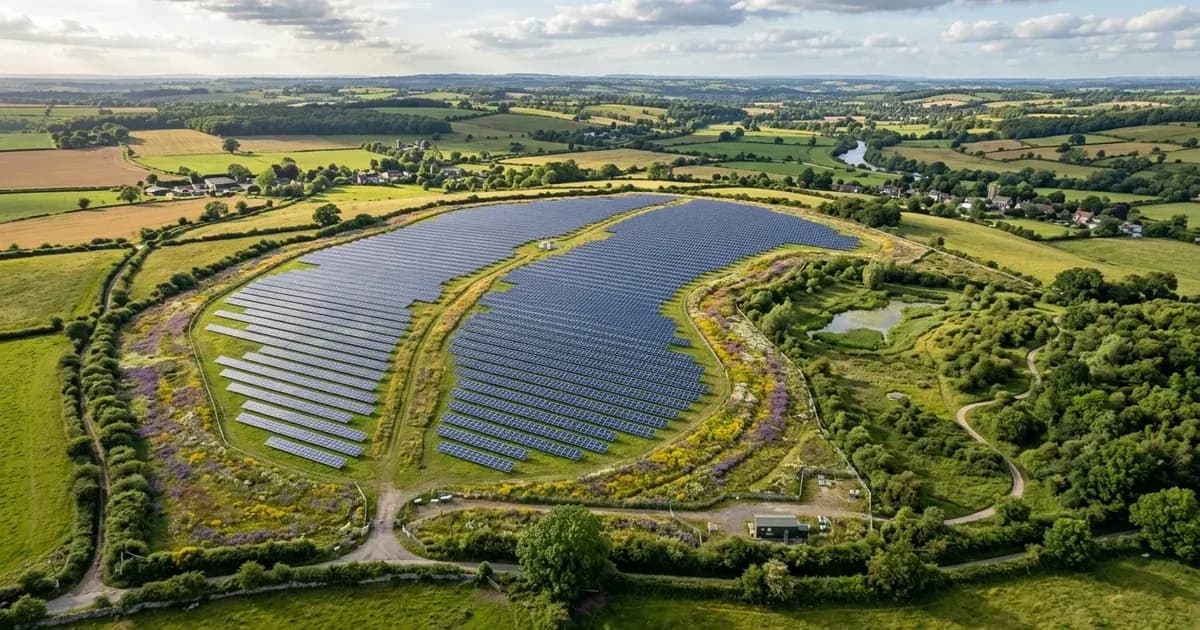
- Preliminary Ecological Appraisal (PEA): Maps on-site UK Habitat Classification types, identifying hedges, ponds, and woodland edges.
- Protected Species Surveys:
- Breeding Birds: Assesses ground-nesting species (such as skylarks and lapwings) across open grassland.
- Great Crested Newts (GCN): Evaluates ponds within 500 metres of the development boundary.
- Badgers & Bats: Identifies active setts and commuting hedgerow corridors requiring minimum construction buffers.
- Landscape and Ecological Management Plan (LEMP): Outlines 30-year habitat maintenance commitments, such as sowing species-rich wildflower meadows and implementing conservation sheep grazing beneath panels.
Survey Stage | Focus Area & Protected Species | Key Deliverables & Commitments |
|---|---|---|
Preliminary Ecological Appraisal (PEA) | Habitat classification mapping | Identifies baseline hedges, ponds, and woodland boundaries |
Protected Species Assessments | Skylarks, GCN (within 500m), badgers, bats | Establishes construction setbacks and habitat buffers |
Ecological Management Plan (LEMP) | 30-year long-term habitat enhancement | Outlines wildflower sowing and conservation sheep grazing |
Grant Limitations: Rooftop vs Ground Mounts
Farmers exploring solar should distinguish between planning requirements and capital grant eligibility:
- Grant Objectives: Schemes focus on the installation of solar equipment to increase both energy resilience and the take-up of renewable energy generation on farms.
- Grant Limits: For solar equipment, the minimum grant available is £15,000 and the maximum grant available is £100,000.
- Ground Mount Exclusion: Items which are not eligible include ground base solar panels, replacement or reinforcement of roofs, construction of farm buildings, and upgrading of existing solar panels.
Planning Context and Grid Notifications
Navigating rural infrastructure requires compliance across planning and grid systems:
- Agricultural Units: Class A permits agricultural development on units of 5 hectares or more, covering buildings and engineering operations reasonably necessary for agriculture.
- DNO Registration Duty: If you are planning to install an energy device in your home or small business, you are required to register your energy device with your Distribution Network Operator ( DNO ), the company that is responsible for bringing electricity to the property where you are installing the device.
- Contractor Assessment: Installation contractors must examine the energy device and required connection to determine whether the Distribution Network Operator needs to be informed before or after installation.
Frequently asked questions
What is the mandatory Biodiversity Net Gain (BNG) requirement for solar farms?
Under Schedule 14 of the Environment Act 2021, development must exceed pre-development biodiversity value by at least 10%.
How is habitat biodiversity value calculated in England?
Biodiversity value is measured using the statutory biodiversity metric produced and published by the Secretary of State.
Are ground-mounted solar panels eligible for Defra farm productivity grants?
No, ground-based solar panels are explicitly excluded from the Improving Farm Productivity grant scheme.
What planning threshold applies to agricultural permitted development?
Class A of GPDO Schedule 2 Part 6 applies to agricultural development on units of 5 hectares or more.
What notification duty applies to contractors installing energy devices?
Installation contractors must examine the energy device and connection to determine whether the DNO needs to be informed before or after installation.
References
- Environment Act 2021 Schedule 14 Biodiversity Gain as Condition of Planning Permission — accessed 28 August 2026
- Defra Farming Blog Improving Farm Productivity Grant Round 2 — accessed 28 August 2026
- Defra Improving Farm Productivity Grant Equipment Definitions — accessed 28 August 2026
- Town and Country Planning General Permitted Development Order 2015 Schedule 2 Part 6 — accessed 28 August 2026
- DESNZ Guidance on Registering Energy Devices — accessed 28 August 2026
Related guides
More from what to buy — and how not to get cheated.