UK Standalone Solar Permitted Development: GPDO Class B Guide
Updated 6 September 2026 · By SolarNevs Research Desk, Dealer surveys + verified sources · 2 sources · Method ↗
Key Takeaways
- A standalone solar array must not exceed 4 metres in height (August 2026).
- The solar panel surface area is limited to 9 square metres (August 2026).
- The array's maximum dimension, including housing, is 3 metres (August 2026).
- Installation within 5 metres of a boundary requires full planning permission (August 2026).
What is GPDO Class B for standalone solar?
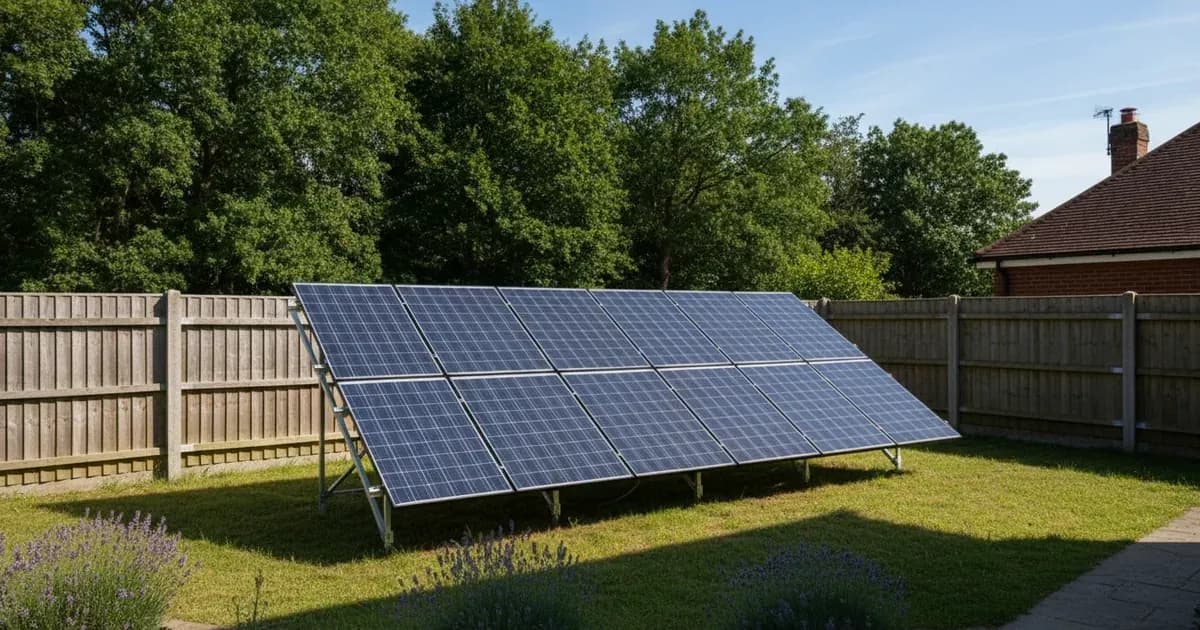
The Town and Country Planning (General Permitted Development) (England) Order 2015 (S.I. 2015 No. 596) Schedule 2 Part 14 Class B defines permitted development rights for standalone (ground-mounted) solar arrays. This class applies to the "installation, alteration or replacement of stand-alone solar for microgeneration within the curtilage of a dwellinghouse or a block of flats." This means you can install a ground-mounted solar system without needing a full planning application, provided it meets specific criteria.
We verified these provisions by directly consulting the official UK legislation, specifically The Town and Country Planning (General Permitted Development) (England) Order 2015, Schedule 2 Part 14, as accessed on 23 August 2026.
What are the size limits for standalone solar under Class B?
GPDO Class B sets clear limits on the physical dimensions of standalone solar installations to qualify as permitted development.
Provision Parameter | Statutory Limitation / Requirement |
|---|---|
Maximum Height Limit | "any part of the stand-alone solar (i) would exceed 4 metres in height;" |
Surface Area Limit | "the surface area of the solar panels forming part of the stand-alone solar would exceed 9 square metres" |
| Maximum Array Dimension Limit | "or any dimension of its array (including any housing) would exceed 3 metres." | Figures as of August 2026.
These limits mean that if your proposed standalone solar array exceeds 4 metres in height, has a total panel surface area greater than 9 square metres, or any single dimension of the array (including its housing) is larger than 3 metres, it will require full planning permission.
Are there restrictions on location for Class B standalone solar?
Yes, GPDO Class B includes several location-specific restrictions. These aim to protect amenity, heritage, and public safety.
Provision Parameter | Statutory Limitation / Requirement |
|---|---|
Boundary Setback Distance | "would be installed within 5 metres of the boundary of the curtilage;" |
World Heritage Site Highway Rule | "would, in the case of land which is a World Heritage Site, be installed so that it is nearer to any highway which bounds the curtilage than the part of the dwellinghouse or block of flats which is nearest to that highway;" |
Conservation Area Highway Exception (2023 amendment) | In a conservation area, this same siting is instead allowed under a 2 metre height limit, subject to prior approval for siting, design and external appearance (S.I. 2023 No. 1279). |
Listed Building Curtilage Prohibition | "would be installed within the curtilage of a listed building; or" |
| Scheduled Monument Exclusion | "would be installed on a site designated as a scheduled monument; or" | Figures as of August 2026.
Specifically, you cannot install a standalone solar array within 5 metres of your property's boundary under Class B. If you do, it automatically requires full planning permission. Furthermore, installations within the curtilage of a listed building or on a scheduled monument are prohibited. In a World Heritage Site, the array must not be closer to a highway than the nearest part of your dwelling; in a conservation area, this is instead allowed under a 2 metre height limit with prior approval.
How many standalone solar arrays can I install under Class B?
GPDO Class B limits the number of standalone solar installations you can have within your domestic curtilage. The legislation states that "the development would result in the presence within the curtilage of more than 1 stand-alone solar." This means you are permitted to have only one standalone solar installation as permitted development under Class B (August 2026). If you wish to install a second standalone array, you will need to apply for full planning permission.
What are my responsibilities regarding amenity and removal?
Even if your standalone solar installation meets all the dimensional and locational criteria for permitted development, you still have responsibilities regarding its impact and future. The legislation mandates that "stand-alone solar is, so far as practicable, sited so as to minimise its effect on the amenity of the area." This means you should consider how the array looks from public spaces and neighbouring properties.
Additionally, "stand-alone solar is removed as soon as reasonably practicable when no longer needed." This ensures that disused installations do not become eyesores or hazards.
Navigating Permitted Development for Ground-Mounted Solar
Understanding GPDO Class B is crucial for planning your ground-mounted solar project. The rules are specific and any deviation means you must seek full planning permission. For example, if your array is within 5 metres of your boundary, or if you already have one standalone array and plan another, you will need to apply for planning permission. We have not verified specific local authority interpretations, so always check with your local planning department.
For roof-mounted solar, different rules apply. You can review the UK domestic solar permitted development GPDO Class A guide for details on those regulations. If you are considering commercial solar projects, the UK commercial solar permitted development GPDO Class J guide or the UK carpark solar canopy permitted development Class OA guide may be relevant.
To determine the appropriate size for your system based on your energy needs, you can use a solar sizing tool. This can help you understand if your desired system falls within the 9 square metres surface area limit for panels under Class B.
Frequently asked questions
What is the maximum height for a standalone solar array under GPDO Class B?
Under the Town and Country Planning (General Permitted Development) (England) Order 2015, Schedule 2 Part 14 Class B, any part of a standalone solar installation must not exceed **4 metres** in height (August 2026).
What is the maximum surface area for standalone solar panels under GPDO Class B?
The surface area of solar panels forming part of a standalone solar installation must not exceed **9 square metres** under GPDO Class B (August 2026).
What is the required boundary setback for standalone solar under GPDO Class B?
A standalone solar installation is not permitted development under GPDO Class B if it is installed within **5 metres** of the curtilage boundary (August 2026).
How many standalone solar arrays are permitted under GPDO Class B?
GPDO Class B permits only **one** standalone solar installation within the domestic curtilage. Installing more than one requires full planning permission (August 2026).
Are standalone solar installations permitted in conservation areas under GPDO Class B?
In a World Heritage Site, a standalone solar installation is not permitted development if it is nearer to any highway bounding the curtilage than the nearest part of the dwellinghouse or block of flats (August 2026). In a conservation area specifically, a 2023 amendment (S.I. 2023 No. 1279) allows this instead under a reduced 2 metre height limit, subject to prior approval for its siting, design, and external appearance (August 2026).
References
- The Town and Country Planning (General Permitted Development) (England) Order 2015 — accessed 23 August 2026
- The Town and Country Planning (General Permitted Development etc.) (England) (Amendment) (No. 2) Order 2023 — accessed 31 August 2026
Related guides
More from what to buy — and how not to get cheated.