Solar Inverter No Grid Connection Warning: UK Troubleshooting and Fix Guide
Updated 18 September 2026 · By SolarNevs Research Desk, Dealer surveys + verified sources · 5 sources · Method ↗
Key Takeaways
- A "No Grid Connection" or "No AC Connection" alert indicates an absence of grid voltage at inverter AC terminals, stopping all solar generation.
- Start by checking whether the power cut is external across your street, or isolated to your premises by inspecting the consumer unit generation breaker.
- Inverter manufacturers require confirming that external AC rotary isolators are switched ON and terminal screw connections are tight and sound.
- Testing live terminal voltages with a multimeter involves severe electric shock hazards; internal testing must only be performed by certified electricians.
Why is your solar inverter reporting no grid connection?
When your solar photovoltaic system operates normally, the inverter synchronizes its alternating-current output with the local electricity supply. If that incoming mains voltage disappears, the inverter instantly enters safety shutdown.
Across major inverter brands in the UK, this condition manifests under different display alerts:
- Growatt inverters present a clear display phenomenon: The inverter displays No AC Connection on the screen or app. No grid synchronization occurs, and the fault LED may be illuminated.
- Solis inverters record alarm code 1015 - NO-GRID (AC MCB Tripping).
- SolaX hybrid systems record fault code IE 02, which indicates grid disconnection.
- GivEnergy units report INV_NO_UTILITY or STORAGE_ERROR_NO_UTILITY.
In every case, the root cause is electrical isolation: the inverter is physically disconnected from the incoming utility grid.
Brand / Platform | Warning Indication | Underlying Diagnostic Meaning |
|---|---|---|
Growatt string & hybrid | Displays No AC Connection | "Absence of grid voltage at inverter AC terminals." https://growatt.tech/2025/12/19/growatt-no-ac-connection/ |
Solis Mini / S5 / S6 | Alarm 1015 - NO-GRID | "1015 - NO-GRID (AC MCB Tripping)" https://solis-service.solisinverters.com/en/support/solutions/articles/44002485766-1015-no-grid-ac-mcb-tripping- |
SolaX X1 / X3 series | Fault IE 02 | "Indicates grid disconnection." https://solaxpowerservice.zendesk.com/hc/en-001/articles/12344096643215-What-does-the-Grid-Lost-Fault-IE02-error-indicate-and-how-to-resolve-it |
GivEnergy Gen 1 / 2 / 3 | INV_NO_UTILITY | "INV_NO_UTILITY - Please ensure that the AC supply is switched on and the AC connections are tight and sound" https://kb.givenergy.cloud/article.php?id=71 |
GivEnergy Storage | STORAGE_ERROR_NO_UTILITY | "STORAGE_ERROR_NO_UTILITY - Please ensure that the AC supply is switched on and the AC connections are tight and sound" https://kb.givenergy.cloud/article.php?id=71 |
The four primary root causes of AC grid loss
Forensic triage divides no-grid faults into four distinct failure points:
- DNO distribution outage: The external high-voltage or low-voltage network has failed due to local cable faults, planned maintenance, or transformer damage.
- Tripped consumer unit protection: The dedicated miniature circuit breaker (MCB) or residual current breaker with overcurrent protection (RCBO) in your fusebox has tripped due to an overload or cable surge.
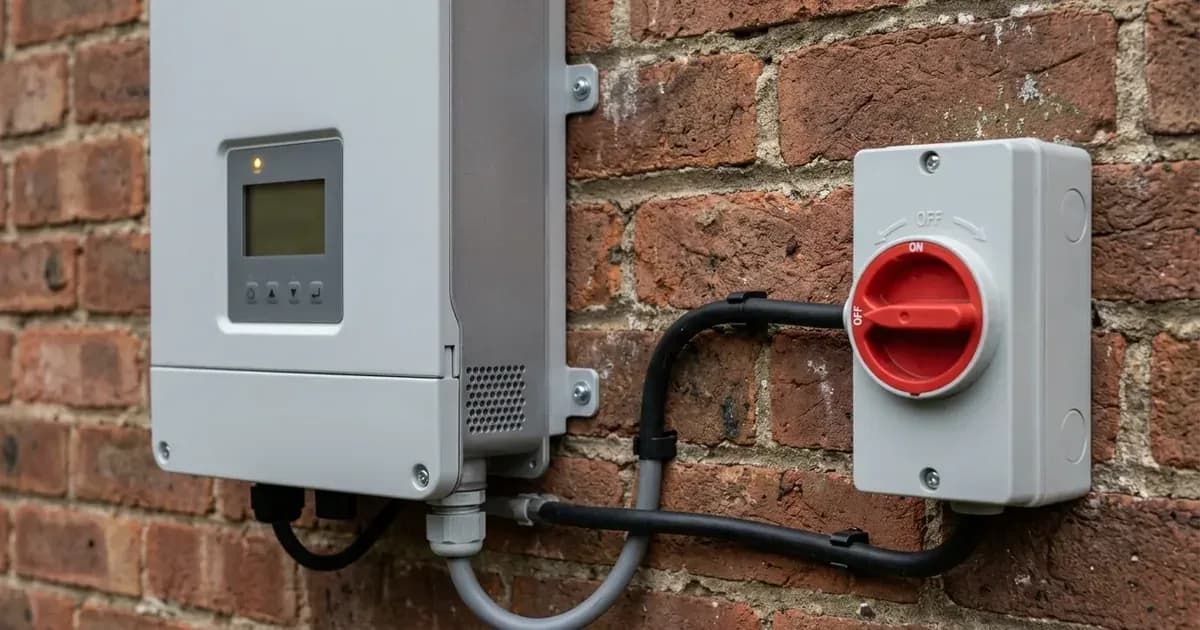
- Open AC rotary isolator: The wall-mounted lockable AC switch-disconnector located between the consumer unit and inverter has been switched OFF or suffered contact failure.
- Loose or damaged AC plug wiring: Thermal expansion, vibration, or poor installation torque has loosened phase or neutral connections inside the inverter AC terminal connector.
Step-by-step diagnostic triage for UK homeowners
Follow this progressive sequence to identify where the circuit is broken:
Step one: Establish whether the outage is external
Look at other household loads. Are your domestic lights, kettle, and sockets working? If your entire house is blacked out, or street lights and neighbouring homes have no power, the issue is an external DNO power cut. Restore grid supply if interrupted by waiting for network engineers, and track restoration progress by dialling 105.
Step two: Check the consumer unit solar generation breaker
Locate your main consumer unit or dedicated solar mini-board. Identify the breaker labelled "Solar PV", "Inverter", or "Microgeneration".
- If the toggle switch is in the DOWN (tripped) position, switch it firmly back to ON once.
- If the breaker trips again immediately with a loud click or flash, do not attempt further resets; this indicates a short circuit or earth fault that requires professional repair.
- On Solis installations where breakers nuisance trip upon generation, installers must please check the rating of the MCB and calculate weather the rating is less than the recommended, and if fatigued, replace the AC Breaker with new one.
Step three: Inspect the external AC rotary isolator
Verify AC breaker and isolators are in ON position. Most UK installations feature a rotary switch with a yellow/red handle adjacent to the inverter. Ensure the handle is fully turned clockwise to the "ON" or "1" mark. If the handle feels loose or fails to click positively into place, internal plastic switch cams may have sheared.
Step four: Verify inverter software settings
On certain inverters, the grid connection software parameter may have been disabled during maintenance. Installers should verify that also from advance setting make Grid-ON is active. For SolaX systems, initial triage confirms: Fix : Check grid connections, reset breakers, or contact utility.
Professional electrical testing: multimeter verification
When homeowners confirm that all external switches are ON but the inverter continues reporting No AC Connection, an accredited electrician must conduct live testing:
1. Terminal voltage measurement
Under BS 7671, the electrician uses a calibrated multimeter to measure voltage across incoming lines. As specified in SolaX technical bulletins: Step 1: Use a multimeter to measure the phase voltage and line voltage at the AC port. Ensure grid voltage is normal. In Growatt documentation: Measure AC voltage at inverter terminals (should match nominal grid voltage).
Under UK statutory standards (ESQCR 2002 Regulation 27), the frequency declared pursuant to paragraph (1) shall be 50 hertz and the voltage declared in respect of a low voltage supply shall be 230 volts between the phase and neutral conductors at the supply terminals. Permitted statutory variations allow in the case of a low voltage supply, a variation not exceeding 10 per cent above or 6 per cent below the declared voltage at the declared frequency. A frequency variation not exceeding 1 per cent is permitted.
2. Single-phase polarity and earth check
On single-phase British installations, electricians must measure from the gland end: If system is single phase (Check AC side voltage Phase to neutral, phase to earthing and neutral to earthing.) Always check reading from inverter AC gland end. Phase to neutral should read approximately 230V, phase to earth should read 230V, and neutral to earth should read near 0V.
3. Contact resistance and terminal inspection
Electricians inspect AC wiring for continuity and secure connections. They check the loose contact in the AC connector, ACDB, and meter side, and tighten or repair AC connections as needed.
4. Internal sensing verification and restart
Once physical voltage is confirmed at the AC plug, technicians verify whether the inverter display reads that voltage: ensure the detection of grid voltage in the inverter is normal. If terminals carry 230V but the inverter registers zero volts, an internal AC detection circuit issue is present. If sensing is normal, restart inverter after confirming stable AC voltage presence to resume generation.
Safety rules: working with AC generation circuits
- Isolate both AC and DC supplies before loosening terminal plugs or removing isolator covers.
- Never insert multimeter test leads into live terminals unless using Category III or IV rated insulated probes with finger guards.
- Do not bypass rotary isolators or link out circuit breakers; all generation circuits must have functional overcurrent and isolation protection under BS 7671 Section 712.
Frequently asked questions
Why does my solar inverter say No Grid Connection or No AC Connection?
This alert means the inverter detects an absence of grid voltage at its AC terminals. It is commonly triggered by a tripped solar circuit breaker in your consumer unit, an AC rotary isolator turned OFF, a localized power cut, or loose AC plug wiring.
Can I reset the solar generation circuit breaker myself?
Yes, you may check your consumer unit and reset a tripped solar breaker once. However, never repeatedly force or tape a breaker in the ON position if it trips immediately, as persistent tripping indicates an electrical short-circuit or earth leakage fault that requires an electrician.
What should I check first if my solar inverter loses grid connection?
First verify whether other household appliances have power. If the whole house or street has lost power, report the power cut by calling 105. If mains power is normal, check whether the rotary AC isolator next to the inverter is in the ON position.
What voltage should be present at the inverter AC terminals in the UK?
Under statutory regulations, British low-voltage supplies have a declared voltage of 230 volts with permitted variations of 10 per cent above or 6 per cent below at 50 hertz. A qualified electrician measuring phase to neutral should read between 216.2 volts and 253.0 volts.
References
- Growatt Technical Support: No AC Connection Diagnostics — accessed 29 August 2026
- Solis Service Center: 1015 NO-GRID AC MCB Tripped Diagnostics — accessed 29 August 2026
- SolaX Help Center: What does the Grid Lost Fault IE02 error indicate — accessed 29 August 2026
- GivEnergy Commissioning Portal Fault Clearing Matrix — accessed 29 August 2026
- Electricity Safety, Quality and Continuity Regulations 2002 Statutory Instrument — accessed 29 August 2026
Related guides
More from inverter errors & fixes.