SolaX Isolation Fault (IE13) and Earth Fault: UK Diagnostics Guide
Updated 18 September 2026 · By SolarNevs Research Desk, Dealer surveys + verified sources · 3 sources · Method ↗
Key Takeaways
- SolaX error code IE 13 indicates an insulation fault where DC current leaks to ground, while Earth Fault and PEGround Fault highlight issues with the protective earthing conductor.
- The first check is noting fault timing: if errors occur strictly at dawn and clear by midday, condensation from morning dew is the most probable cause.
- Never test solar array circuits during damp conditions without personal protective equipment; always ensure complete isolation and wait at least five minutes for capacitor discharge before touching terminals.
- True electrical faults require systematic string isolation and multimeter testing to identify cables with damaged insulation or abnormal ground voltage splits.
What is a SolaX Isolation Fault (IE13)?
On SolaX solar and hybrid inverters, error code IE 13 represents an Isolation Fault (insulation fault). Before energising and synchronising with the grid each morning, the inverter measures the galvanic isolation resistance between the active DC conductors (PV+ and PV-) and the building protective earth (PE). If current leakage to earth exceeds factory safety limits, the internal microcontrollers prevent grid connection to safeguard against electrical shock and fire hazards.
In UK installations, maintaining array insulation is a statutory requirement under British electrical regulations, as detailed in our UK solar electrical installation guide. Related earthing requirements are coordinated with distribution networks per our micro-generator grid connection guide.
A related alarm, Earth Fault or PEGround Fault, indicates that the connection to the external earthing terminal is compromised. Official guidance states: check the ground connection of the inverter and PV modules, and ensure proper PE wire installation and insulation integrity.
Morning dew false detection vs persistent insulation leakage
Understanding the environmental pattern of the alarm prevents unnecessary component replacement:
- Morning Dew False Detection: Overnight humidity, heavy condensation, and dawn frost deposit thin moisture films across solar panel frames, module backsheets, and MC4 connectors. As SolaX service engineers note: check the time points and frequency of the faults. If they only occur occasionally in the morning, it may be a false detection caused by dew. Upgrade the inverter firmware version to the latest to optimize sensor sampling thresholds.
- Persistent Environmental Leakage: If the IE 13 alert persists during dry, sunny afternoons or appears continuously across multiple days, physical degradation is present. Common root causes include cable abrasion on slate roof edges, rodent damage in attic spaces, or water intrusion inside unsealed DC isolator enclosures.
SolaX isolation testing thresholds and diagnostic protocol
To locate and rectify an array insulation fault, SolaX technical support outlines a four-step diagnostic procedure:
Step 1: Inverter PV terminal impedance test
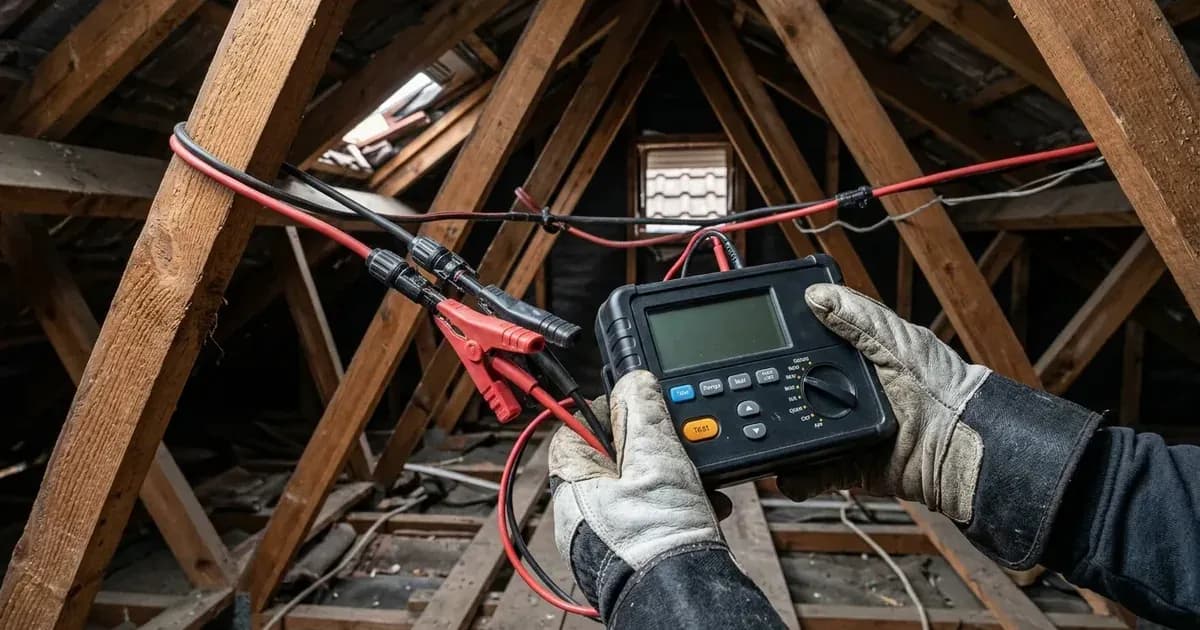
Isolate the inverter completely from AC and DC supplies. Using an insulation resistance tester, measure the impedance between the inverter's PV terminal and ground. The normal value should be greater than 100 MΩ. A measurement below this threshold indicates an internal surge protection device (SPD) failure or inverter circuit breakdown.
Step 2: String-by-string isolation swap
If inverter terminal impedance exceeds 100 MΩ, the fault resides in the rooftop solar strings. Follow the manufacturer string-swap protocol: Turn off the DC switch and the AC power supply, connect a single string of photovoltaic panels, then turn on the DC switch and the AC switch. Check if the inverter reports any errors. Follow this method to connect the photovoltaic panels one by one, identify the faulty string, and remove it.
Step 3: DC ground voltage differential testing
If string swapping does not immediately reveal the defective circuit, use a digital multimeter to assess positive and negative ground voltages: If the problem still cannot be identified, measure the positive and negative terminal voltages of each string of photovoltaic panels against the ground. A ground voltage of less than 30V for both the positive and negative terminals is considered normal. If there is a significant difference in the ground voltage between the positive and negative terminals of the same string of photovoltaic panels, for example, one at 100V and the other at 0V, then remove that string of panels.
Step 4: Cable insulation and connector inspection
Once the faulty string is isolated, carry out a thorough visual inspection: please check the wire insulation for damage. Examine all rooftop DC cable runs, conduit entries, and MC4 connectors for physical crushing, UV brittleness, or water ingress.
Isolation fault symptom and triage matrix
Symptom Detail | Probable Root Cause | Prescribed Corrective Action |
|---|---|---|
IE 13 appears at dawn; clears by 10:00 AM | Morning dew on module frames | Upgrade inverter firmware; check MC4 connector drip loops |
IE 13 triggers during or following rainfall | Water penetration in DC isolator or plug | Open isolator enclosure; dry seals; replace damaged connectors |
Inverter PV terminal impedance < 100 MΩ | Damaged internal inverter DC input stage | Isolate unit; contact SolaX technical service for repair |
DC+ to ground measures 100V, DC- measures 0V | Direct earth short on negative string cable | Inspect string cabling; locate grounded conductor; repair pinch |
Earth Fault or PEGround Fault displayed | Loose or severed main earth conductor | Check the ground connection of the inverter and PV modules |
Unresolved DC leakage prevents grid export, directly interrupting earnings under the Smart Export Guarantee.
Critical electrical safety rules
Working on DC photovoltaic arrays involves lethal voltages that cannot be switched off while daylight strikes the modules:
- High DC Voltages: Series strings on residential systems operate at high DC string voltages. Touching an uninsulated conductor with ground fault current can be fatal.
- Capacitor Discharge Time: After the inverter is powered off, there may still be residual electricity and heat which may cause electric shocks and body burns. Please wear personal protective equipment (PPE) and start maintaining the inverter at least five minutes after power off.
- Insulated Instruments: All multimeters, test probes, and hand tools must be CAT III / CAT IV rated with insulated grips. Never disconnect DC connectors while the string switch is closed.
Escalating to SolaX technical support
If the fault cannot be cleared through string isolation and ground checks, collect the mandatory diagnostic evidence required by SolaX engineering:
- Inverter Serial Number: Record 1) SN number of the inverter from the chassis barcode label.
- Terminal Impedance Reading: Note 2)The measurement results of the inverter's PV terminal-to-ground impedance in megohms.
- String Ground Voltage Log: Record 3)The measurement results of the ground voltage for each photovoltaic panel across positive and negative poles.
Frequently asked questions
What does IE 13 Isolation Fault mean on a SolaX inverter?
IE 13 represents an insulation fault where the electrical isolation resistance between the DC photovoltaic array and ground has dropped below safety standards. Before handling string cables or opening DC isolators, always ensure the system is completely powered down and allow at least five minutes for capacitor discharge.
Why does my SolaX inverter report an isolation fault only in the morning?
Morning alarms often represent temporary false detection caused by dew or humidity condensing across solar panel frames and connectors. Once the morning sun evaporates surface moisture, the inverter typically clears the fault and resumes operation.
What is the acceptable DC terminal insulation resistance on a SolaX inverter?
According to SolaX technical service benchmarks, measuring the impedance between the inverter's PV terminal and ground should yield a normal value greater than 100 MΩ.
How can I locate which solar string has an earth leakage fault?
Technicians disconnect all strings after isolating AC and DC supplies, reconnect strings individually one by one, and power on the inverter to observe which specific circuit triggers the IE 13 alarm.
References
- SolaX Service: How to deal with Isolation Fault — accessed 29 August 2026
- SolaX Help Center: How do I troubleshoot the Earth Fault error — accessed 29 August 2026
- SolaX X1-Hybrid-G4 User Manual — accessed 29 August 2026
Related guides
More from inverter errors & fixes.