Community Solar Explained: Solar Without a Roof
Updated 17 September 2026 · By SolarNevs Research Desk, Dealer surveys + verified sources · 2 sources · Method ↗
Key Takeaways
- You subscribe to a share of an off-site array and receive credits on your utility bill. No hardware, no roof, typically no upfront cost.
- Savings are modest — commonly 5–15% — not the profile of owning a rooftop system, and that's the honest trade.
- Shared-renewables legislation exists in roughly two dozen states plus DC, with programs strongest in the Northeast, Minnesota, Illinois, Colorado and Maryland.
- Read the exit clause first. Term length, cancellation notice, and what happens when you move matter more than the headline discount.
The mechanism
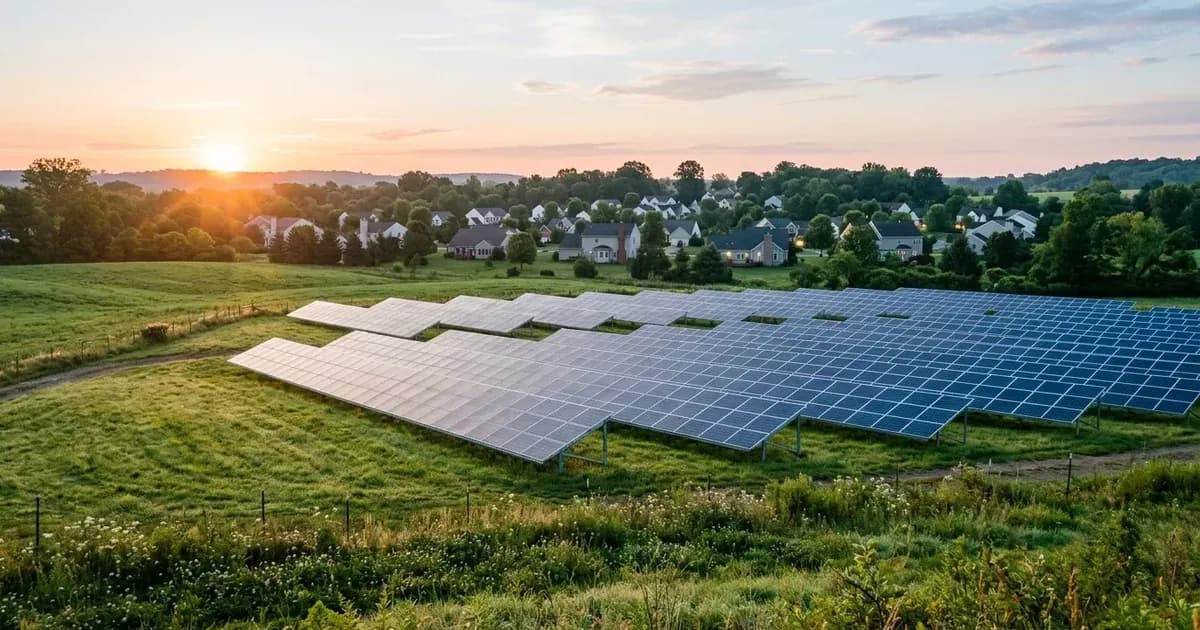
A developer builds a solar project — usually single-digit megawatts, enough for hundreds or thousands of households — somewhere in your utility's service territory. Its output goes onto the grid, not down a private wire to your house. There is no physical connection between that array and your outlets, and there doesn't need to be.
What connects you is accounting. You subscribe to a share, typically sized to cover roughly 80–100% of your historical usage. Each month the utility takes the project's metered production, multiplies your share by the applicable credit rate, and posts a credit line on your bill. You pay the subscription; you receive the credits; the difference is your savings.
That's the whole product. It's net metering restructured so that the panels don't have to be yours or be on your building.
Rooftop ownership | Community solar |
|---|---|
Large upfront cost or financing | Typically none |
You own a 25-year asset | You own nothing |
Savings compound for decades | Modest ongoing discount |
No property effect | |
Needs a suitable roof you control | Needs neither |
Moving is a complication | Moving may be, too — check the contract |
Program structures vary by state; a few offer ownership-style shares rather than subscriptions, with different economics.
Who it's genuinely for
Renters and apartment dwellers. The largest group locked out of rooftop solar entirely, and the reason community solar exists as policy rather than just as a product.
Shaded, north-facing, or structurally unsuitable roofs. Tree cover defeats more residential solar projects than latitude ever does, and orientation compromises only stretch so far.
Anyone blocked by an HOA or a landlord. Solar access rights help in some states, but not everyone wants the fight.
Homeowners near the end of their stay. If you'll move before a rooftop system would pay back, a cancellable subscription may fit better than an installation.
And people who simply don't want to own hardware. No roof penetrations, no maintenance schedule, no inverter to replace in year twelve. That's worth something.
What to read before you sign
The subscription agreement is the product. Four clauses carry it:
Exit terms. The single most important line. How much notice to cancel? Is there a fee? Some agreements are month-to-month; others run years with penalties. Ask specifically what happens when you move — within the utility territory and outside it.
The discount structure. Many programs offer a fixed percentage off the value of your credits. Others pass through a per-kWh rate that floats with the project's output and the utility's credit rate. Fixed is more predictable; floating can be better or worse.
Term length. Multi-year commitments are common. Match the term to how long you actually expect to stay.
Program-rule changes. State programs are being revised — Colorado's subscriber-organization credit rules change for arrangements on or after October 1, 2026, and it isn't the only state adjusting. A 2024 explainer may describe a program that no longer exists in that form.
The honest verdict
Community solar is a good product with modest ambitions. It will not transform your finances; a 5–15% discount on the electricity portion of a utility bill is real but small. It will not insulate you from rate increases the way an owned array does, and it builds no equity.
What it does is put solar within reach of the majority of American households that cannot put panels on a roof they control — which is a larger share of the country than the rooftop conversation usually admits. If you have a good roof, own your home, and can fund a system, ownership beats it on every long-run measure. If you don't, community solar is not a consolation prize. It's the version of this that was built for you, and the only thing standing between you and it is a contract worth reading twice.
Frequently asked questions
How does community solar work?
A developer builds a solar farm in your utility's territory and feeds its output to the grid. You subscribe to a share sized to your usage, and your utility posts a credit on your bill for your share of the project's production. You own no hardware.
How much do you save with community solar?
Typically a modest 5–15%, and many programs are structured as a fixed discount on the bill credits you receive. It's real money with no upfront cost, but it is not the savings profile of owning a rooftop system.
Who should use community solar?
Renters, apartment dwellers, people with shaded or north-facing roofs, anyone whose HOA or landlord makes rooftop solar impossible, and homeowners planning to move before a rooftop system would pay back.
What should I check before subscribing?
The exit terms above all — cancellation notice, fees, and what happens when you move. Then the credit rate and whether the discount is fixed or floating, and the subscription's term length.
References
- US EPA – Shared renewables and community solar — accessed 5 August 2026
- NYSERDA – How community solar works — accessed 5 August 2026
Related guides
More from schemes, subsidies & financing.