Solar Generators for Camping: The Realist's Setup
Updated 18 September 2026 · By SolarNevs Research Desk, Dealer surveys + verified sources · 1 source · Method ↗
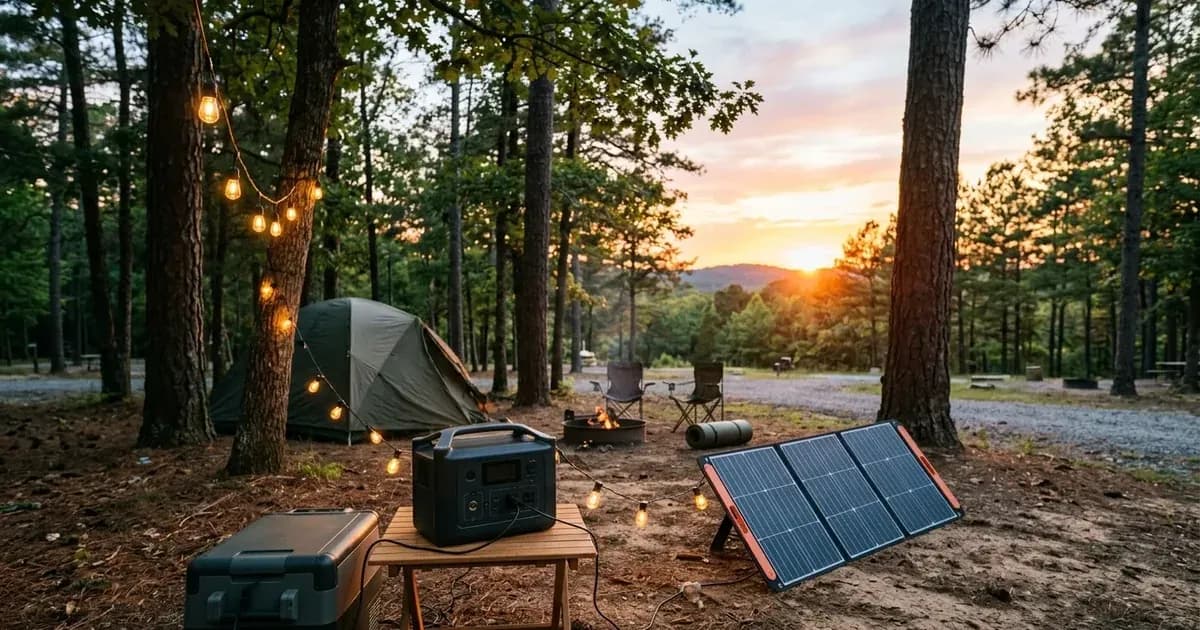
Key Takeaways
- Camp power is a watt-hour budget: devices cost little, the 12V fridge is the steady tax, and anything that makes heat is a splurge.
- The tiers map to trips: weekend = 250–500 Wh, fridge-and-CPAP camping = ~1,000 Wh + panel, basecamp = 2,000 Wh and a sore back.
- Panels earn their carry from day three: they turn a finite tank into a renewable one — the category's entire magic trick.
- Cook with fire, chill with electrons: the division of labor every experienced site converges on.
The campsite energy budget
Run the tank-and-tap math on a real weekend and the hierarchy jumps out. Cheap: phone charges and LED strings — tens of watt-hours, days of ambience per battery. The steady tax: a 12V compressor fridge, the tier-defining load — a few hundred watt-hours per warm day, the single best reason to move up a class. The splurges: induction burners, kettles, hair dryers — resistive heat drains hundreds of watt-hours per use, which is why the physics keeps repeating: electricity is precious at camp exactly where it's trivial at home. Propane makes coffee; the battery makes the fridge cold and the CPAP run — respect the division and everything lasts.
The three setups that cover everyone
Trip style | Kit | The experience |
|---|---|---|
Weekend, devices + lights | 250–500 Wh, charged at home | Never think about power |
The fridge-camper, 3+ days | ~1,000 Wh + 100–200 W folding panel | Morning re-aim ritual; endless cold drinks |
Basecamp / group / CPAP-critical | 2,000 Wh + 200 W panel | Wall-battery money on wheels — be sure |
Tiers per the sizing guide's method; the fridge decision is the fork.
The panel's arithmetic: a 100 W folder realistically delivers a meaningful fraction of its label across a camp day — enough to replace a fridge's daily draw in decent sun, which converts "three days of battery" into "as long as the weather holds." That's the entire reason to carry glass to a campsite, and from day three onward it's a winning trade.
Field craft that outperforms hardware
Chase the sun hourly — a re-aimed panel out-harvests a bigger ignored one; the kickstand is the spec that matters. Charge during drives — car ports refill meaningfully on travel days between sites. Pre-chill everything — a fridge full of cold food at departure halves day-one draw. Shade the station — lithium dislikes heat at camp as much as on walls; under the table beats on it. Know the bail-out — every developed campground's electrical pedestal is a guilt-free full recharge when the forecast betrays you.
The realist's summary: a mid-size station, one folding panel, propane for heat, and a budget mindset delivers the actual promise — cold food, lit tents, charged devices, silence — indefinitely. The failed campsites bought watts for a fantasy kitchen; the happy ones budgeted watt-hours for the jobs only electricity does.
Frequently asked questions
What size solar generator do I need for camping?
Weekend device-charging lives happily on 250–500 Wh. Add a 12V fridge and CPAP nights and you want the 1,000 Wh class with a panel. Basecamp living with induction cooking pushes 2,000 Wh+ — at which point weight becomes the constraint.
Do I need solar panels with my camping power station?
For one or two nights, no — charge at home. For three-plus days or fridge duty, a 100–200 W folding panel converts the finite battery into a renewable one, which is the whole trick.
Can I cook with a solar generator?
Physics says barely: induction and kettles drain hundreds of watt-hours per meal — a battery's whole day for dinner. Camp stoves burn fuel for a reason; save the battery for what only electricity does.
How do I make a power station last a whole trip?
Budget it like water: lights and phones are cheap, the fridge is the steady tax, anything that makes heat is a splurge. Re-aim the panel every couple of hours and recharge during drives.
References
- EIA – Measuring electricity (Wh budgeting) — accessed 5 August 2026
Related guides
More from schemes, subsidies & financing.