Commercial Solar Microgrid And Generator Synchronization Guide South Africa
Updated 16 September 2026 · By SolarNevs Research Desk, Dealer surveys + verified sources · 1 source · Method ↗
Key Takeaways
- Commercial solar microgrids in South Africa combine solar PV, battery storage, and diesel generators to ensure reliable power.
- All such installations require formal certification, including a SANS 10142-1-2 Certificate of Compliance (CoC).
- Specific technical protocols, such as frequency-watt curtailment and minimum generator base-load rules, are critical for stable operation.
- Verifying generator governor response times is essential to prevent system instability, particularly during variable solar conditions.
Understanding Solar-Diesel Microgrid Synchronization in South Africa
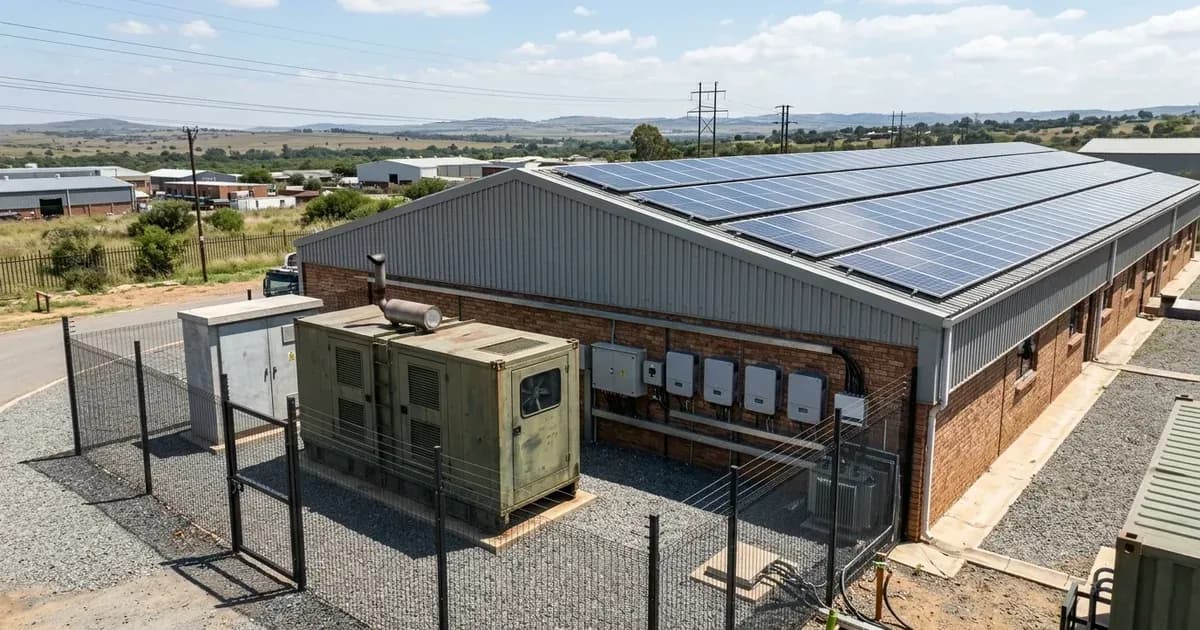
Commercial solar microgrids in South Africa integrate solar photovoltaic (PV) systems with battery energy storage and diesel generators. This combination provides a resilient power supply, reducing reliance on the national grid and offering backup during outages. Effective synchronization ensures a seamless transition between power sources and stable operation.
The regulatory framework for these systems in South Africa includes NERSA Licensing Exemptions, as outlined in Schedule 2 of the Electricity Regulation Act. Technical standards such as NRS 097-2-3, SANS 10142-1-2, and IEC 62109-1/2 govern the design, installation, and safety of these hybrid systems.
The Mechanism of Hybrid Power Integration
Integrating solar PV with a diesel generator requires careful engineering to ensure system stability and efficiency. When solar power is abundant, it can reduce the load on the diesel generator or even shut it down, saving fuel. When solar generation drops, the diesel generator must seamlessly take over the load.
Key aspects of this integration include:
- Frequency-Watt Curtailment: This mechanism automatically reduces solar inverter output when grid frequency rises, preventing over-frequency conditions that can destabilise the microgrid.
- Minimum Generator Base-Load Rule: Diesel generators often require a minimum operating load to run efficiently and prevent damage. The solar system must be managed to ensure the generator always operates above this threshold when active.
- Automatic Transfer Switch (ATS): An ATS is a critical component that manages the connection between different power sources (grid, solar, generator) and the load. It ensures that only one source is connected at a time, preventing back-feeding and protecting equipment.
- Anti-Islanding Protection: Inverters must have anti-islanding protection to disconnect from the grid if the main power supply fails, preventing dangerous situations for utility workers.
Essential Certifications and Compliance
For commercial solar microgrid installations in South Africa, adherence to specific certifications and regulations is mandatory. These ensure safety, reliability, and compliance with national standards.
Parameter | Verbatim Microgrid Standard / Engineering Rule | What it means for you |
|---|---|---|
SANS -- CoC Certification | "The entire hybrid generating installation must be certified with a formal SANS 10142-1-2 CoC." | Your complete solar-diesel microgrid must have a Certificate of Compliance. |
CoC for Grid-Tied PV | "A registered Master Installation Electrician must issue a supplemental SANS 10142-1-2 CoC." | A qualified electrician must provide an additional CoC for the grid-tied solar PV part of your system. |
Inverter Approval | "Embedded generation inverters must be certified to NRS 097-2-1 and listed on the approved equipment register." | Ensure your inverters meet the NRS 097-2-1 standard and are on the approved list for South Africa. |
Zero Export to Grid Compliance | "Zero-export installations must incorporate a certified reverse power relay that blocks unauthorized feed-in." | If your system is designed not to export power, it must have a relay to prevent electricity flowing back to the grid. |
AC Isolation Switch | "A lockable double-pole AC isolation switch must be positioned near the consumer distribution board." | A safety switch must be installed close to your main electrical panel for emergency power cut-off. |
Surge Protection | "Class I and Class II surge arresters must protect all DC string inputs and main AC distribution panels." | Your system needs surge protection devices on both the DC (solar panel) and AC (main power) sides to guard against lightning and power surges. |
Neutral-Earth Bonding | "The installation must include automatic neutral-earth bonding relays during off-grid islanding operation." | When operating off-grid, your system must automatically bond the neutral and earth connections for safety. |
Registration and Approval | "All grid-tied and hybrid solar PV installations must be officially registered and approved by City Power." | Your installation needs formal registration and approval from the local power authority. |
Tax Depreciation | "Commercial and agricultural solar energy investments qualify for accelerated 100% tax depreciation." | Investing in commercial or agricultural solar can offer significant tax benefits. This is general information, not tax advice; consult a tax professional. |
What you can check yourself, and what you cannot
As a system owner, you can perform visual inspections and monitor system performance. You can check that all visible components are intact, and that monitoring systems are reporting correctly. You can also ensure that emergency stop buttons are accessible and clearly marked.
However, any work involving electrical connections, inverter settings, or internal components of the microgrid system must be performed by a qualified and accredited professional. Changing inverter settings, especially those related to grid protection or synchronization, can breach connection agreements and create hazardous conditions. Only a registered Master Installation Electrician or a professional engineer with ECSA sign-off should undertake such tasks. Always isolate power at all sources (PV, battery, AC grid, generator) before any inspection or maintenance that requires opening enclosures, and wait for capacitor discharge times as specified in equipment manuals.
What the published sources do not tell you
The provided official documentation outlines critical regulatory and certification requirements for commercial solar microgrids in South Africa. However, it does not provide specific numerical values or detailed engineering protocols for several key operational parameters.
Specifically, published guidance does not detail:
- The exact percentage for the "Minimum Generator Base-Load Rule" that diesel generators require for stable and efficient operation in a solar-diesel microgrid.
- Specific thresholds or curves for "Solar Inverter Frequency-Watt Curtailment" that dictate how inverters should reduce output in response to frequency changes.
- Detailed specifications or response times for generator governors that are crucial for preventing "hunting" during rapid solar cloud transient events.
- The specific requirements for "Battery C-Rate and Thermal Management" beyond general mention.
- Detailed procedures for "Fuel Optimization and Carbon Offset" strategies.
These operational specifics are typically found in detailed engineering studies, equipment manuals, or specific grid connection agreements, which can vary by site and equipment. It is crucial to consult with a qualified professional engineer for the design and implementation of these specific parameters to ensure system stability and compliance.
Frequently asked questions
What are the primary technical requirements for commercial solar microgrid and generator synchronization guide south africa?
Key requirements include compliance with local grid codes, correct equipment certification, and proper electrical isolation.
Who is authorized to install and inspect commercial solar microgrid and generator synchronization guide south africa?
All high-voltage DC, AC grid tie-in, and switchboard modifications must be performed by a qualified, accredited electrical professional.
How is export power limited in commercial solar microgrid and generator synchronization guide south africa?
Export limiting is achieved using certified bidirectional smart meters or power sensors providing dynamic feedback to the inverter system.
References
- Eskom Distribution: Small-Scale Embedded Generators (SSEG) registration and connection requirements — accessed 15 September 2026
Related guides
More from inverter errors & fixes.