South Africa Commercial Rooftop Solar Building Compliance Guide
Updated 16 September 2026 · By SolarNevs Research Desk, Dealer surveys + verified sources · 2 sources · Method ↗
Key Takeaways
- Commercial rooftop solar installations in South Africa are subject to mandatory building and electrical compliance standards.
- Structural integrity (SANS 10400-L) and fire safety (SANS 10400-T) are critical design considerations.
- A registered Master Installation Electrician must sign off on a Certificate of Compliance (CoC) for the electrical work.
- Always confirm specific requirements with your local municipality, even when national standards apply.
Understanding Commercial Rooftop Solar Compliance in South Africa
Commercial rooftop solar installations in South Africa must adhere to specific building and electrical standards to ensure safety, structural integrity, and grid stability. These guidelines, exemplified by those from the City of Cape Town, cover structural integrity, fire safety, electrical installation, and inverter type testing. While these specific guidelines are published by the City of Cape Town, they state their applicability across all South African municipalities for commercial, industrial, and agricultural buildings. However, always confirm local requirements with your specific municipality.
The Regulatory Framework for Commercial Solar
The South African Bureau of Standards (SABS) is the standard-setting body responsible for national standards. For commercial rooftop solar, several key standards apply:
- SANS 10400 (Building Regulations, Part L & Part T): This standard governs the structural integrity of buildings and fire safety. Part L addresses structural loading, ensuring that the roof can safely support the additional weight of a solar installation. Part T deals with fire safety, requiring clear access for emergency services and appropriate setbacks.
- SANS 10142-1-2 (Specific requirements for embedded generation): This electrical standard dictates the safe and compliant installation of embedded generation systems, including cabling, switchgear, and interconnection points.
- NRS 097-2-1: This standard specifies the requirements for grid-tied inverters, ensuring they are type-tested and certified to safely interact with the national electricity grid.
Adherence to these standards is not optional; it is a legal requirement for all commercial, industrial, and agricultural solar installations in South Africa.
Key Compliance Requirements for Commercial Rooftop Solar
The following table outlines the essential compliance requirements for commercial rooftop solar installations, based on guidelines from the City of Cape Town.
Requirement | Standard / Rule | What it means for you |
|---|---|---|
Structural Roof Loading | "Commercial roof structures must undergo structural loading calculations by a registered structural engineer prior to installation." | Before installing solar panels, a registered structural engineer must assess your building's roof to ensure it can safely bear the weight of the solar system. |
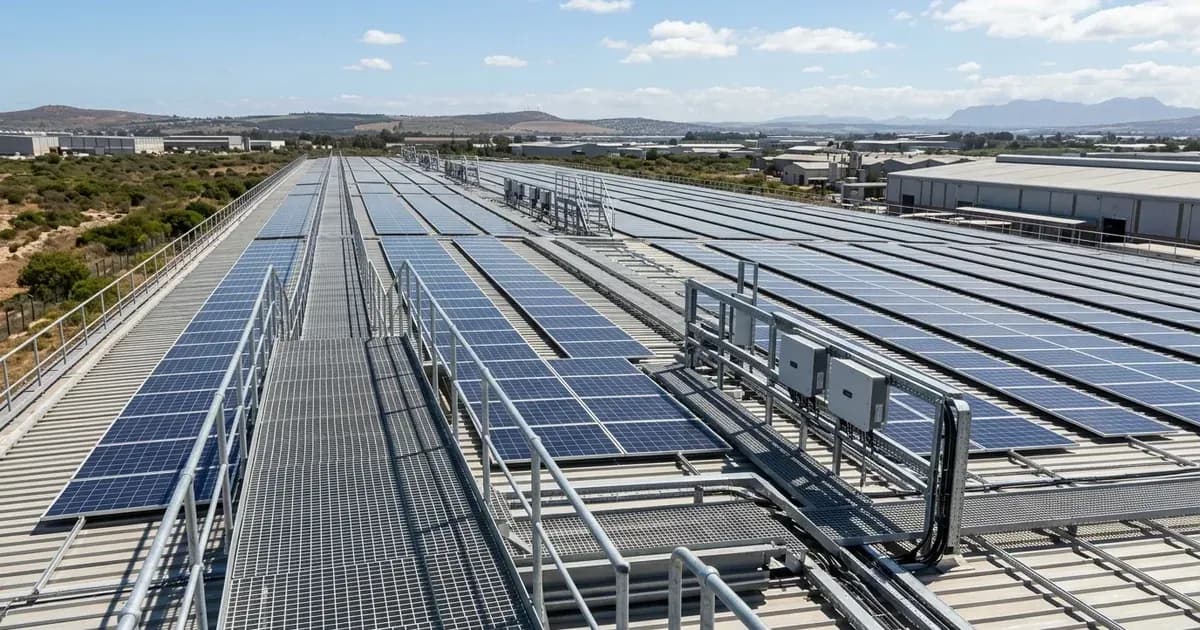
Fire Safety Corridors | "Commercial rooftop layouts must incorporate designated fire access walkways and perimeter setbacks for emergency responders." | Your rooftop solar layout must include clear pathways and open areas around the perimeter to allow fire services safe access in an emergency. |
Electrical Installation | "All physical interconnection, cabling, and switchgear must comply with SANS 10142-1-2 embedded generation standards." | All electrical components, wiring, and connections must meet the specific safety and performance requirements for embedded generation systems as outlined in SANS 10142-1-2. |
CoC Sign-Off | "A registered Master Installation Electrician must test, verify, and sign the official Certificate of Compliance." | The entire electrical installation must be inspected, tested, and certified by a qualified Master Installation Electrician, who will issue a Certificate of Compliance (CoC). |
Inverter Type Testing | "Inverters must possess accredited laboratory test certificates demonstrating compliance with NRS 097-2-1 standards." | Your chosen inverters must have official certification from an accredited laboratory confirming they meet the NRS 097-2-1 standards for grid interconnection. |
Reverse Power Blocking | "Non-exporting commercial installations must incorporate a certified reverse power protection relay to prevent unmetered feed-in." | If your system is designed not to feed excess power back to the grid, it must include a certified device to prevent any unmetered electricity export. |
Warning Safety Signage | "Affix permanent statutory warning labels at all electrical distribution boards, meters, and isolation switches." | Clear, permanent warning labels must be placed at all critical electrical points, such as distribution boards, meters, and isolation switches, to alert personnel to the presence of solar power. |
Permission to Install (PTI) | "Commercial building owners must obtain formal municipal Permission to Install before commencing installation." | You must secure formal written permission from your local municipality before starting any solar installation work on a commercial building. |
Safe Electrical Lockout | "Follow standard occupational health and safety electrical lockout procedures during switchboard modifications." | Any work involving modifications to electrical switchboards requires strict adherence to occupational health and safety electrical lockout procedures to prevent accidental energisation. |
Professional Certification and Safety Practices
Installing commercial rooftop solar is not a do-it-yourself task. Several aspects require the involvement of registered professionals:
- Structural Engineering: The structural loading calculations for your roof must be performed by a registered structural engineer. This ensures the safety and long-term integrity of your building.
- Electrical Work and CoC: All electrical installation work, including physical interconnection, cabling, and switchgear, must be carried out by qualified electricians. Crucially, a registered Master Installation Electrician must test, verify, and sign the official Certificate of Compliance (CoC). This CoC is a legal document confirming that the installation meets all relevant safety and technical standards.
- Safe Electrical Lockout: During any work on electrical switchboards, especially modifications, it is mandatory to follow standard occupational health and safety electrical lockout procedures. This involves isolating power sources and locking them out to prevent accidental re-energisation, protecting workers from electrical hazards.
You, as the building owner or project manager, are responsible for ensuring that these professionals are engaged and that all required certifications and safety practices are followed.
What the Published Sources Do Not Tell You
While the provided guidelines cover many critical aspects of commercial rooftop solar compliance, there are areas not explicitly detailed:
- Local Municipal Variations: Although the City of Cape Town's guidelines state they apply "across all municipalities in South Africa" for commercial, industrial, and agricultural buildings, specific municipal bylaws or interpretations can vary. It is always prudent to verify requirements directly with your local municipality's planning and electrical departments.
- Heritage Buildings and Special Zones: Official scheme guidelines notes that heritage buildings or those in special planning zones may require additional architectural approvals from the municipal planning department. These specific requirements are not detailed.
- Detailed Technical Specifications: The guidelines mandate compliance with SANS 10400-L, SANS 10400-T, and SANS 10142-1-2, but they do not provide the specific engineering calculations for structural loading, the exact dimensions for fire access corridors, or the comprehensive technical specifications within these standards. These details are found within the full SANS documents, which are typically paywalled by the SABS.
- Accredited Inverter Lists: While NRS 097-2-1 compliance is required for inverters, official scheme guidelines does not provide a list of accredited or type-tested inverters. You would need to consult other sources, often from Eskom or specific municipalities, for such lists.
Frequently asked questions
What are the key building standards for commercial rooftop solar in South Africa?
Commercial rooftop solar installations must comply with SANS 10400-L for structural loading and SANS 10400-T for fire safety, ensuring the roof can support the installation and emergency access is maintained.
Which electrical standard applies to commercial embedded generation in South Africa?
All physical interconnection, cabling, and switchgear for commercial embedded generation must comply with SANS 10142-1-2, the specific standard for embedded generation installations.
Is a Certificate of Compliance (CoC) required for commercial solar installations?
Yes, a registered Master Installation Electrician must test, verify, and sign the official Certificate of Compliance for the commercial solar installation.
Do inverters for commercial solar need specific certification in South Africa?
Inverters used in commercial installations must possess accredited laboratory test certificates demonstrating compliance with NRS 097-2-1 standards for grid interconnection.
What is reverse power blocking and when is it required?
Reverse power blocking is a certified protection relay required for non-exporting commercial installations to prevent unmetered feed-in of electricity back into the grid.
References
- City of Cape Town - Authorisation and Requirements to Install a Small-Scale Embedded Generation (SSEG) System — accessed 27 August 2026
- SABS SANS 10400 and SANS 10142-1-2 Standards — accessed 27 August 2026
Related guides
More from inverter errors & fixes.