Farm Microgrid And Solar Pump Synchronization Guide South Africa
Updated 16 September 2026 · By SolarNevs Research Desk, Dealer surveys + verified sources · 1 source · Method ↗
Key Takeaways
- South African off-grid farm microgrids must comply with SANS 10142-1-2 and NERSA Off-Grid Registration Rules.
- All agricultural solar pumping installations require a valid Certificate of Compliance signed by an electrician.
- Inverter surge ratings must be carefully matched to motor locked-rotor amperage (LRA) for loads like pumps and cold storage.
- Commercial and agricultural solar energy investments qualify for accelerated 100% tax depreciation.
Establishing an Off-Grid Farm Microgrid in South Africa
Establishing an off-grid farm microgrid in South Africa requires adherence to specific technical standards and regulatory frameworks. These systems are designed for off-grid farm homesteads, cold storage, automated livestock feeding, and borehole pump synchronization. The primary technical standards governing these installations include SANS 10142-1-2, NRS 097-2-1, and IEC 60364-7-712. Additionally, all such installations must comply with the NERSA Off-Grid Registration Rules.
An off-grid farm microgrid provides energy independence and reliability, crucial for agricultural operations that may be distant from the national grid or require consistent power for critical loads. These systems often integrate solar PV with battery storage and may include backup generators.
Compliance and Certification for Farm Solar Installations
All solar installations on South African farms, particularly off-grid microgrids and pumping systems, must meet stringent compliance and certification requirements. This ensures safety, reliability, and adherence to national electrical standards.
System Component / Scope | Applicable Standard / Rule | Mandatory Certification Requirement |
|---|---|---|
Farm Microgrid & Hybrid System | SANS 10142-1-2 | Formal supplemental CoC issued by a Master Installation Electrician |
Embedded Generation Inverter | NRS 097-2-1 | Certified unit listed on the approved equipment register |
Agricultural Solar Pumping | SANS 10142-1-2 | Valid Certificate of Compliance signed by an accredited electrician |
Off-Grid Regulatory Standing | NERSA Registration Rules | Mandatory compliance for off-grid farm generation |
Surge & Earthing Protection | SANS 10142-1-2 / IEC 60364-7-712 | Class I/II SPDs and automatic neutral-earth bonding relays |
The farm microgrid must be inspected and certified under SANS 10142-1-2 by an accredited electrician. This certification process confirms that the entire installation meets the required safety and performance benchmarks. A registered Master Installation Electrician must issue a supplemental SANS 10142-1-2 CoC (Certificate of Compliance) for the system.
Inverters used in these systems are also subject to specific certification. Embedded generation inverters must be certified to NRS 097-2-1 and listed on the approved equipment register. This ensures that the inverter technology is suitable for the South African electrical environment and can safely integrate with the farm's electrical infrastructure. Furthermore, all agricultural solar pumping installations require a valid Certificate of Compliance signed by an electrician.
Essential Safety and Electrical Standards
Safety is paramount in any electrical installation, especially in off-grid farm environments where reliable power is critical and potential hazards exist. South African standards mandate several key safety features for farm microgrids.
The installation must include automatic neutral-earth bonding relays during off-grid islanding operation. This mechanism is crucial for maintaining safety when the microgrid operates independently from the main grid, ensuring proper earthing and fault protection. A lockable double-pole AC isolation switch must be positioned near the consumer distribution board. This provides a clear and safe means to isolate the entire AC supply for maintenance or emergencies.
To protect equipment and personnel from electrical surges, Class I and Class II surge arresters must protect all DC string inputs and main AC distribution panels. These devices divert excess voltage from lightning strikes or other transients, preventing damage to sensitive electronics. The entire hybrid generating installation must be certified with a formal SANS 10142-1-2 CoC. This comprehensive certification covers all aspects of the system, from generation to distribution, ensuring it meets national safety standards.
Solar Pumping and Motor Load Considerations
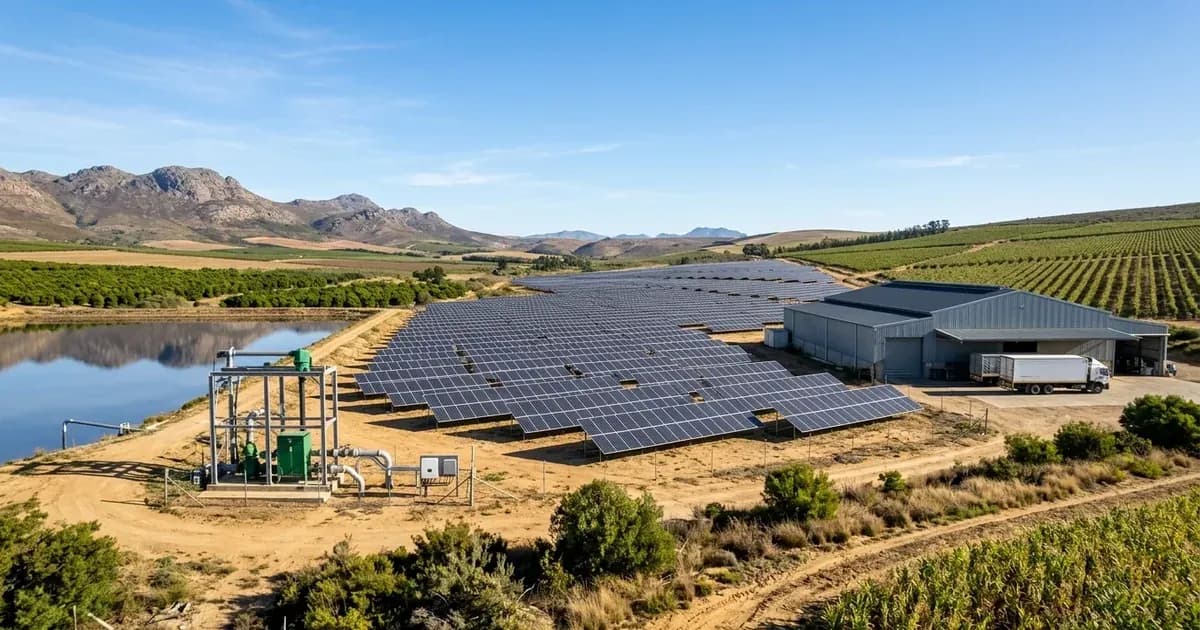
Solar pumping is a common application for off-grid solar on farms, providing water for irrigation, livestock, and domestic use. One specific type is direct-drive solar pumping, which operates without batteries, storing energy directly as pressurized water in reservoirs. This method simplifies the system by eliminating battery storage, but requires careful sizing of the solar array to match pump demand.
When integrating motor loads such as pumps or cold storage compressors into a farm microgrid, it is critical to verify motor nameplate locked-rotor amperage (LRA) to verify inverter surge rating sufficiency. Motors draw a significantly higher current during startup (LRA) than during continuous operation. If the inverter's surge capacity is insufficient, it will trip or fail when attempting to start these motors, leading to system instability or damage. Careful matching of the inverter's capabilities to the motor's LRA is essential for reliable operation.
Financial Incentives for Agricultural Solar
Investing in solar energy for agricultural operations in South Africa offers significant financial benefits beyond energy savings. Commercial and agricultural solar energy investments qualify for accelerated 100% tax depreciation. This incentive allows businesses and farms to deduct the full cost of their solar energy assets from their taxable income within a shorter period, significantly reducing the upfront financial burden and improving the return on investment for solar projects. This tax benefit encourages the adoption of renewable energy solutions in the agricultural sector, supporting both economic growth and environmental sustainability.
What the Published Sources Do Not Tell You
While official documentation outlines key regulations and general requirements, it does not provide specific details on the application process for NERSA Off-Grid Registration Rules. These processes often involve detailed documentation and specific forms that vary over time. Similarly, published guidance does not detail the specific surge rating requirements for various types of farm motors (e.g., different pump types, cold storage compressors) or how to calculate the exact inverter capacity needed for diverse motor loads. This requires consulting motor nameplate data and inverter specifications. The document also does not provide specific guidance on the design and sizing of direct-drive solar pumping systems, which depends on factors like water head, flow rate, and solar irradiance.
Frequently asked questions
What are the primary technical requirements for farm microgrid and solar pump synchronization guide south africa?
Key requirements include compliance with local grid codes, correct equipment certification, and proper electrical isolation.
Who is authorized to install and inspect farm microgrid and solar pump synchronization guide south africa?
All high-voltage DC, AC grid tie-in, and switchboard modifications must be performed by a qualified, accredited electrical professional.
How is export power limited in farm microgrid and solar pump synchronization guide south africa?
Export limiting is achieved using certified bidirectional smart meters or power sensors providing dynamic feedback to the inverter system.
References
- Eskom Distribution: Small-Scale Embedded Generators (SSEG) registration and connection requirements — accessed 15 September 2026
Related guides
More from inverter errors & fixes.