Stop Sunsynk Battery Charging Your EV
Updated 16 September 2026 · By SolarNevs Research Desk, Dealer surveys + verified sources · 1 source · Method ↗
Key Takeaways
- Your Sunsynk inverter treats EV charging as a normal household load, leading to your home battery discharging into your electric vehicle.
- You can prevent this by adjusting your inverter's time of use settings to set a 100% battery target State of Charge (SOC) during EV charging periods.
- A wiring modification, involving a Henley block to 'hide' the EV charger from the inverter's current transformer (CT), is another method, but this is specific to UK electrical standards. (Sunsynk's British terms: a Henley block is a connector or splitter block here, and a consumer unit is a distribution board.)
- While inverter settings can be adjusted by the owner, any electrical wiring changes must be carried out by a registered person and require a Certificate of Compliance (CoC).
Why your Sunsynk system discharges to your EV charger
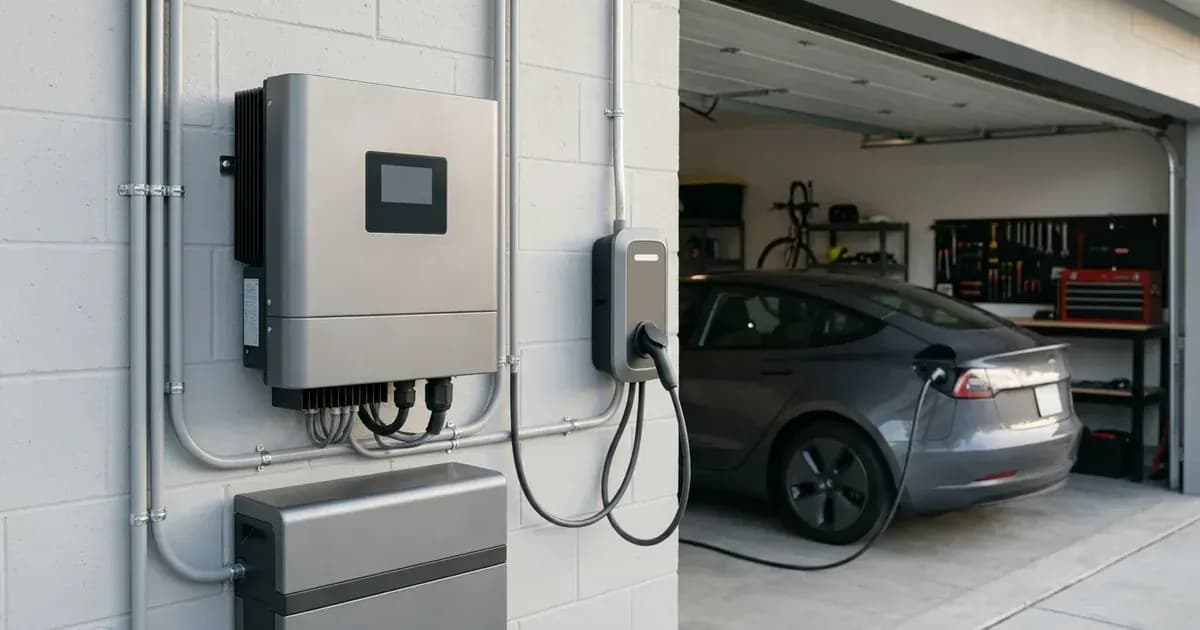
When you connect an electric vehicle (EV) charger to your home's electrical system, your Sunsynk inverter views the energy drawn by the charger as an ordinary household load. This means that if your home battery has available charge, the inverter will use that stored energy to power the EV charger. Sunsynk describes this behaviour as "the Sunsynk system will see this charge as a load and discharge your storage batteries to support this, essentially using one battery to charge another." This can deplete your home battery, leaving less power available for your household during times like load-shedding.
Comparison Parameter | Method 1: Inverter TOU Settings | Method 2: Supply Splitting (Sub-DB) |
|---|---|---|
Implementation Type | Software / inverter display & app | Physical AC wiring reconfiguration |
Mechanism | Set target SOC to 100% or set charge window during EV charging | Split meter live tails upstream of CT clamp to dedicated sub-DB |
Household Impact | Stops battery discharge to EV and all property loads | Home battery continues powering house; only EV load is hidden |
Who Can Perform | Homeowner / System Owner | Registered Electrician only |
Compliance Needs | User settings modification | Updated Certificate of Compliance (CoC) required |
Regional Status | Applicable globally | Based on UK guidance; requires local SA standards compliance |
Method 1: Adjusting inverter settings to prevent discharge
The first method to prevent your Sunsynk battery from discharging to your EV charger involves adjusting your inverter's time of use settings. This is a software-based solution that you can typically manage through your inverter's display or monitoring application.
To implement this, you need to "set the battery target SOC to 100%, or you can set the battery to charge in this window" during the specific hours you plan to charge your EV. By setting the target State of Charge (SOC) to 100%, you instruct the inverter to maintain the battery at full capacity, preventing it from discharging to any loads during that period. Alternatively, defining a charge window for the battery during EV charging hours will also prevent discharge.
It is important to note that this method "stops discharge to EV charger but also to other property loads" during the specified time. This means that while your EV charges, other appliances in your home will draw power directly from the grid or solar PV, rather than from your battery.
For detailed instructions on configuring time of use settings and battery SOC targets, refer to our guide on Sunsynk system mode and timer settings.
Method 2: Reconfiguring your electrical wiring (UK guidance)
A second, more involved method focuses on physically altering your electrical installation to prevent the inverter from 'seeing' the EV charger as a load. Sunsynk provides guidance on this, but it is explicitly stated as "UK-ONLY" and may not align with South African electrical regulations or common practice.
This method involves "Splitting the live tails coming from your meter using a Henley block and connecting the EV charger to its own sub-consumer unit." Sunsynk writes for a British audience here: a Henley block is what a South African electrician calls a connector or splitter block, and a consumer unit is a distribution board. The purpose of this wiring change is to position the inverter's current transformer (CT) in such a way that "the EV charger is ‘hidden’ from the Sunsynk inverter and is no longer seen as a property load." This effectively bypasses the inverter's monitoring for the EV charger, ensuring that the home battery is not used to power it.
Given that this is UK-specific guidance, it is crucial to consult with a qualified and registered electrician in South Africa before considering any such wiring modifications. South African electrical installations must comply with NRS 097-2-1 and other local standards, which may differ significantly from UK regulations.
What you can change yourself, and what you cannot
Understanding the distinction between owner-adjustable settings and work requiring a registered professional is vital for safety and compliance.
What you can change yourself: Adjustments to your Sunsynk inverter's "time of use settings" and "battery target SOC" fall into the category of owner-facing settings. These changes are made through the inverter's user interface or monitoring app and do not involve physical alterations to your electrical system. They are generally safe for homeowners to modify to suit their energy consumption patterns.
What you cannot change yourself: Any physical modification to your home's electrical wiring, such as "Splitting the live tails coming from your meter using a Henley block and connecting the EV charger to its own sub-consumer unit," must be performed by a registered person. In South Africa, such work requires a qualified electrician to ensure compliance with national electrical standards and to issue an updated Certificate of Compliance (CoC). Attempting these changes yourself is dangerous and can void warranties, lead to electrical hazards, or result in fines. (Sunsynk's British terms: a Henley block is a connector or splitter block here, and a consumer unit is a distribution board.)
What the published sources do not tell you
While Sunsynk provides clear methods for managing EV charging, there are some limitations in the available documentation for a South African context.
The detailed wiring modification involving a "Henley block" is explicitly labelled as "UK-ONLY" guidance. The sources do not provide an equivalent wiring solution or specific South African electrical standards (like NRS 097-2-1) that would apply to 'hiding' an EV charger load from an inverter's CT clamp in South Africa. Therefore, while the principle of isolating the EV charger from the inverter's measurement is sound, the specific implementation details for a South African installation are not covered by Sunsynk's global support documents.
Additionally, the documentation refers to "time of use settings" and "battery target SOC" without providing exact menu paths or program numbers, as these can vary by firmware version and inverter model. Users may need to consult their specific inverter manual or the Sunsynk monitoring app interface to locate these settings.
Frequently asked questions
Why does my Sunsynk inverter discharge my home battery to charge my EV?
Your Sunsynk system treats EV charging as a standard household load. This means it will use available power from your home battery to support the EV charger, effectively using one battery to charge another.
How can I stop my Sunsynk battery from charging my EV using inverter settings?
You can set the battery target State of Charge (SOC) to 100% during the period you intend to charge your EV. Alternatively, you can configure a specific charge window within the time of use settings. This prevents the battery from discharging to any property loads, including the EV charger.
Is there a wiring solution to prevent my Sunsynk battery from charging my EV?
Sunsynk's UK guidance suggests splitting the live tails from your meter using a Henley block and connecting the EV charger to its own sub-consumer unit. This allows the inverter's CT clamp to 'hide' the EV charger load, preventing the inverter from seeing it as a property load. This method is UK-specific and may not apply in South Africa. (Sunsynk's British terms: a Henley block is a connector or splitter block here, and a consumer unit is a distribution board.)
Can I change these settings myself?
Adjusting inverter settings like battery target SOC or time of use windows is typically an owner-facing task. However, any changes to your electrical wiring, such as installing a Henley block or sub-consumer unit, must be performed by a registered person and require an updated Certificate of Compliance (CoC). (Sunsynk's British terms: a Henley block is a connector or splitter block here, and a consumer unit is a distribution board.)
Will preventing battery discharge to my EV affect other household loads?
Yes, if you use the inverter settings method (setting target SOC to 100% or a charge window), the battery will stop discharging to all property loads during that period, not just the EV charger. This ensures the battery retains its charge for other uses, such as during load-shedding.
References
- Sunsynk Support: How to stop batteries from discharging to an EV charger — accessed 27 August 2026
Related guides
More from inverter errors & fixes.