Victron Phoenix Smart IP43 Charger: Setup & Wiring
Updated 16 September 2026 · By SolarNevs Research Desk, Dealer surveys + verified sources · 1 source · Method ↗
Key Takeaways
- The Phoenix Smart IP43 Charger line offers adaptive multi-bank charging for marine, RV, and commercial DC power systems.
- Operates on universal utility and generator power: Nominal input voltage - AC supply 120 - 240VAC and Input voltage range - AC supply 85 - 250VAC (full power from 100VAC, startup from 90VAC) across Input frequency - AC supply 45 - 65Hz.
- Supports high-voltage DC generator systems with an Input voltage - DC supply 90 - 375 VDC rating.
- Maximizes electrical efficiency with active power factor correction: Power factor >0.99.
- Implements an intelligent charging process: Charge algorithm 6-stage adaptive (3 stage for Li-ion).
- Provides dedicated starter battery maintenance: Max output current - Starter battery 4A (1+1 output models only).
- Eliminates parasitic battery drain with Back drain current <1mA.
- Offers seamless monitoring and control: Data communication VE.Direct and Bluetooth (via VictronConnect app).
- Integrates dry-contact alarm automation: Programmable relay Yes (SPDT - 5A up to 250VAC / 5A up to 28VDC).
- Engineered with dual-zone protection: Protection category Electronic components: IP43 | Connection area: IP22 across Operating temperature -20 to +60°C (0 - 140°F) Full rated output up to 40°C.
AC Power Architecture & Multi-Bank DC Outputs
The Phoenix Smart IP43 Charger is designed for marine craft and specialized mobile machinery requiring reliable multi-output charging. Its dual-zone casing isolates sensitive power electronics (IP43) from the lower terminal connection compartment (IP22).
The Victron Phoenix Smart IP43 Charger accepts universal 85–250 VAC (45–65Hz) and 90–375 VDC input (>0.99 power factor), utilizing a dual-zone housing with an IP43 electronics compartment and IP22 terminal strip:
- Main Battery Output: 12V (30A/50A), 24V (16A/25A), 6-Stage Adaptive Charging, Full Power to 40°C.
- Starter Trickle: 4A Auxiliary Output, Isolated Diode, 1+1 Models Only, <1mA Back Drain.
- Comms & Relays: Bluetooth BLE, VE.Direct Port, SPDT 5A Relay, Remote On/Off.
Installation & Wiring Best Practices
- Universal Mains Input: Connect AC power to the AC mains inlet. The unit handles Nominal input voltage - AC supply 120 - 240VAC and accommodates extreme voltage drops down to Input voltage range - AC supply 85 - 250VAC (full power from 100VAC, startup from 90VAC) across Input frequency - AC supply 45 - 65Hz.
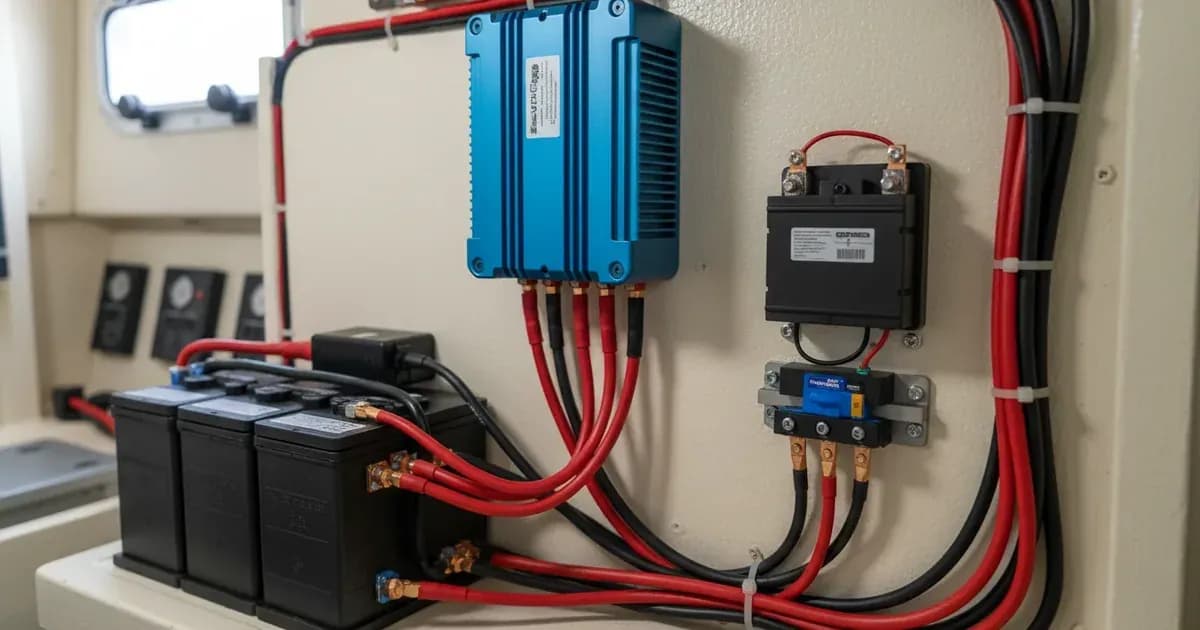
- Service Bank Connection: Wire primary DC positive cables to the main output terminals, sizing conductors for full rated current.
- Engine Starter Auxiliary: Connect the engine starting battery to the isolated trickle terminal (Max output current - Starter battery 4A (1+1 output models only)), keeping starting batteries charged without discharging into the house bank.
Bluetooth Configuration & Relay Automation
The Phoenix Smart IP43 Charger combines local wireless intelligence with hardware automation:
- VictronConnect Integration: Using **Data communication VE.Direct and Bluetooth (via VictronConnect app)**, technicians can adjust charge voltages, select battery chemistries, or activate low-current charging modes.
- Adaptive 6-Stage Algorithm: The Charge algorithm 6-stage adaptive (3 stage for Li-ion) algorithm cycles through bulk, absorption, recondition, float, storage, and refresh phases to maximize battery health.
- Ultra-Low Standby Drain: Disconnecting AC power leaves the charger in an ultra-low quiescent state with Back drain current <1mA.
- Programmable SPDT Relay: The built-in Programmable relay Yes (SPDT - 5A up to 250VAC / 5A up to 28VDC) can be configured to trigger remote visual alarms, audible horns, or generator auto-start contacts.
- Thermal Resilience: Designed to deliver full rated charging across Operating temperature -20 to +60°C (0 - 140°F) Full rated output up to 40°C within its Protection category Electronic components: IP43 | Connection area: IP22 enclosure.
Technical Specifications & Connectivity Summary
Parameter | Engineering Rating | Design Significance |
|---|---|---|
Nominal AC Supply | Nominal input voltage - AC supply 120 - 240VAC | Universal compatibility with global shore power and generators |
Operating AC Range | Input voltage range - AC supply 85 - 250VAC (full power from 100VAC, startup from 90VAC) | Wide brownout tolerance on heavily loaded generators |
Supply Frequency | Input frequency - AC supply 45 - 65Hz | Stable operation on variable frequency marine gensets |
DC High Voltage Supply | Input voltage - DC supply 90 - 375 VDC | Enables charging from high-voltage DC microgrid buses |
Power Factor | Power factor >0.99 | Active PFC minimizes generator kVA loading |
Charging Curve | Charge algorithm 6-stage adaptive (3 stage for Li-ion) | Optimizes lead-acid absorption times and protects LiFePO4 cells |
Starter Trickle Current | Max output current - Starter battery 4A (1+1 output models only) | Dedicated maintenance trickle charge for crank batteries |
Quiescent Back Drain | Back drain current <1mA | Negligible battery discharge during shore-power disconnection |
Connectivity Ports | Data communication VE.Direct and Bluetooth (via VictronConnect app) | Dual wireless and wired telemetry options |
Alarm Relay | Programmable relay Yes (SPDT - 5A up to 250VAC / 5A up to 28VDC) | Dry contacts for generator starting and fault signaling |
Ingress Category | Protection category Electronic components: IP43 | Sealed electronics section resistant to splashing water |
Thermal Range | Operating temperature -20 to +60°C (0 - 140°F) Full rated output up to 40°C | High-temperature tolerance for engine spaces |
Add a battery at a surveyed price
Installers quote supply and fitting of the battery on this page for your existing or new system.
How this pays for the site: installers pay SolarNevs a fixed introduction fee when we pass them a genuine enquiry. They cannot pay to appear higher, and our surveyed prices are published before any introduction. You can also take our dated price tables straight to any installer.
Frequently asked questions
What AC and DC input voltage ranges are supported by the Phoenix Smart IP43?
The unit accepts a **Nominal input voltage - AC supply 120 - 240VAC** with an **Input voltage range - AC supply 85 - 250VAC (full power from 100VAC, startup from 90VAC)** across **Input frequency - AC supply 45 - 65Hz**, and an **Input voltage - DC supply 90 - 375 VDC** with **Power factor >0.99** (August 2026).
What charging algorithm and starter battery capabilities are provided?
It provides a **Charge algorithm 6-stage adaptive (3 stage for Li-ion)** and includes a **Max output current - Starter battery 4A (1+1 output models only)** (August 2026).
What data communications and relay switching ratings are integrated?
It features **Data communication VE.Direct and Bluetooth (via VictronConnect app)**, an ultra-low **Back drain current <1mA**, and a **Programmable relay Yes (SPDT - 5A up to 250VAC / 5A up to 28VDC)** (August 2026).
What are the environmental ratings and operating temperature specifications?
The charger features **Protection category Electronic components: IP43 | Connection area: IP22** and operates from **Operating temperature -20 to +60°C (0 - 140°F) Full rated output up to 40°C** (August 2026).
References
- Victron Energy: Phoenix Smart IP43 Charger Manual — accessed 31 August 2026
Related guides
More from what to buy — and how not to get cheated.