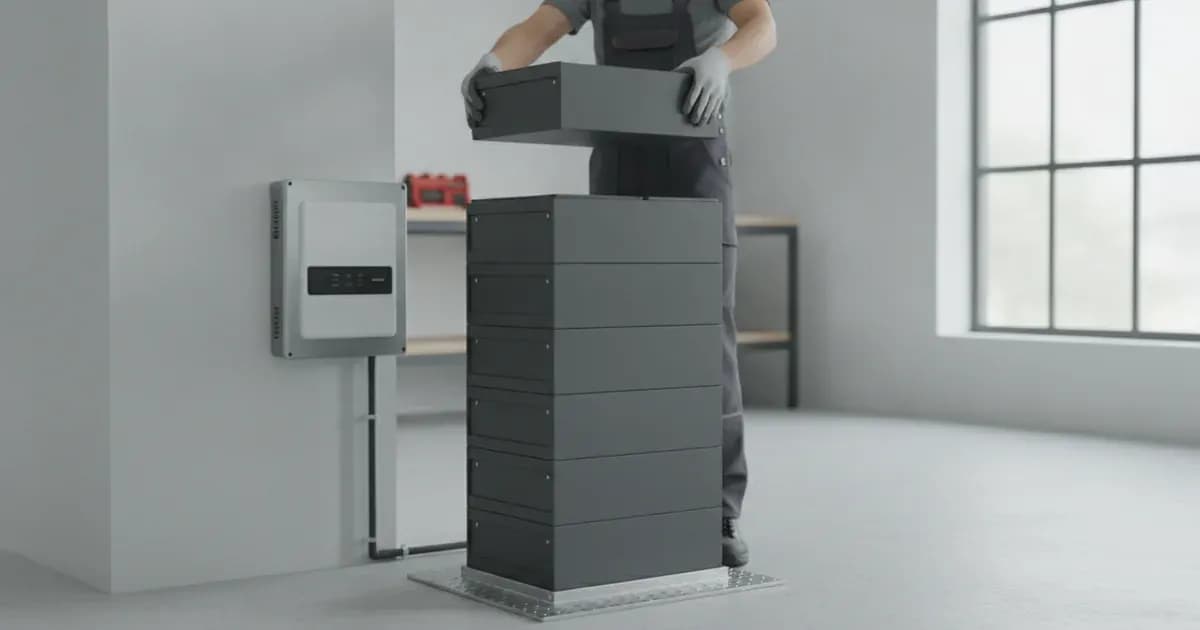
BYD Battery Box Premium HVS And HVM Stacking Guide
Updated 15 September 2026 · By SolarNevs Research Desk, Dealer surveys + verified sources · 4 sources · Method ↗
Key Takeaways
- High-voltage battery systems require professional installation and adherence to national electrical codes.
- An MCS Certificate is essential for accessing export tariffs and ensuring building regulations compliance.
- Proper electrical bonding of the inverter chassis and battery enclosure to the main earthing terminal is critical for safety.
- Correct installation of Current Transformers (CTs) and RS485 communication cabling is vital for system operation.
Understanding High-Voltage Battery System Installation
Installing high-voltage battery systems, such as the BYD Battery-Box Premium HVS and HVM series, involves specific safety and regulatory considerations. These systems are engineered for residential and commercial off-grid and grid-parallel energy storage applications worldwide. They are compatible with standard single-phase and three-phase electrical distribution systems globally.
The process requires careful attention to electrical bonding, wiring, and communication protocols to ensure safe and efficient operation.
What is actually going on
High-voltage battery systems store electrical energy for later use, often in conjunction with solar photovoltaic (PV) installations. These systems manage battery charge and discharge based on factors like grid tariffs and household load, dynamically.
Proper installation ensures the system operates safely and in compliance with local regulations. This includes correct wiring, earthing, and configuration of monitoring components. For instance, Current Transformer (CT) clamps are used to measure power flow. Incorrect installation, such as inverted CT clamp placement, can lead to negative power flow readings during high household consumption.
Regulatory Compliance and Safety Standards
All energy storage systems installed in Great Britain must comply with international microgeneration safety and grid protection standards. This compliance is crucial for the safety of the installation and for meeting regulatory requirements.
An MCS Certificate is required to access export tariffs and verify building regulations compliance for your energy storage system. This certification ensures that the installation meets recognised industry standards for quality and safety.
Key aspects of compliance include:
- Electrical Bonding: The inverter chassis ground and battery metal enclosure must be bonded to the main installation earthing terminal. This provides a critical safety path in case of an electrical fault.
- Wiring and Isolation: All DC conductors, AC feeders, and auxiliary control cables must be installed in compliance with applicable national electrical codes. Complete AC circuit isolation and lock-out are necessary before working on live components, such as installing CT clamps on live busbars.
- Communication: Maintain shielded twisted-pair cabling and verify proper RS485 communication baud rate settings for reliable data exchange between system components.
What you can check yourself, and what you cannot
Maintenance & Inspection Domain | Homeowner Permitted Scope | Accredited Installer Scope Only |
|---|---|---|
Visual Inspection | Inspect for visible damage or loose parts without touching | Tightening terminals or handling electrical components |
System Monitoring | Track app performance and note error messages or negative flow | Reconfiguring inverter or battery operating parameters |
Electrical Cabling & CTs | Observe power flow readings | Installing CT clamps on live busbars; DC/AC feeder wiring |
Earthing & Bonding | Confirm external integrity | Bonding chassis ground and battery enclosure to main earthing terminal |
Testing & Certification | Verify MCS Certificate documentation | Insulation resistance testing, polarity checks, and PTO sign-off |
What you can check:
- Visual Inspection: You can visually inspect the installation for obvious signs of damage or loose connections, though you should not attempt to tighten them yourself.
- System Monitoring: You can monitor the system's performance through its user interface or app, noting any error messages or unexpected behaviour. For example, if the system reports negative power flow during high household consumption, it could indicate an inverted CT clamp installation.
- Documentation: Ensure you have received all necessary documentation, including the MCS Certificate, which is required to access export tariffs and verify building regulations compliance.
What you cannot check or do yourself:
- Electrical Wiring: All DC conductors, AC feeders, and auxiliary control cables must be installed and verified by an accredited electrical engineer. This is not a DIY task due to the inherent risks of high-voltage electricity.
- Component Installation: Tasks such as installing CT clamps on live busbars or bonding the inverter chassis ground and battery metal enclosure to the main earthing terminal require professional expertise and safety precautions.
- System Commissioning: Complete pre-commissioning checks, insulation resistance testing, and polarity verification prior to final energization and utility permission to operate must be performed by qualified personnel.
- Changing Settings: Do not attempt to change inverter or battery settings yourself, as incorrect configurations can lead to system malfunction or safety hazards.
What the published sources do not tell you
The provided sources offer general principles for energy storage system installation and compliance but do not contain specific installation instructions, wiring diagrams, or detailed technical specifications for BYD Battery-Box Premium HVS or HVM series products. This includes information on:
- Specific stacking procedures or hardware for the BYD HVS/HVM series.
- Detailed kWh ratings or module configurations for these specific battery models.
- Product-specific fault codes or diagnostic procedures.
- Recommended torque settings for electrical connections.
- Detailed sizing guidelines for specific BYD battery configurations in relation to inverter models.
For product-specific details, always refer to the official manufacturer's installation manuals, datasheets, and guides provided with your BYD Battery-Box Premium HVS or HVM system. These documents contain the precise information required for safe and compliant installation.
Still showing the fault? Book a technician
If the steps above did not clear it, tell us the inverter or battery and the exact code. We pass it to a technician who covers your city; visit charges are quoted before they come.
How this pays for the site: the technician or verifier pays SolarNevs a fixed introduction fee. Nobody pays to be recommended, and you are free to use our free guides instead.
Frequently asked questions
What are the primary technical requirements for byd battery box premium hvs and hvm stacking guide?
Key requirements include compliance with local grid codes, correct equipment certification, and proper electrical isolation.
Who is authorized to install and inspect byd battery box premium hvs and hvm stacking guide?
All high-voltage DC, AC grid tie-in, and switchboard modifications must be performed by a qualified, accredited electrical professional.
How is export power limited in byd battery box premium hvs and hvm stacking guide?
Export limiting is achieved using certified bidirectional smart meters or power sensors providing dynamic feedback to the inverter system.
References
- BYD Battery-Box Premium HVS & HVM Operating Manual V2.2 (installation, grounding conductor, electrical connection) — accessed 6 September 2026
- BYD Battery-Box Premium HVS Datasheet V1.4 (2-5 modules per tower, CAN/RS485 communication) — accessed 6 September 2026
- BYD Battery-Box Premium HVM Datasheet V1.4 (3-8 modules per tower, CAN/RS485 communication) — accessed 6 September 2026
- NEPRA (Alternative & Renewable Energy) Distributed Generation and Net Metering Regulations, 2015 (SRO 892) — accessed 6 September 2026
Related guides
More from inverter errors & fixes.