Sungrow Hybrid Inverter and BYD Battery Setup Guide
Updated 7 September 2026 · By SolarNevs Research Desk, Dealer surveys + verified sources · 3 sources · Method ↗
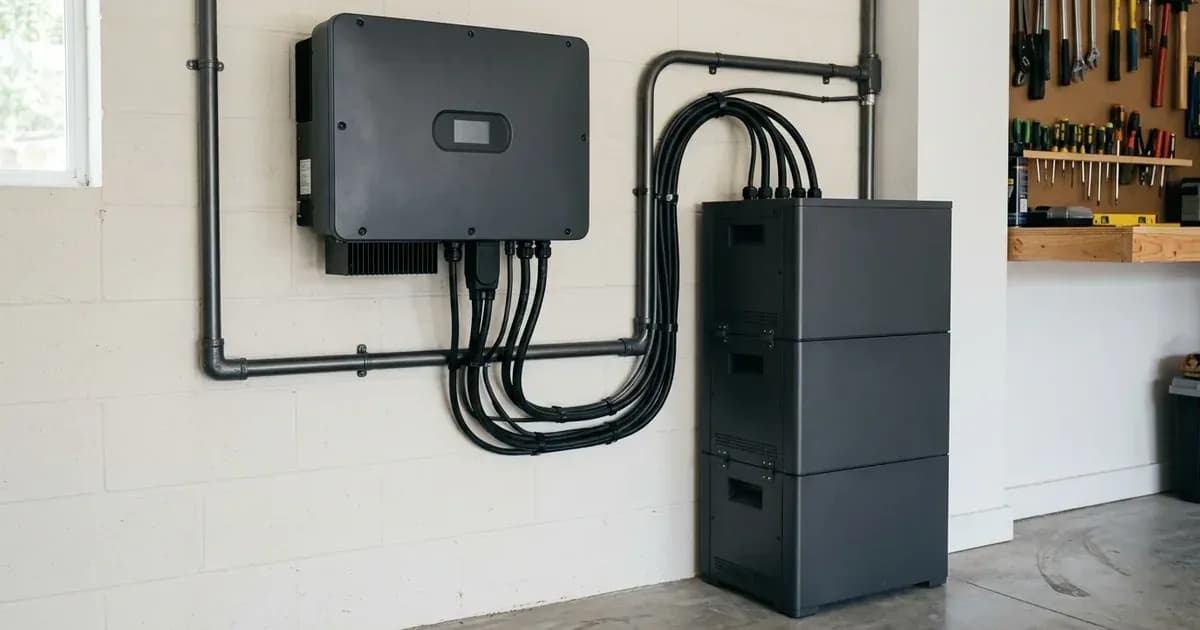
This guide details the setup and commissioning of Sungrow hybrid inverters, specifically the SH5.0-10RT three-phase model, when paired with BYD Battery-Box Premium HVS or HVM high-voltage battery storage systems. We cover critical aspects from high-voltage DC interfacing and CAN communication to safe capacitor discharge procedures and iSolarCloud app setup.
1. Understanding Sungrow and BYD Integration
Sungrow hybrid inverters are designed for seamless integration with high-voltage lithium battery systems like the BYD Battery-Box Premium HVS and HVM series. This combination provides robust energy storage solutions for residential and light commercial applications.
1.1 Compatible Models and Capacities
The Sungrow SH5.0-10RT (Three-Phase) hybrid inverter, along with single-phase models like the SH5.0RS and SH6.0RS, are compatible with BYD Battery-Box Premium HVS (5.1-12.8kWh) and HVM (8.3-22.1kWh) battery systems.
1.2 High-Voltage DC Interfacing
The Sungrow hybrid inverter interfaces directly with high-voltage lithium battery systems. This direct connection simplifies wiring and optimizes energy transfer between the solar array, inverter, and battery storage.
1.3 High-Speed Backup Power
In the event of a grid outage, the integrated backup port on Sungrow inverters provides seamless automatic transfer to backup loads within milliseconds. This ensures critical loads remain powered without interruption.
2. CAN Communication and Wiring
Effective communication between the Sungrow inverter and the BYD Battery-Box Battery Management System (BMS) is crucial for optimal performance and safety.
2.1 Dedicated CAN Communication Port
Communication occurs via a dedicated CAN communication port on the Sungrow inverter. Use a shielded twisted-pair cable for this connection to ensure reliable data exchange.
2.2 Standard CAN Bus Pinouts
The standard CAN communication utilizes CAN-H and CAN-L terminals on the inverter's communication connection board. Ensure these are correctly wired to the corresponding BYD battery terminals.
3. Safety and Earthing Procedures
Working with high-voltage DC systems requires strict adherence to safety protocols.
3.1 Protective Earthing
It is essential to bond the inverter chassis ground and the BYD battery enclosure to the main installation earthing terminal. This protective earthing minimizes electrical shock hazards.
3.2 High-Voltage DC Circuit Isolation
Before performing any service or maintenance on the inverter or battery system, always turn off the battery DC circuit breaker. Wait at least 5 minutes for internal capacitors to discharge before servicing. This critical step prevents electrical shock from residual energy.
4. Commissioning with iSolarCloud App
The iSolarCloud app simplifies the commissioning process for Sungrow inverters and BYD battery systems.
4.1 Wireless Setup
You can commission inverters and configure battery parameters wirelessly using the iSolarCloud app via a local Wi-Fi hotspot. This allows for convenient setup directly from your mobile device.
4.2 Battery Parameter Configuration
Within iSolarCloud, configure essential battery parameters such as the minimum backup reserve SOC (State of Charge) and discharge cut-off limits. Setting these correctly helps to maximize battery service life.
5. Grid Code Compliance
Sungrow hybrid inverters ship with a multi-standard certification set (including VDE-AR-N 4105, AS/NZS 4777.2, and G99) so the same hardware platform can be configured to different grid codes worldwide. For installations in Pakistan, the applicable interconnection requirements are set by NEPRA's Distributed Generation and Net Metering Regulations (SRO 892/2015), which require grid-connected inverters to comply with UL 1741 and IEEE 1547-2003. Installing an anti-islanding-enabled inverter, which automatically isolates the system from the grid on a power failure, is mandatory under these net metering regulations.
6. Best Practices for BYD Battery-Box Assembly
When stacking BYD HVS/HVM battery modules, ensure all module base connectors are firmly seated before tightening corner bolts. This ensures a secure and reliable electrical and mechanical connection between modules.
Still showing the fault? Book a technician
If the steps above did not clear it, tell us the inverter or battery and the exact code. We pass it to a technician who covers your city; visit charges are quoted before they come.
How this pays for the site: the technician or verifier pays SolarNevs a fixed introduction fee. Nobody pays to be recommended, and you are free to use our free guides instead.
Frequently asked questions
What are the essential requirements for sungrow hybrid inverter and byd battery setup guide?
Verify system specifications, local regulations, and standard installation safety procedures prior to commissioning.
How do I ensure regulatory compliance?
Ensure all equipment is approved on relevant regulatory registries and installed by accredited certified professionals.
References
- Sungrow SH5T–25T Three-Phase Hybrid Inverter User Manual — accessed 27 August 2026
- BYD Battery-Box Premium HVS/HVM Operating Manual — accessed 27 August 2026
- AEDB Net-Metering Reference Guide (NEPRA SRO 892/2015) — accessed 31 August 2026
Related guides
More from inverter errors & fixes.