Daewoo Battery Troubleshooting: Backup and Charging Fixes
Updated 6 September 2026 · By SolarNevs Research Desk, Dealer surveys + verified sources · 5 sources · Method ↗
Key Takeaways
- Daewoo DIB Deep Cycle (12-month free replacement warranty) and DSS MaxPlus thick-plate (6-month warranty) batteries are lead-acid units, not tubular batteries.
- Kill power first and use insulated tools when servicing terminals (a dropped wrench across a bank shorts hundreds of amps); set charger current to Daewoo's official C/10 rule (around one tenth of Ah rating, ~15 A for 145 Ah DIB-180, 22 A for 220 Ah DIB-260 per string), requiring roughly eight to ten hours for full recharge, noting that charge setpoints are 25 °C reference figures requiring negative temperature compensation (-5 mV/°C/cell) in hot ambient conditions.
- A healthy rested Daewoo 12 V battery measures 12.6–12.8 V (referenced to 25 °C; hot ambient conditions require negative temperature compensation of -5 mV/°C/cell); readings drifting from 12.6 toward 11.8 V or below 12.0 V critical require immediate recharge with temperature compensation, never discharging below 50% capacity.
- Equalization or boost charging deliberately drives cells into the explosive hydrogen gassing region and must only be performed in an actively ventilated space away from sparks and flames; if servicing accessible vent caps, wear eye protection against corrosive sulfuric acid and add distilled water only (never tap water and never acid).
- Replace batteries immediately if casings show physical swelling (swollen units must not be recharged), excessive operational heat, failing to climb above 12 V (voltage referenced to 25 °C; hot ambient conditions require -5 mV/°C/cell temperature compensation) after a long charge, or age beyond 3 years.
Why is my Daewoo battery not charging or providing low backup?
A Daewoo deep-cycle battery (such as the DIB-135, DIB-180, DIB-200, or DIB-260) fails to charge or provides short backup primarily due to insufficient charger current set below the C/10 guideline, high terminal contact resistance from loose or corroded connections, or chronic sulfation from repeated deep discharges below 50% capacity. Daewoo batteries are manufactured by Treet Battery Limited as deep-cycle lead-acid units rather than tubular batteries, and Daewoo storage batteries feature no internal BMS, CAN/RS485 comms, or on-board alarm panels. Running them on incorrect inverter settings or allowing resting voltage to drift toward 11.8 V (referenced to 25 °C with -5 mV/°C/cell temperature compensation in ambient heat) causes active paste degradation.
Your first diagnostic step is measuring resting terminal voltage with a multimeter after disconnecting loads, followed by inspecting cable lug tightness with insulated tools after isolating power (as short circuits across terminals release hundreds of amps).
Step-by-step diagnosis for Daewoo battery issues
Follow these sequential diagnostic steps using official Daewoo technical guidelines to locate electrical or chemical faults:
- Measure Rested Terminal Voltage (Open Circuit Voltage):
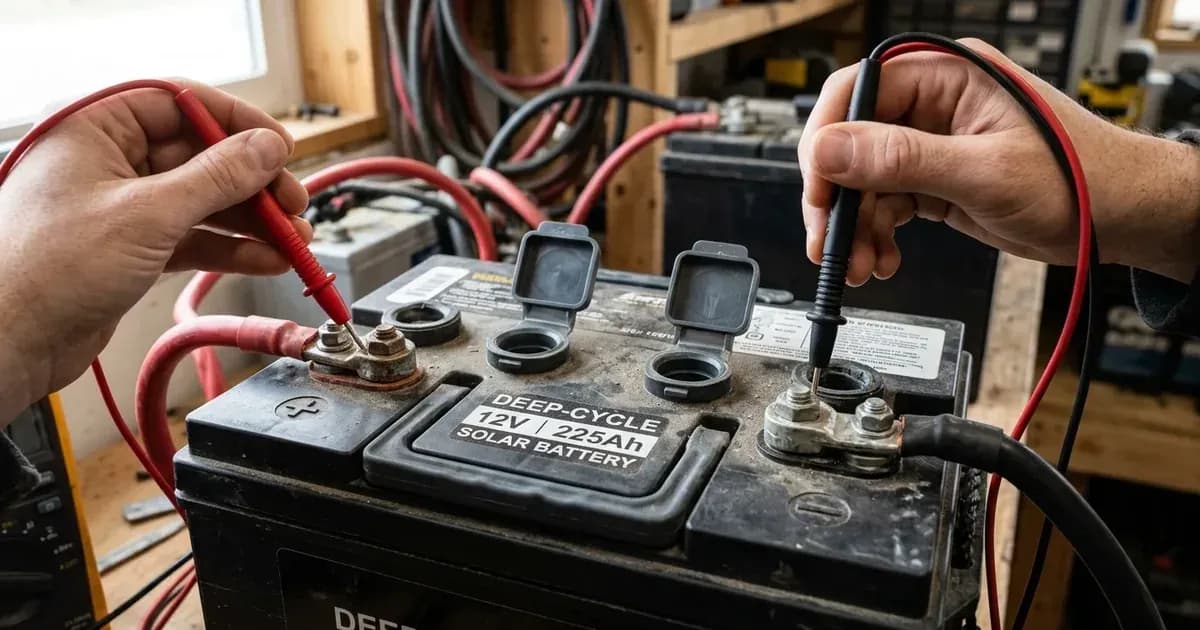
- Action: Disconnect the battery from the inverter or UPS, let it rest, and measure voltage across the terminals with a DC voltmeter.
- Result: Compare your reading against Daewoo's official voltage ladder (referenced to 25 °C, noting that ambient heat requires negative temperature compensation of -5 mV/°C/cell):
- 12.6–12.8 V: Battery is fully charged and chemically healthy (≥12.6 V rest indicates the battery is fine, check inverter settings/load).
- 12.3–12.5: Mildly discharged (12.0–12.4 requires cleaning terminals, full recharge, retest).
- 12.0–12.2: Weak charge (charge immediately).
- Below 12.0 V: Critically discharged (<11.8 indicates deep-discharged or aging; perform a slow charge and evaluate).
- Meaning: If voltage refuses to rise at all while the charger is running, Daewoo's own diagnosis points away from state of charge and towards the charger, the wiring, or a dead cell.
- Inspect Battery Terminal Posts and Cable Lugs:
- Action: Kill power and isolate the DC breaker first, using insulated tools because a metal spanner dropped across battery terminals shorts hundreds of amps. Visually inspect lead terminal connections for white powder or looseness.
- Meaning: Official Daewoo technical bulletins identify loose or corroded terminals as the single most common and ignored cause of charging failure. Clean corroded posts with a wire brush, tighten terminal hardware firmly with an insulated spanner (no manufacturer torque spec is published across Pakistani battery brands, so tighten snug without overtightening), and apply a protective petroleum jelly coat over the exterior of the joint.
- Verify Charger Current Allocation (The C/10 Rule):
- Action: Check the charge current setting on your solar inverter or standalone UPS.
- Meaning: Daewoo's official engineering guidance specifies charging current at approximately one-tenth of the battery's nominal Amp-hour rating (C/10, around 15 A for a 150 Ah unit). For example, a DIB-180 (145 Ah) requires approximately 15 A charging current, while a DIB-260 (220 Ah) requires 22 A per string. A correctly set charger needs roughly eight to ten hours to complete a full recharge; with current set below C/10 that cycle never finishes, leaving the battery chronically undercharged and sulfated. Note that charge setpoints are 25 °C reference figures that require negative temperature compensation (-5 mV/°C/cell) in hot installations.
- Inspect Electrolyte Fluid in Accessible Units:
- Action: Wear eye protection goggles and protective gloves to guard against corrosive sulfuric acid splashes whenever unthreading vent caps. If your Daewoo unit features unsealed or removable service caps, inspect fluid levels when cool.
- Meaning: While Daewoo markets its batteries as 100% sealed, zero-maintenance, official company resources advise checking electrolyte in accessible models. Fluid must submerge active plates just above the plates. Add distilled water only, never tap water and never acid.
- Examine Interconnect Cabling and DC Breakers:
- Action: Isolate power with insulated tools (as accidental shorts release hundreds of amps), check that cables are adequately sized, and inspect the main DC battery breaker.
- Meaning: Thin or loose wiring causes slow charging and hot cable joints. Resize cables appropriately and consult a qualified electrician. Review our guide on solar battery installation mistakes and cable sizing.
- Decode Inverter Acoustic Alarms and Error Messages:
- Action: Observe inverter LCD warning codes during grid outages.
- Meaning: Daewoo storage batteries have no electronic alarm panel, BMS, or CAN/RS485 comms. If your inverter sounds continuous beeps when battery power drops, all alarms originate from inverter voltage sensing. Refer to our diagnostic walkthrough on inverters beeping continuously.
Common Causes and Fixes for Daewoo Deep-Cycle Batteries
Symptom detail | Likely cause | Fix |
|---|---|---|
Inverter charges for roughly eight to ten hours but backup collapses rapidly | Charger current set far below C/10; chronic undercharging | Adjust inverter charge current to ~C/10 of bank Ah rating (e.g., 15 A for 145 Ah DIB-180, 22 A for 220 Ah DIB-260 per string), referencing charge setpoints to 25 °C with temperature compensation (-5 mV/°C/cell) in summer heat. |
Terminals run hot and cable joints discolor | Loose terminal bolts or corroded lead contact faces | Kill power first and use insulated tools (a spanner shorts hundreds of amps). Clean corrosion, tighten snug (no manufacturer torque spec published), and coat connection exteriors with petroleum jelly. |
Battery resting voltage sits below 11.8 V after charge | Severe plate sulfation from repeated deep discharge (below 50% capacity) | Run a slow recharge (referenced to 25 °C with temperature compensation of -5 mV/°C/cell). If voltage fails to climb above 12 V (voltage referenced to 25 °C; hot ambient conditions require -5 mV/°C/cell temperature compensation) after a long charge, replace the battery. |
Single battery in 48 V string reads about 10.5 V charged | Shorted or dead internal cell (community-reported diagnosis based on classic 6-cell arithmetic; not covered in Daewoo's official guides) | Replace the defective 12 V monobloc — a shorted cell has no repair solution, replacement only. |
Battery container sides bulge outward (casing swells) | Community-reported causes: overcharging (float/bulk set too high), blocked vents, extreme heat, or internal short (Daewoo officially names swelling only as a replace trigger) | Disconnect charging immediately. Swollen batteries cannot be repaired, must not be recharged, and must be decommissioned. |
Won't hold charge after 2 to 3 years of heavy load shedding | Normal cyclic active-material shedding and plate wear | Replace unit through authorized dealer trade-in. Standard batteries achieve 300–500 cycles, while DIB deep-cycle models are rated for 500–700 cycles. |
Zero charge current displayed on inverter | Tripped DC breaker or open inline DC fuse | Isolate power with insulated tools (shorted terminals release hundreds of amps), reset DC breaker, and test fuse continuity with a multimeter. |
Deep-Cycle Maintenance vs Physical Replacement Triggers
Daewoo batteries operate as sealed or low-maintenance lead-acid units without digital BMS electronics:
Operating Best Practices
- Avoid Deep Discharges: Daewoo's technical guidelines strongly advise never discharging storage batteries below 50% capacity (roughly 12.0 V rest, referenced to 25 °C with -5 mV/°C/cell temperature compensation in ambient heat). That is far shallower than the factory low-voltage cutoff most inverters ship with — the Axpert VM III defaults its low DC cutoff (P29) to 42.0 V on a 48 V bank (range 42.0–48.0 V), which works out to just 10.5 V per 12 V battery — so habitually running the bank all the way down to cutoff accelerates active paste degradation.
- Charge Duration: A properly sized charger operating under Daewoo's C/10 current guideline requires roughly eight to ten hours to complete a full recharge cycle. All charge voltage figures are referenced to 25 °C; hot ambient conditions require negative temperature compensation (-5 mV/°C/cell) to prevent thermal degradation.
- Equalization Practices: Daewoo suggests running periodic equalization occasionally to maintain efficiency, though Daewoo publishes no custom voltage tables. On an Axpert VM III 5KW 48 V system (four 12 V units in series), inverter defaults provide equalization at 58.4 V for 60 min (timeout 120 min) every 30 days when battery type is set to Flooded or User-Defined (Program 05, with P26 bulk default 56.4 V, range 48.0–61.0 V, and P02 charge current 10–80 A, default 60 A; all setpoints referenced to 25 °C with -5 mV/°C/cell temperature compensation in heat). Equalization deliberately drives cells into the explosive hydrogen gassing region, so only equalize in an actively ventilated space away from sparks and open flames.
- Temperature Management: Pakistani summer heat degrades batteries. Install batteries in shaded, well-ventilated spaces away from direct sunlight, and inspect terminals (using insulated tools after killing power because shorts release hundreds of amps) and electrolyte (wearing eye protection to guard against sulfuric acid, adding distilled water only, never acid) every 3–6 months.
Replace-Now Criteria
Daewoo official technical resources state clearly that when lead plates suffer severe wear or internal damage, no chemical additive or repair tool can restore capacity ("no repair solution available"). Replace your Daewoo battery if:
- The battery casing swells or exhibits visible distortion (swollen units must not be recharged).
- Terminal voltage won't climb above 12 V (voltage referenced to 25 °C; hot ambient conditions require -5 mV/°C/cell temperature compensation) after a long charge.
- The battery runs unusually hot in normal service.
- The unit is older than 3 years — Daewoo lists age past 3 years as a replacement trigger on its own (older than 3 years ⇒ replace), and a bank cycled daily through load shedding will be deep into its 500–700 cycles rating by then.
For general system charging faults, consult our parent troubleshooting guide on solar battery not charging.
Safety: Working with Lead-Acid Storage Batteries
Lead-acid battery servicing requires strict attention to chemical and electrical hazards:
- Hydrogen Off-Gassing: Charging and equalization generate flammable hydrogen gas by deliberately driving cells into the gassing region. Ensure battery locations have continuous ventilation in a well-ventilated area and prohibit open flames, sparks, and smoking nearby. Remove metal jewellery before touching terminals.
- Sulfuric Acid: Electrolyte is corrosive sulfuric acid. Wear safety glasses and protective gloves whenever inspecting battery terminals or vent caps. If acid splashes skin or eyes, flush thoroughly with running water and seek medical attention. Top up only with distilled water when cool, never tap water or acid.
- Terminal Connections and Arc Flash: Kill power and isolate the DC breaker first before servicing terminals, and use insulated tools; dropping a metal spanner across a battery bank shorts hundreds of amps and causes severe arc flashes.
- Heavy Lifting Precautions: Daewoo DIB monoblocs are heavy: DIB-180 weighs 40 kg (retail listings note 9 plates), DIB-200 weighs 49 kg (dimensions 519×277×212 mm), and DIB-260 weighs 64 kg. Always use two people to lift and position batteries safely on a stable shelf.
- Safe Disposal: Never discard lead-acid batteries in domestic waste. Treet Battery Limited offers an official old-battery trade-in adjustment through authorized dealer networks.
When to call a technician instead
Contact a certified solar technician or an authorized Daewoo Battery service center under the following conditions:
- You are uncomfortable measuring high DC voltages or rewiring series battery banks.
- The inverter alarms or shuts down as soon as you reconnect the battery string.
- Batteries run excessively hot to the touch during normal charging cycles.
- Warranty processing: Daewoo DIB batteries carry a 12-month free replacement warranty (DSS models carry 6 months) administered through 100+ authorized dealers (240+ nationwide). Keep your original purchase invoice and warranty card.
For professional escalation guidelines, consult when to call a solar technician.
Still showing the fault? Book a technician
If the steps above did not clear it, tell us the inverter or battery and the exact code. We pass it to a technician who covers your city; visit charges are quoted before they come.
How this pays for the site: the technician or verifier pays SolarNevs a fixed introduction fee. Nobody pays to be recommended, and you are free to use our free guides instead.
Frequently asked questions
Are Daewoo UPS and solar batteries tubular or flat-plate?
Daewoo (manufactured by Treet Battery Limited) does not sell a tubular line. Its solar and UPS lineup consists of DIB Deep Cycle and DSS MaxPlus thick-plate lead-acid batteries, officially marketed as 100% sealed, zero-maintenance.
Why is my Daewoo battery not charging fully?
Common causes include low charger current settings, loose terminal connections, or an inverter configured with incorrect charging voltages. Daewoo recommends setting charging current to approximately C/10 (around one tenth of the battery rating in ampere hours, such as 15 A for a 150 Ah unit), which requires roughly eight to ten hours for a full recharge; standard charge setpoints are 25 °C reference figures requiring negative temperature compensation (such as -5 mV/°C/cell on Deye hybrid profiles) in hot Pakistani ambient conditions, and Daewoo publishes no charging datasheet of its own.
What resting voltage indicates a healthy Daewoo battery?
According to official Daewoo technical guides, a healthy resting battery reads 12.6–12.8 V after disconnecting loads (referenced to 25 °C; hot ambient conditions require negative temperature compensation of -5 mV/°C/cell). A reading between 12.0–12.2 weak indicates a discharged state, while drifting toward 11.8 V or below 12.0 critical represents severe discharge requiring immediate recharge (with temperature compensation in hot environments), as Daewoo advises never discharging below 50% capacity.
How long do Daewoo deep-cycle batteries last in Pakistan?
Daewoo rates its standard batteries for 300–500 cycles and DIB deep-cycle models for 500–700 cycles. Under daily domestic load shedding and high summer temperatures in Pakistan, this typically equals 2 to 3 years of service life, after which Daewoo notes active-material wear requires full replacement (older than 3 years ⇒ replace).
Can I add distilled water to a Daewoo battery?
While officially marketed as 100% sealed, zero-maintenance, Daewoo's official maintenance resources note that if your unit has accessible vent caps, electrolyte levels should be checked when cool and maintained just above plates. Always wear eye protection to guard against corrosive sulfuric acid splashes when opening service caps, and add distilled water only, never tap water and never acid.
References
- Daewoo Battery Official About Us — accessed 23 August 2026
- Daewoo Battery Why Your UPS Battery is Not Charging — accessed 23 August 2026
- Daewoo Battery How to Check UPS Battery Health at Home — accessed 23 August 2026
- Daewoo Battery Deep Cycle Collections — accessed 23 August 2026
- Daewoo Battery UPS Battery Lifespan Guide — accessed 23 August 2026
Related guides
More from inverter errors & fixes.