Solar Panel Cleaning and Lichen Removal: UK Homeowner and Safety Guide
Updated 18 September 2026 · By SolarNevs Research Desk, Dealer surveys + verified sources · 2 sources · Method ↗
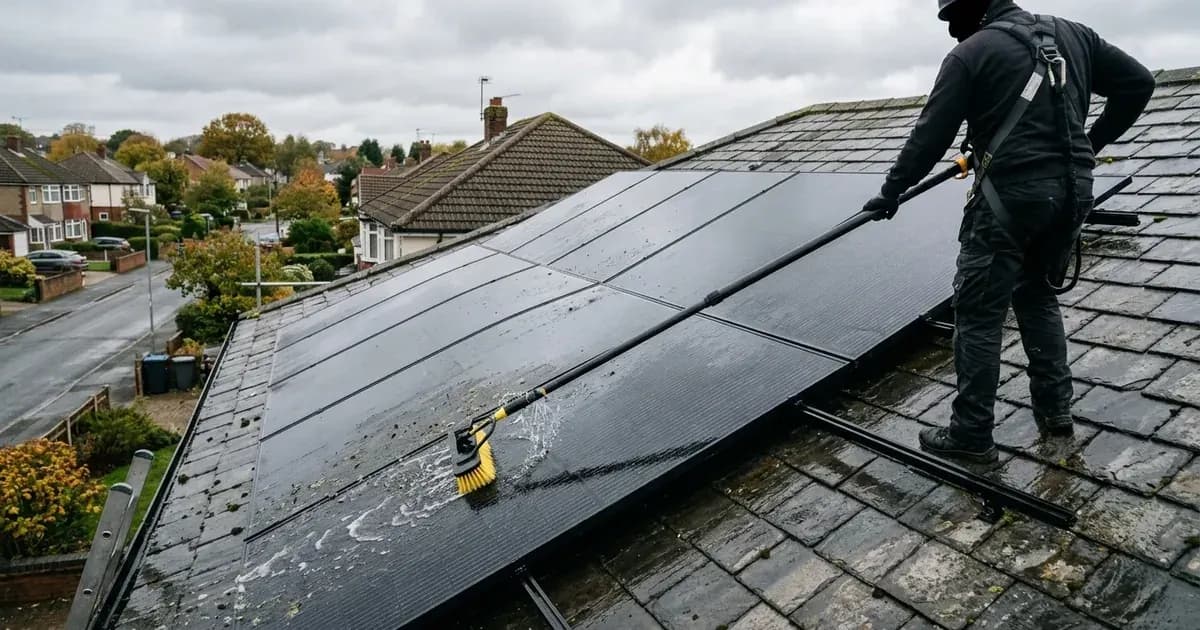
Key Takeaways
- Under the Work at Height Regulations 2005, any roof cleaning activity where a fall could cause personal injury legally requires structured fall prevention, work restraint, or scaffold access.
- The Building Research Establishment emphasizes that Damaged PV systems can be dangerous, so the first priority at fire scenes is health and safety.
- Pitched domestic roofs present heightened physical hazards: Many commercial buildings accessed had flat roofs, which are easier to, access and work from than damaged pitched roofs, typical in domestic properties.
- Never use a domestic pressure washer, metallic scrapers, or harsh chemicals on solar arrays; pressure washing forces water into electrical enclosures and strips the anti-reflective glass coating.
- Lichen encrustation chemically bonds to glass; safely removing it requires de-ionized pure water and soft nylon brushes on telescopic ground poles, or specialist biodegradable enzyme biocides.
1. Safety regulations and the legal framework for roof work
In the damp British climate, airborne spores of crustose lichen (such as Caloplaca and Xanthoria parietina) land on solar panels, thriving on dust and moisture. While self-cleaning occurs on roofs pitched steeper than 15 degrees during heavy downpours, lichen firmly attaches itself, reducing generation yield by up to 20% through persistent localized shading.
However, attempting to clean rooftop solar panels introduces serious legal and physical safety obligations. In the UK, all maintenance at elevation is governed by statutory instrument. Under the rules, regulations apply where, if measures required by these Regulations were not taken, a person could fall a distance liable to cause personal injury.
Under the law, 6. —(1) In identifying the measures required by this regulation, every employer shall take account of a risk assessment. The hierarchy of safety requires avoiding work at height where possible (such as using ground-based water-fed telescopic poles).
Where roof access cannot be avoided, contractors must employ a fall prevention, work restraint, work positioning, fall arrest or rescue system. Access equipment includes any scaffold, suspended scaffold, cradle, mobile platform, trestle, gangway, gantry and sta. Under the rules, “ladder” includes a fixed ladder and a stepladder; ladders may only be utilized for light work of short duration where other equipment is not justified. Furthermore, (5) Where the measures taken under paragraph (4) do not eliminate the risk of a fall occurring, ever contractor must take steps to minimize the distance and consequence of any potential fall.
Regulatory & Safety Standard | Legal / Investigative Requirement | Originating Authority |
|---|---|---|
Fall Protection Mandate | a fall prevention, work restraint, work positioning, fall arrest or rescue system | Work at Height Regulations 2005 |
Risk Assessment Duty |
| Work at Height Regulations 2005 |
Equipment Scope | “ladder” includes a fixed ladder and a stepladder; | Work at Height Regulations 2005 |
Roof Pitch Comparative Risk | Many commercial buildings accessed had flat roofs, which are easier to, access and work from than damaged pitched roofs, typical in domestic properties. | BRE National Solar Centre |
Electrical Terminal Construction | The metal contacts are crimped onto the ends of the cable and latched into place inside the plastic barrels. | BRE National Solar Centre |
Primary Fire Vulnerability | DC isolators were found to present the greatest fire risk within the database of incidents. | BRE National Solar Centre |
2. Electrical shock hazards and water ingress risks
Cleaning a solar PV array is not equivalent to washing domestic windows. A rooftop array generates high-voltage direct current whenever sunlight is present, even when the property AC isolator is switched off.
Forensic investigations by the Building Research Establishment (BRE) into solar incidents demonstrate that Damaged PV systems can be dangerous, so the first priority at fire scenes is health and safety. In particular, Many commercial buildings accessed had flat roofs, which are easier to, access and work from than damaged pitched roofs, typical in domestic properties. Slipping on wet slate or clay tiles while carrying hoses creates severe fall hazards.
Crucially, spraying pressurized water onto solar arrays creates catastrophic electrical failure risks:
- Pressure Washer Ingress: DC isolators were found to present the greatest fire risk within the database of incidents. The majority of domestic isolator fires result from moisture entering upward-facing cable glands. Firing a 120-bar pressure washer directly at the bottom or rear of panels injects water past enclosure gaskets into live isolator switchgear.
- Connector Degradation: Under arrays, The metal contacts are crimped onto the ends of the cable and latched into place inside the plastic barrels. While Figure 11: Typical (undamaged) DC connectors, separated (top image) and coupled (bottom image) shows sealed housings, older weathered connectors have microscopic cracks in rubber O-rings. Pressurized water causes immediate earth faults (triggering PV ISO Low alarms on the inverter) and can spark DC electrical arcing.
- Catastrophic Structural Fires: When DC arcing occurs near combustible roofing battens, fires spread rapidly. In published research, Figure 3 shows an example of a domestic roof, with a PV system fitted, destroyed by fire.
3. The biology of lichen and why ordinary rain cannot wash it off
Lichen is not simple dirt or pollen; it is a symbiotic colony of fungus and algae. The fungal component produces tiny root-like anchors called rhizines that secrete weak organic acids. These rhizines grip into the microscopic surface texture of the solar glass and the sealant bead bordering the aluminium frame.
Because lichen creates a hard, cement-like crust, normal British rainfall simply washes over it. Furthermore, as the lichen grows, it casts hard shade over individual solar silicon cells. In modern PV modules, shading even a single cell forces the bypass diodes to activate, causing the entire string output to drop disproportionately and creating localized hot spots that accelerate cell degradation.
4. Professional cleaning methods: pure water and telescopic poles
To safely restore module output without voiding warranties or risking falls from height:
Method 1: Ground-Based Water-Fed Poles (Best Practice)
Professional solar cleaners use carbon-fibre telescopic poles extending up to 10 to 15 metres, allowing technicians to clean two-storey residential roofs safely from ground level. This eliminates work at height risks entirely.
Method 2: De-Ionized Reverse Osmosis Pure Water
Never wash solar panels with ordinary domestic tap water. British tap water contains dissolved calcium and magnesium (hard water minerals). When tap water evaporates on hot solar glass, it leaves chalky limescale deposits that bake onto the surface, permanently reducing light transmission. Professionals use pure de-ionized water filtered through reverse-osmosis (RO) membranes to 0 parts per million total dissolved solids, ensuring glass dries spotless with zero mineral residue.
Method 3: Approved Biodegradable Enzyme Biocides
To dissolve stubborn lichen without scraping, specialists apply manufacturer-approved biodegradable biocides (such as specialized quaternary ammonium or citrus-based solutions). These gentle solutions kill the lichen rhizines over several weeks without damaging the glass anti-reflective coating, after which normal rainfall washes away the dead organic residue naturally.
Frequently asked questions
Can I use a pressure washer to clean my solar panels?
No. High-pressure jet washers force water through waterproof IP65/IP67 rubber gaskets into DC isolators and MC4 connectors. High pressure also strips the anti-reflective coating off tempered glass, permanently voiding panel warranties.
Why is lichen harder to remove from solar panels than normal dirt?
Lichen is a composite organism of algae and fungi that produces microscopic fungal root threads (rhizines). These rhizines chemically etch into the micro-pores of solar glass and frame seals, resisting ordinary rainwater and simple brushing.
What should I use to clean lichen off solar panels safely?
Use specialized non-abrasive soft nylon bristle water-fed poles supplied with de-ionized pure water produced by reverse osmosis, paired with manufacturer-approved biodegradable biocide washes that dissolve lichen spores without harming glass.
Do I need scaffolding or fall protection to clean domestic solar panels?
Under the Work at Height Regulations 2005, anyone undertaking maintenance where a person could fall and suffer injury must utilize proper fall prevention, work restraint, or certified working platforms rather than balancing on ladders.
References
- UK Statutory Instruments: The Work at Height Regulations 2005 (SI 2005/735) — accessed 29 August 2026
- BRE National Solar Centre: Fires and Solar PV Systems Investigations — accessed 29 August 2026
Related guides
More from inverter errors & fixes.