Pigeon Proofing Solar Panels: Mesh Installation, Nest Legality & Cable Damage Guide
Updated 18 September 2026 · By SolarNevs Research Desk, Dealer surveys + verified sources · 2 sources · Method ↗
Key Takeaways
- Under the Wildlife and Countryside Act 1981, it is a criminal offence if any person takes, damages or destroys the nest of any wild bird while that nest is in use or being built; or takes or destroys eggs.
- Empirical fire research proves that Damaged PV systems can be dangerous, so the first priority at fire scenes is health and safety.
- The second PV component most likely to be implicated as the cause of a fire is the DC connector: in 5 cases, the connectors were most likely the source of the fire, in a further 7 cases, they may have been the source.
- Chewed DC cabling and accumulating nesting detritus create direct arcing hazards beneath arrays; repair work requires daylight isolation protocols to prevent lethal shock risks.
- Never drill through solar panel aluminium frames to attach mesh; always specify non-penetrating UV-stabilized mounting clips that preserve module integrity and manufacturer warranties.
1. UK wildlife law and pigeon nesting under solar arrays
The sheltered space beneath residential solar panels offers warmth, elevation, and protection from predators, making it an ideal nesting habitat for feral pigeons (Columba livia). However, homeowners facing noise, fouling, and cable damage must navigate strict UK wildlife protection laws before undertaking remedial work.
Under Section 1 of the primary statute, any person who intentionally kills, injures or takes any wild bird; or takes, damages or destroys the nest of any wild bird while that nest is in use or being built; or takes or destroys an egg of any wild bird, he shall be guilty of an offence.
The legislation extends complete protection to nesting materials, providing that possessing an egg of a wild bird or any part of such an egg, is unlawful. While certain general licences exist for pest control in agriculture, A person shall not be guilty of an offence under subsection (2) if he shows that— statutory statutory exceptions apply. In domestic solar installations, contractors cannot legally clear an active pigeon nest containing eggs or fledglings; proofing mesh installation must be scheduled either before birds establish a nest in spring, or after chicks have fledged and abandoned the site in autumn.
Legal & Safety Parameter | Statutory / Investigative Baseline | Authority Source |
|---|---|---|
Wild Bird Nest Protection | takes, damages or destroys the nest of any wild bird while that nest is in use or being built; or | Wildlife and Countryside Act 1981 |
Egg Harm Prohibition | takes or destroys an egg of any wild bird, | Wildlife and Countryside Act 1981 |
Criminal Liability Standard | he shall be guilty of an offence. | Wildlife and Countryside Act 1981 |
Primary Electrical Fire Component | DC isolators were found to present the greatest fire risk within the database of incidents. | BRE National Solar Centre |
Secondary Electrical Fire Component | in 5 cases, the connectors were most likely the source of the fire, in a further 7 cases, they may have been the source. | BRE National Solar Centre |
Electrical Terminal Construction | The metal contacts are crimped onto the ends of the cable and latched into place inside the plastic barrels. | BRE National Solar Centre |
2. Electrical fire hazards: chewed cabling and DC arcing
Beyond noise and blocked gutters, bird habitation poses severe electrical hazards to building fabric and occupant safety. The space under solar modules houses live DC string cabling carrying high direct current voltages.
Investigations conducted by the Building Research Establishment (BRE) demonstrate the vulnerability of balance-of-system electrical components. While DC isolators were found to present the greatest fire risk within the database of incidents, connectors and cables are closely implicated. Forensic data records that The second PV component most likely to be implicated as the cause of a fire is the DC connector: in 5 cases, the connectors were most likely the source of the fire, in a further 7 cases, they may have been the source.
Under arrays, The metal contacts are crimped onto the ends of the cable and latched into place inside the plastic barrels. When pigeons roost, their claws and beaks abrade cable jacketing. Pigeons peck at the soft outer cross-linked polyethylene (XLPO) sheath, exposing underlying conductors. Furthermore, heavy guano accumulation is acidic and corrosive, degrading the weather seals of MC4 couplings over time.
When exposed copper contacts wet roof tiles or aluminium rails, ground leakage currents trigger inverter isolation faults. Worse, intermittent contact between damaged conductors creates continuous DC electric arcs. Because direct current does not pass through a zero-voltage crossing like alternating current, arcs do not self-extinguish. They generate temperatures high enough to ignite combustible roofing fabric, igniting dry nesting twigs and roof underlayment.
3. Structural fire consequences and safety precautions
The BRE study emphasizes that Damaged PV systems can be dangerous, so the first priority at fire scenes is health and safety. In recorded incident analyses, Figure 3 shows an example of a domestic roof, with a PV system fitted, destroyed by fire. In less severe cases, • Localised fires caused some damage to areas surrounding the point of origin, mainly affect timber rafters, felt, and battening directly beneath the array.
When inspecting suspected pigeon damage:
- Never reach under panels blindly: Live DC conductors remain energized whenever ambient daylight strikes the array.
- Monitor inverter fault logs: Inspect your inverter for "PV ISO Low", "Isolation Fault", or earth leakage error codes following rainstorms.
- Use qualified solar technicians: Assessing damaged string cabling requires high-voltage DC test meters, lockout isolators, and personal protective equipment.
4. Professional pigeon proofing installation methodology
To permanently exclude pigeons without damaging modules or breaking UK wildlife legislation, professional solar contractors employ a multi-step installation process:
1. Timing and Nest Inspection
Survey the array using telescopic cameras. If active nests, eggs, or chicks are detected, proofing must pause until birds depart. If nests are abandoned, technicians carefully remove guano and debris, sanitizing the roof space with biocide.
2. Specifying Exclusion Mesh
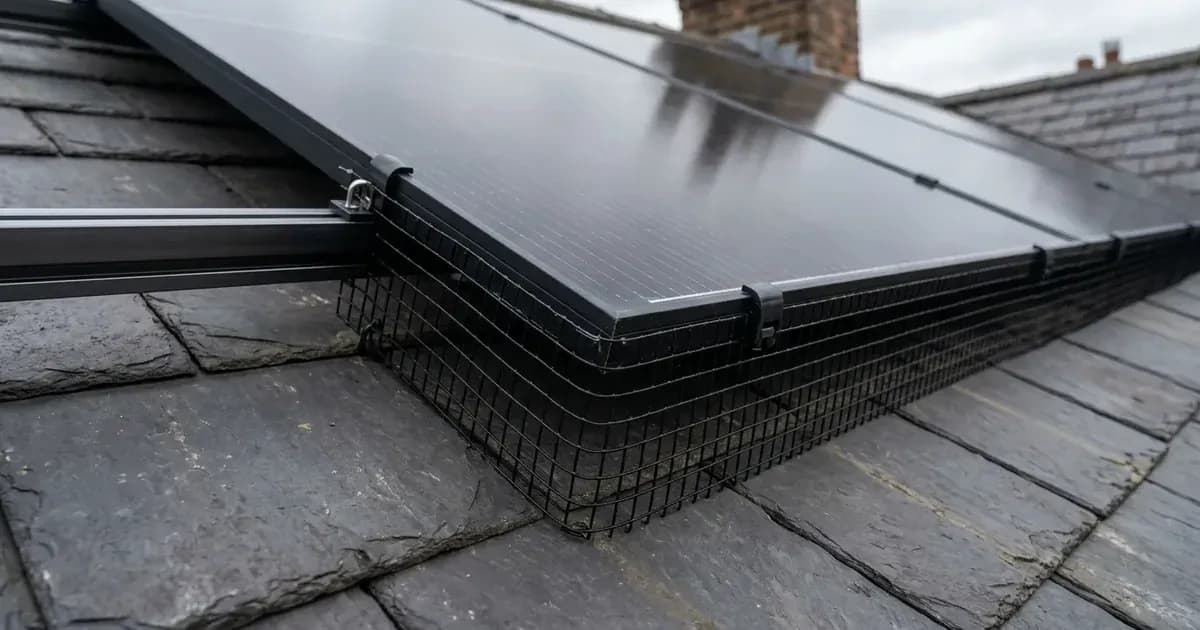
Specify heavy-duty galvanized steel wire mesh coated in black UV-resistant PVC (typically 12mm x 12mm or half-inch aperture). This prevents small birds and rodents from squeezing through while maintaining natural convective airflow beneath panels to prevent inverter overheating.
3. Non-Invasive Fastening Clips
Never screw or rivet mesh directly into module frames. Professional installers fit specialized nylon or stainless steel solar clips. These fasteners clamp onto the bottom lip of the module frame with a locking washer, holding the mesh firmly against the roof tile contour without penetrating aluminium or touching glass.
4. Cable Re-securing and Conduit Protection
Inspect all exposed DC string wiring. Any cable showing peck marks or insulation thinning must be cut back and re-terminated using certified MC4 connectors crimped with calibrated tooling. Re-secure all cabling off the roof tiles using UV-rated metal cable ties, running vulnerable spans through split UV-stabilized conduit.
Frequently asked questions
Can I legally remove pigeons nesting under my solar panels in the UK?
Under the Wildlife and Countryside Act 1981, it is a criminal offence to take, damage, or destroy the active nest of any wild bird while it is being built or in use. You must wait until all chicks have naturally fledged before installing proofing mesh.
Do pigeons cause electrical fire hazards under solar arrays?
Yes. Pigeons peck and scratch at DC solar cables, stripping outer insulation and exposing live copper. Exposed DC cables cause arcing and earth faults against roof tiles and metal mounting frames, creating serious thermal hazards.
Will screwing bird mesh into solar panel frames void my warranty?
Yes. Drilling or screwing directly into an aluminium solar module frame voids the manufacturer product warranty and can shatter the tempered glass. Professional installers always use non-invasive UV-stabilized nylon clips that grip the module lip.
How do I know if pigeons have chewed my solar panel wiring?
Common indicators include inverter isolation fault alarms (such as PV ISO-PRO or Isolation Fault), sudden drops in solar string yield, and visible nesting twigs or guano blocking gutters beneath the array.
References
- UK Public General Acts: Wildlife and Countryside Act 1981 (c. 69 Section 1) — accessed 29 August 2026
- BRE National Solar Centre: Fires and Solar PV Systems Investigations — accessed 29 August 2026
Related guides
More from inverter errors & fixes.