UK Solar Battery Storage Costs, Savings & System Sizing Guide
Updated 18 September 2026 · By SolarNevs Research Desk, Dealer surveys + verified sources · 2 sources · Method ↗
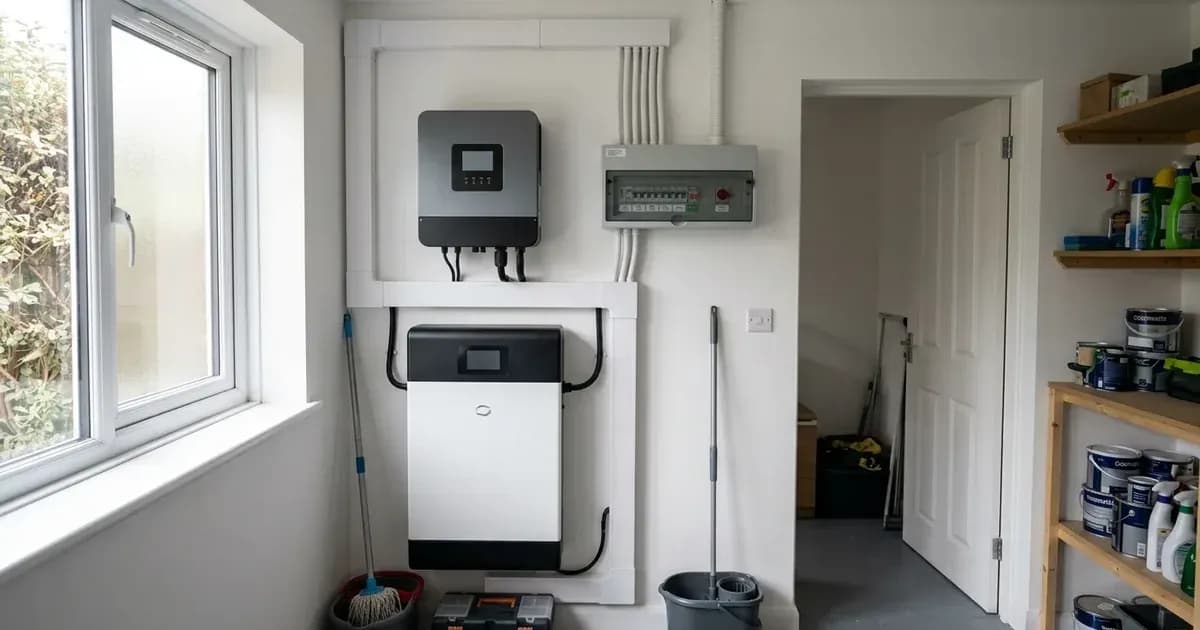
Pairing domestic battery storage with residential photovoltaic arrays enables households to store surplus daytime solar generation rather than exporting it to the national grid. By discharging stored power during evenings or peak tariff windows, homeowners dramatically reduce their reliance on expensive grid imports.
Evaluating whether energy storage represents a sound investment requires understanding current capital equipment pricing, physical site requirements, operating lifespans, and available UK funding schemes.
Capital Costs and System Sizing Tiers
The financial investment required for residential storage depends upon usable capacity, cell chemistry, and power conversion electronics. Domestic battery pricing encompasses a broad spectrum based on household requirements.
Across the wider market, equipment expenditure can range from £1,500 to £10,000 depending on manufacture and size. For modest residential dwellings seeking entry-level storage, the cost for a 5kWh battery system is around £4,600 installed.
When sizing storage as part of an integrated domestic installation, industry benchmarks indicate that battery storage tends to cost around £5000 to £8000 for larger family properties. Evaluating system dimensions and capacity requirements ensures equipment matches domestic demand.
Physical Footprint, Capacity & Operating Lifespan
Battery storage capacity is measured in kilowatt hours (kWh) and a typical home system might be 10 kWh. This capacity comfortably accommodates evening baseload appliances, lighting, entertainment systems, and cooking cycles across a standard three- to four-bedroom home.
In terms of physical space requirements, modern storage units are relatively compact. A typical battery storage system is around 100cm x 60cm x 25cm. This is slightly taller and wider than a washing machine but much less deep, enabling flexible mounting options within modern properties.
Component longevity differs substantially from photovoltaic modules. While solar panels operate effectively across 25 years or longer, chemical cell degradation limits battery longevity. The typical lifespan of a battery is about 10 to 12 years, requiring homeowners to plan for a mid-system replacement cycle over the lifetime of their roof array.
Operational Depth of Discharge and Policy Support
Modern lithium storage systems incorporate sophisticated battery management systems (BMS) that regulate charge and discharge cycles to maximize operational longevity.
To safeguard chemical cells against premature failure, depth of discharge limits are strictly enforced by onboard firmware. When the battery gets down to a set level, maybe 20% of the total storage capacity, your system will stop taking electricity out of the battery. Installers emphasize that the system should never let your battery discharge to zero, as this can significantly reduce the life of the battery.
To accelerate nationwide adoption and alleviate upfront costs, major public funding programmes are expanding. The Warm Homes Plan is set to invest close to £15 billion in improving the UK’s homes to cut energy bills. Under this statutory programme, for people on low incomes, there will be fully funded government support to install battery storage. For owner-occupiers above grant income thresholds, there will also be low and zero-interest loans available for homeowners regardless of income.
Siting Options, Installation Best Practice & Tariff Arbitrage
Selecting an appropriate location within the dwelling is vital for thermal management, ventilation, and maintenance accessibility. Siting options depend on the enclosure protection rating of the hardware. A battery can be installed in garages, on external walls or utility rooms, depending on which one you choose. External wall installations require appropriate weatherproofing enclosures to withstand sub-zero winter temperatures.
Procuring equipment requires competitive verification. Consumers are strongly advised to obtain quotes from certified professionals. We recommended getting at least three quotes from installers who are certified with MCS to make sure you get the best value.
Co-locating installation delivers tangible economic efficiencies. You should be able to save money by installing battery storage at the same time as solar panels. As the installers are already on-site, they would be able to integrate the panels with the battery as part of the same job, sharing electrical labour and certification charges.
Importantly, batteries offer financial value even without on-site photovoltaic generation. If you have a battery and no solar panels, you will stop charging the battery when it is full, and discharge it when the next cheap tariff period ends. By charging during cheap overnight windows on dynamic tariffs, households avoid daytime peak prices.
Where solar panels are present, any excess generation remaining after the battery reaches full charge can be monetised. Typically you will get around 12p for every unit that you do not use yourself through the smart export guarantee, ensuring that every kilowatt-hour generated delivers measurable financial return.
Frequently asked questions
How much does a domestic solar battery cost in the UK?
According to the Energy Saving Trust, domestic battery storage systems range from £1,500 to £10,000, with a typical 5kWh unit costing around £4,600 and a 10kWh system often priced between £5,000 and £8,000.
Can I install a battery storage system without solar panels?
Yes, standalone batteries can charge overnight on cheap off-peak time-of-use tariffs and discharge during peak daytime rate periods.
How long do residential solar batteries last before replacement?
The typical operating lifespan of a domestic battery storage system is approximately 10 to 12 years.
References
- Energy Saving Trust Battery Storage Guide — accessed 29 August 2026
- Energy Saving Trust Solar Panels Guide — accessed 29 August 2026
Related guides
More from schemes, subsidies & financing.