Solar Panels for a 3-Bed House UK: Sizing, Costs & Installation Guide
Updated 18 September 2026 · By SolarNevs Research Desk, Dealer surveys + verified sources · 2 sources · Method ↗
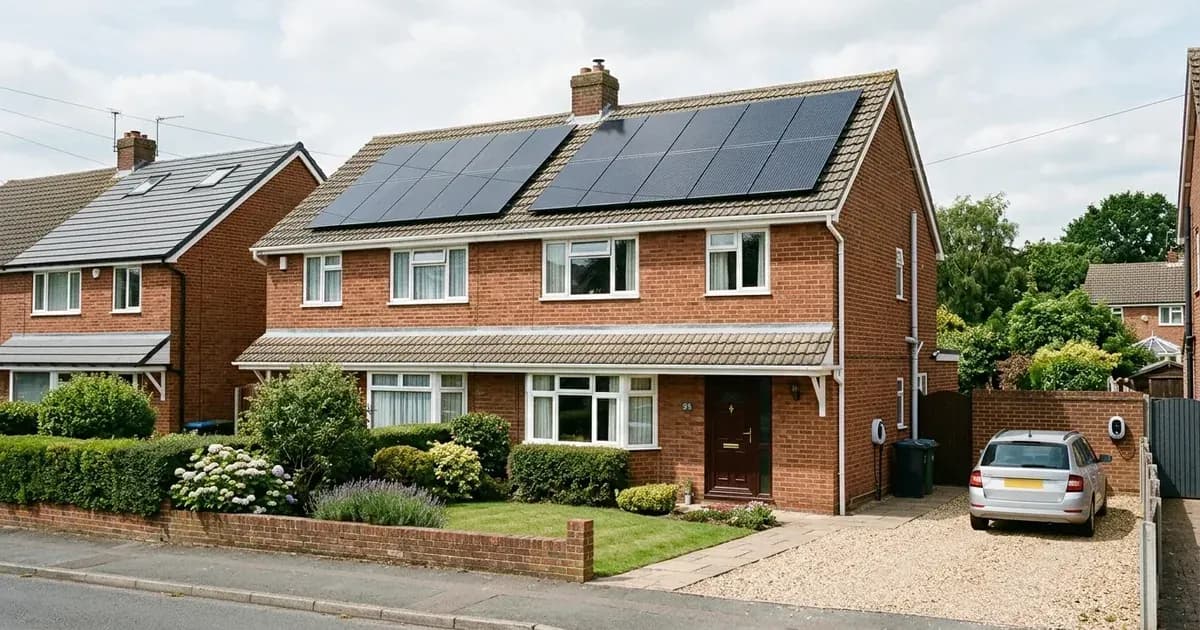
The three-bedroom semi-detached or terraced home represents the standard housing archetype across the United Kingdom. With millions of families occupying properties of this size across England, Scotland, and Wales, establishing accurate sizing baselines, realistic capital costs, and practical grid rules is essential for evaluating residential solar photovoltaics.
Homeowners investing in solar panels seek to reduce exposure to retail energy bills, maximize on-site utilization of clean microgeneration, and ensure compliance with distribution network regulations.
<Callout type="info" title="Key Sizing & Installation Benchmarks: 3-Bed UK Home">
- Annual Consumption Baseline: Ofgem Medium TDCV baseline of 2,700 kWh/year electricity (Profile Class 1) and 11,500 kWh/year gas.
- System Capacity: The average solar panel system is around 4.5 kilowatt peak (kWp).
- Capital Installation Cost: An average home solar panel system costs around £7600 to install.
- Mounting Configuration: The ideal place to install solar panels is on a sloping roof angled towards the sun.
- Planning Regulations: Solar panels on houses are considered permitted development without planning permission.
- Grid Compliance: Mandatory notification and registration with the local distribution network operator (DNO).
- Procurement Practice: Get quotes from at least three installers who are MCS certified.
</Callout>
Sizing Baseline: The Ofgem Medium TDCV Profile
To dimension a residential solar array accurately, engineers first determine baseline annual household electricity consumption. In the UK, statutory consumption benchmarks are established by the energy regulator, Ofgem.
Under the regulatory determination:
- Electricity Profile Class 1: Low 1,800 kWh, Medium 2,900 to 2,700 kWh, High 4,300 to 4,100 kWh.
- Gas: Low 8,000 to 7,500 kWh, Medium 12,000 to 11,500 kWh, High 17,000 kWh.
A standard three-bedroom property occupied by three or four individuals aligns closely with the Ofgem Medium baseline of 2,700 kWh of electricity per year. Sizing an array against this consumption ensures that generation substantially offsets household demand without creating excessive unmanageable export.
For a detailed analysis of national consumption bands and regulatory methodologies, see our dedicated report on Ofgem typical domestic consumption values and solar sizing.
System Sizing: Capacity and Panel Configuration
When specifying an array for a 3-bedroom property, installers balance roof dimensions against generation requirements.
The average solar panel system is around 4.5 kilowatt peak (kWp).
Sizing Dimension | Technical Specification | Operational Impact |
|---|---|---|
Nominal Array Capacity | 4.5 kWp | Generates clean solar electricity throughout the year |
Household Electricity Match | 2,700 kWh/year baseline | Annual generation comfortably covers domestic consumption volume |
Roof Application | Pitched roof layout | Direct integration onto rafter structures |
Because annual generation from a 4.5kWp array provides substantial renewable energy relative to the 2,700 kWh annual demand of an average 3-bed home, matching instantaneous generation to household activity is the primary technical objective.
To explore how panel counts vary across specific roof architectures, read our technical breakdown on how many solar panels do I need in the UK.
Capital Installation Costs and Equipment Sizing
Equipment costs for residential solar installations have stabilized following international supply chain expansions.
According to Energy Saving Trust benchmarks, an average home solar panel system costs around £7600* to install.
This average figure includes:
- High-efficiency monocrystalline solar photovoltaic modules.
- String or hybrid inverter hardware and DC balance-of-system isolators.
- Pitched roof mounting brackets, rails, and weather seals.
- AC cabling, generation metering, and consumer unit isolation breakers.
- Scaffolding access and electrical certification.
Furthermore, domestic solar installations benefit from statutory tax relief under HMRC Notice 708/6, ensuring that qualifying supply-and-installation contracts attract zero-rate 0% VAT. For an overview of capital outlays and savings modeling, see our comprehensive guide to UK solar panel costs and savings.
Roof Mounting: Pitched vs Flat Configurations
Roof geometry directly influences array yield and structural integration.
The ideal place to install solar panels is on a sloping roof as the panels work best when angled towards the sun.
On a standard pitched domestic roof, panels mount parallel to existing rafters using specialized mounting hooks that penetrate beneath slates or tiles into structural timber. This maintains natural ventilation behind modules while protecting roof integrity. While south-facing orientations provide optimal yield, east-facing and west-facing orientations also generate consistent power, spreading generation evenly across morning and afternoon domestic routines.
Daytime Occupancy & Self-Consumption Dynamics
In a residential solar installation, financial performance is governed by how much self-generated electricity is consumed on-site versus exported to the grid.
Most people aren’t at home in the middle of the day to take advantage of the energy generated by their solar panels. When you don’t use the energy from your panels it’s sent back into the grid.
Occupancy patterns create distinct operational realities:
- Traditional Commuter Routine: If a home is vacant during daytime hours, appliances remain idle while solar generation peaks at solar noon, causing the majority of generation to flow outward into the distribution network.
- Home Working Patterns: If you work from home you’ll naturally use some of the energy yourself. Running computers, background appliances, and meal preparation during daylight hours absorbs clean solar energy directly, displacing grid purchases.
Homeowners can shift daytime loads by scheduling washing machines, dishwashers, and immersion hot water diverters to operate during midday generation windows.
Adding Battery Storage: Load Shifting and Peak Offsetting
To resolve the mismatch between daytime solar generation and evening family electricity demand, many homeowners choose to install domestic battery storage.
Battery storage lets you save your solar electricity to use when your panels aren’t generating energy.
Furthermore, smart energy tariffs expand storage economics: Some energy providers also offer time of use tariffs which encourage you to use electricity outside of peak hours when electricity is cheaper.
When paired with a dynamic time-of-use tariff, a home battery performs two complementary functions:
- Absorbs daytime solar surplus that would otherwise export to the grid.
- Charges from off-peak grid electricity overnight during cheaper tariff periods, discharging during expensive evening peak hours.
For comprehensive analysis of regional financial recovery timelines, consult our detailed guide on UK solar panel payback periods.
Planning Permission & Distribution Network Operator Rules
Domestic solar installations are subject to established UK planning and electrical network regulations.
Under national planning frameworks: Solar panels on houses are considered ‘permitted development’ and don’t usually need planning permission.
However, electrical grid connection requires formal network coordination: If you’re planning to install a solar panel system in your home you must register it with your distribution network operator (dno). The dno is the company responsible for bringing electricity to your home.
Under national distribution engineering recommendations, standard domestic microgeneration systems operate under a notification procedure where the installer submits commissioning documentation to the local DNO, while larger domestic installations require advance connection permission prior to commissioning.
Installer Procurement & Certification Standards
Achieving a durable, compliant installation requires engaging reputable trade professionals.
When procuring a residential system:
- Multiple Tenders: Get quotes from at least three installers to compare equipment specifications, warranties, and labor rates.
- Accreditation: Make sure the installers you look at are mcs-certified which ensures they adhere to a strict code of conduct.
MCS certification ensures that installers comply with technical standards and consumer protection codes. Furthermore, MCS compliance is mandatory to register for export remuneration tariffs under the Smart Export Guarantee and to qualify for government grants.
For a standard 3-bedroom UK home, a professionally designed 4.5kWp solar system provides clean on-site generation that cuts household electricity bills, reduces reliance on the national grid, and enhances property energy efficiency.
Frequently asked questions
How much do solar panels cost for a typical 3-bed house in the UK?
An average home solar panel system costs around £7600 to install, based on official Energy Saving Trust benchmarks.
What size solar panel system is suitable for a 3-bedroom house?
The average solar panel system is around 4.5 kilowatt peak (kWp), which provides a balanced match for medium household electricity consumption.
What is the typical annual electricity consumption for a 3-bed UK home?
Under Ofgem Typical Domestic Consumption Values, Profile Class 1 domestic consumers have a medium electricity baseline of 2,700 kWh per year and a medium gas baseline of 11,500 kWh per year.
Do I need planning permission to install solar panels on a 3-bed house?
Solar panels on houses are considered permitted development and do not usually need planning permission, though the system must be registered with your distribution network operator.
References
- Ofgem Decision on Typical Domestic Consumption Values (TDCVs) — accessed 16 September 2026
- Energy Saving Trust Solar Panels Advisory Guide — accessed 16 September 2026
Related guides
More from schemes, subsidies & financing.