UK Metal Roof Solar Mounting Systems Guide: Trapezoidal, Corrugated and Standing Seam
Updated 18 September 2026 · By SolarNevs Research Desk, Dealer surveys + verified sources · 1 source · Method ↗
Key Takeaways
- Standing seam metal roofs achieve photovoltaic array installation via penetration-free assembly using specialized seam clamp profiles.
- Trapezoidal and corrugated sheet roofs utilize direct-cladding short rails that eliminate the need for time-consuming pre-drilling into rafters or purlins.
- Convective rear airflow is maintained using elevated rail channels such as 60 mm profiles to dissipate heat and house module-level power electronics.
- System hardware carries a standard 12-year product warranty that extends to 20 years when statically verified through digital planning tools.
How Do Solar Mounting Systems Attach to UK Metal Roofs?
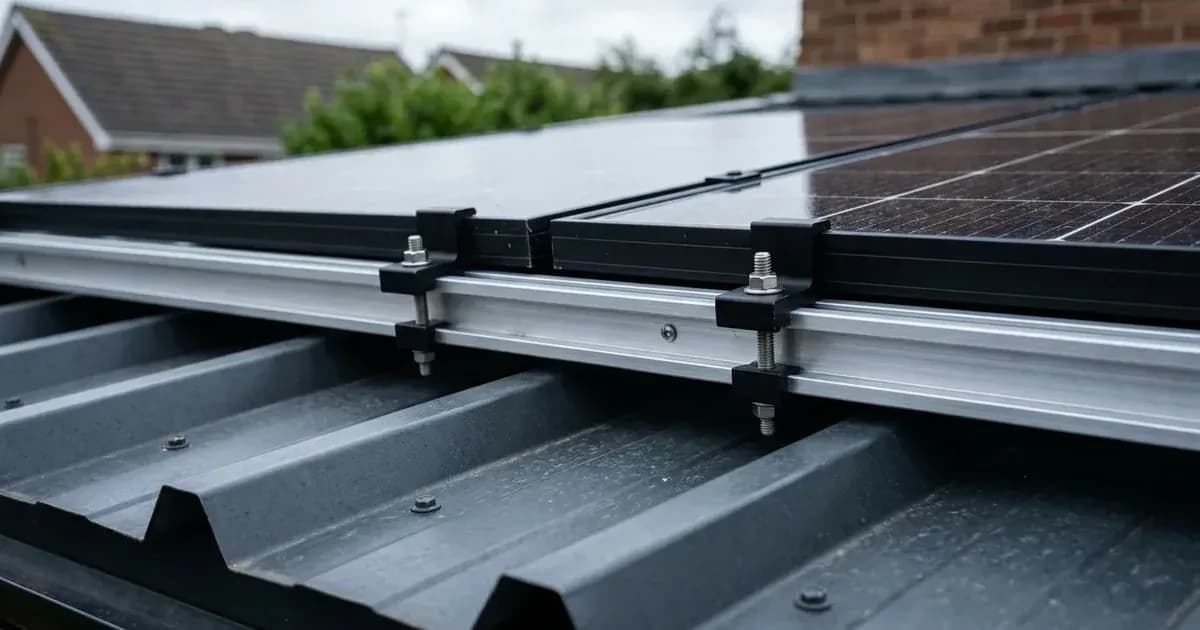
Solar mounting systems attach to UK metal roofs using three distinct engineering methods depending on the profile of the roof cladding. On standing seam profiles, specialized clamps grip the rolled or folded sheet metal ribs directly to achieve completely penetration-free assembly without drilling any fastener holes into the weatherproofing barrier. On trapezoidal sheet metal and sandwich panel elements, lightweight short rails attach directly into the raised sheet crowns with self-tapping fasteners, eliminating pre-drilling into the roof substructure. On corrugated fibre cement or corrugated sheet metal roofs, engineered brackets span across the corrugations to provide secure, watertight structural support.
Unlike traditional installations on pitched roofs detailed in our UK domestic tiled roof solar mounting systems guide or our UK domestic slate roof solar mounting guide, metal roof installations avoid intrusive tile removal or slate cutting. All structural mounting hardware across the K2 Systems network is covered by a baseline 12-year product warranty. When system designers plan the array in K2 Base with static verification and document the installation through K2 DocuApp, this comprehensive warranty protection extends to 20 years.
Standing Seam Clamps: Achieving Penetration-Free Solar Installation
Standing seam roofs are widely installed across modern UK residential extensions, rural barns, and contemporary dwellings due to their clean architectural lines and exceptional longevity. Mounting solar arrays onto these surfaces requires strict preservation of the metal sheeting to prevent any compromise to manufacturer weather-tightness warranties.
Specialized standing seam clamp brackets provide completely penetration-free assembly by clamping tightly around the standing seam folds using precision torque settings. The engineering architecture accommodates diverse metal roofing profiles across the United Kingdom:
- Double standing seam profiles common on traditional zinc and copper roofing.
- Angled standing seam profiles widely specified on modern pre-finished steel roofs.
- Snap seam systems frequently utilized for residential domestic outbuildings.
- Round seam profiles characteristic of industrial roll-formed metal cladding.
By clamping directly onto the vertical seams, the array load is transferred across the roof structure without introducing mechanical penetrations. Direct lateral rail connections link the seam clamps to standard mounting profiles, delivering rapid, flexible installation while preserving the underlying weatherproofing membrane.
K2 MultiRail Systems: Direct-Cladding Fixings for Trapezoidal and Corrugated Roofs
For trapezoidal box profile metal roofs and insulated sandwich panels, the K2 MultiRail platform integrates the roof connection and mounting rail in one component. This component integration delivers rapid planning and minimizes material handling on the roof.
The MultiRail system is engineered to install across roof pitches ranging from 5 to 75 degrees on trapezoidal or corrugated sheet metal. A primary engineering benefit of this direct-attachment approach is that no pre-drilling or time-consuming fixing in the roof substructure is necessary during installation. Installers do not need to locate internal timber rafters or steel purlins through the roof sheet, dramatically accelerating installation velocity while avoiding structural misalignment.
For systems requiring elevated clearance, the MultiRail High variant provides enhanced elevation above the metal sheeting. This physical elevation provides improved rear ventilation of the modules, enabling higher yield by allowing cool ambient air to circulate behind the solar cells and reduce thermal efficiency losses on warm summer afternoons. The increased clearance beneath the modules also enables easier installation of micro-inverters and power optimisation devices directly on the mounting rail network.
Metal Roof Profile | Primary Mounting Technology | Attachment Mechanism | Key Structural Feature | Pitch Range |
|---|---|---|---|---|
Standing Seam | Standing Seam Clamps | Non-penetrating seam clamping | Penetration-free assembly | Pitched roof |
Trapezoidal Sheet | K2 MultiRail / MiniRail | Direct sheet crown fasteners | Roof connection and mounting rail in one component | 5 to 75 degrees |
Corrugated Metal | MultiRail CSM / Brackets | Crown-mounted contoured fixings | Contoured EPDM sealing gaskets | Pitched roof |
Low-Slope Metal | K2 MiniFive MK2 | Direct crown rail with tilt elevation | Additional 5 degree tilt angle | Low pitch slopes |
K2 MiniRail MK2 and MiniFive: Compact Dimensions and 60 mm Airflow Clearance
When working on domestic residential outbuildings, workshops, and garages, physical storage volume and transport logistics represent significant operational considerations. The K2 MiniRail system features compact dimensions that allow for small packaging and low weight, resulting in streamlined site transport and minimal vehicle payload impact.
Like the MultiRail system, MiniRail fastens directly to the raised crowns of trapezoidal metal profiles so that no pre-drilling or time-consuming fixing in the roof substructure is necessary during installation. Several technical variants tailor the platform to specific site requirements:
- MiniRail MK2: Features a standardized MK2 rail channel that enables mounting with the same module clamp on all pitched roof systems, standardizing components across the installer inventory.
- MiniRail 60 MK2: Delivers greater clearance between the module and the trapezoidal sheet metal thanks to a height of 60 mm. This 60 mm air gap optimizes convective airflow behind the solar laminate and ensures that optimizer and micro-inverters can thus be installed beneath the module without contacting the metal roof sheet.
- MiniFive MK2: Incorporates a compact elevation bracket that provides an additional 5 degree inclination for solar modules. This additional 5 degree tilt improves the solar angle of incidence on low-pitch roofs and promotes increased rear ventilation for enhanced solar yield.
For flat metal or membrane surfaces where ballasting or mechanical anchoring is required, installers can review structural guidelines in our UK domestic flat roof solar mounting guide.
Thermal Expansion Management: The K2 BasicRail Floating Connection
Metal roofing materials expand and contract significantly under seasonal temperature fluctuations between cold UK winters and hot summer sunshine. When long aluminum solar mounting rails are anchored rigidly across multiple metal roof sheets, thermal expansion forces can shear sheet fasteners or distort the underlying roof profile.
The K2 BasicRail system resolves this structural challenge through controlled thermal expansion. The installation architecture is exceptionally streamlined, as only four installations steps are required while remaining suitable for high structural loads. Controlled linear expansion along the rail direction is achieved through the floating rail fixation of the BasicClip component.
By allowing the mounting rail to glide within the BasicClip during expansion and contraction cycles, there is no transfer of forces into the roof cladding. This thermal stress isolation preserves the watertight integrity of sheet laps, prevents ovalisation of screw penetrations, and ensures long-term weather-tightness across the complete operating life of the solar energy installation.
Structural Planning, Static Verification and 20-Year Warranties
To ensure that metal roof solar installations withstand UK wind uplift forces and local snow loading, mounting configurations should always undergo rigorous structural calculation prior to procurement.
Every component within the K2 mounting system network is backed by a standard 12-year product warranty. However, installers can substantially enhance client protection: if the project is planned in K2 Base with static verification and documented in K2 DocuApp, the warranty for the mounting system is extended to 20 years.
Digital static verification in K2 Base calculates precise fastener spacing, clamp quantities, and localized wind edge zones according to British Building Regulations and Eurocode standards. Documenting the completed assembly in K2 DocuApp provides photographic proof of correct torque settings and bracket placement, satisfying building control officers and giving property owners enduring confidence in their renewable power investment.
Frequently asked questions
Can you install solar panels on a UK metal roof without penetrating the sheeting?
Yes. On standing seam metal roofs, specialized seam clamps grip the standing seams directly to provide completely penetration-free assembly without drilling holes through the roof sheets.
Do solar mounting rails on trapezoidal roofs require fixing into the timber rafters?
No. Modern short-rail systems like K2 MiniRail and MultiRail fix directly to the crowns of trapezoidal metal sheeting using approved thin-sheet screws, eliminating pre-drilling into the underlying roof substructure.
What is the warranty coverage for K2 metal roof solar mounting systems?
All components carry a standard 12-year manufacturer product warranty, which extends to 20 years when the installation is planned in K2 Base with static calculation verification and documented via K2 DocuApp.
Why is rail height important on metal roof solar installations?
Elevated rails such as the 60 mm MiniRail 60 MK2 provide essential rear ventilation clearance to keep panels cool during peak solar generation and create clearance to install micro-inverters or optimisers beneath the modules.
References
- K2 Systems Product Brochure Mounting Systems — accessed 29 August 2026
Related guides
More from sizing, net billing & installation.