Myenergi Eddi Solar Diverter UK: Technical Installation & Wiring Guide
Updated 18 September 2026 · By SolarNevs Research Desk, Dealer surveys + verified sources · 1 source · Method ↗
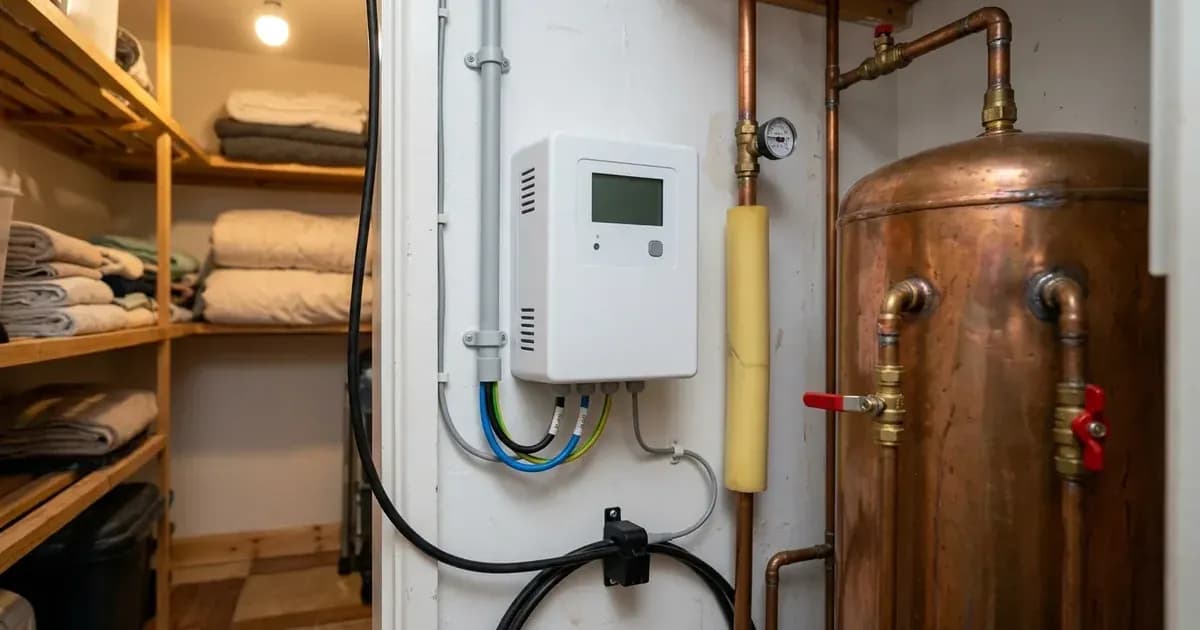
Domestic solar photovoltaic arrays generate surplus electricity during peak daylight hours when household demand is frequently minimal. In an unmanaged solar installation, research suggests that most homeowners use less than 50% of renewable energy at the point of generation, with the remainder simply exported to the grid.
The myenergi eddi solar power diverter addresses this imbalance by acting as an intelligent energy controller. Rather than seeing self-generated energy exported to the grid, the eddi intercepts surplus microgeneration and redirects it into domestic hot water cylinders, thermal stores, or electric heating appliances. By modulating electrical output to match instantaneous surplus, the eddi converts surplus electricity into domestic hot water.
<Callout type="info" title="Key Hardware Specifications: myenergi eddi">
- Maximum Resistive Load: Up to 3.68kW capacity with a mechanical thermostat.
- Minimum Operating Load: Modulates power down to a minimum load of 100W.
- Standby Power Consumption: In standby mode, the eddi uses just 3W of power.
- Grid Sensing Hardware: Supplied with a current transformer clamp with a 5m cable.
- Wireless Comms Option: Wireless CT integration via harvi if physical separation exceeds four meters.
- Origin & Warranty: Designed and manufactured in Britain with a standard 3-year warranty.
</Callout>
Core Operating Principles and Energy Redirection
The primary function of the myenergi eddi is continuous self-consumption optimization. Rather than exporting surplus electricity back to the grid in periods of high generation and low demand, eddi redirects renewable energy to your immersion heater, storage heater, underfloor heating or electric heater.
The internal power circuitry continuously balances home import and export. As solar generation fluctuates due to passing clouds or household appliance use, the eddi adjusts power delivered to the heating element multiple times per second.
This proportional diversion ensures that the immersion element only consumes genuine surplus generation. When self-generation exceeds home consumption, energy is directed to the hot water cylinder rather than exported, maximizing on-site renewable utilization.
Electrical Specifications and Power Consumption
The eddi is engineered for domestic and commercial electrical environments in the UK. In standby mode, the eddi solar power diverter uses just 3W of power. It has a maximum heater load of 3.68kW and a minimum load of 100W.
Electrical Parameter | Technical Specification | Operational Impact |
|---|---|---|
Maximum Continuous Output | Up to 3.68kW resistive load | Full compatibility with standard domestic immersion elements |
Minimum Modulation Threshold | 100W | Allows early morning and late afternoon trickle heating |
Standby Idle Draw | 3W | Negligible parasitic monitoring draw on household supply |
Heater Thermostat Type | Mechanical thermostat only | Electronic thermostats cause control failure and component damage |
Because standard domestic immersion elements in the UK are rated for typical cylinder duty, the 3.68kW ceiling of the eddi provides ample thermal headroom for standard residential immersion cylinders.
System Variants: Single-Phase vs Three-Phase
Properties across Great Britain feature varying service supply architectures. While the majority of domestic homes operate on a single-phase supply, larger residential properties, agricultural holdings, and commercial premises often utilize a three-phase connection.
To accommodate these differing configurations, the system is available in single (eddi) and three-phase (eddi+) model variants, our eco-smart solar power diverter is an essential addition to any modern home. On three-phase properties equipped with three-phase solar inverters, the eddi+ coordinates power management across phases to optimize energy redirection.
Hardware Components and Unboxing
Installing an energy diverter requires dedicated hardware for physical mounting, mains wiring, and radio-frequency data transmission.
When you open the box, you’ll find the eddi unit and supporting mounting bracket, alongside a current transformer with 5m cable, two antennae, a quick start guide, vHub & WiFi Operation Manual, plus fixtures and fittings for use on cable clamps.
The supplied antennae attach to the eddi enclosure, enabling robust communication across the myenergi wireless network to communicate with paired devices such as the myenergi Zappi solar EV charger or the harvi sensor. The vHub functionality provides direct connectivity for remote control and firmware updates.
CT Clamp Placement and Current Sensing
Accurate current measurement at the grid boundary is essential for effective power diversion. Our eddi solar power diverter comes with a CT clamp as standard, alongside a 5m cable.
The current transformer clamp must be clipped around the main incoming meter tails between the electricity meter and consumer unit:
- Orientation: The CT clamp arrow must point toward the consumer unit in the direction of grid import. If installed backwards, the eddi misinterprets solar export as grid import and will not divert power.
- Cable Length Limitations: The supplied CT cable is 5m long. If a longer cable is required, you can extend with a CAT5 Ethernet cable, or by connecting the CT wirelessly with a myenergi harvi.
- Twisted-Pair Requirement: When extending the CT cable using network cabling, a dedicated twisted pair must be used to protect the measurement signal against electromagnetic noise from adjacent wiring.
The myenergi Harvi Wireless Sensor Option
In many UK homes, the hot water cylinder is located in an upstairs airing cupboard while the consumer unit and electric meter are situated in an entrance hallway, garage, or external meter cupboard. Running a physical cable across multiple rooms can be difficult or unsightly.
If the distance between the eddi and your consumer unit is more than four meters, a CT clamp connected to a harvi wireless sensor will be required.
The harvi provides a wireless solution. harvi is our wireless sensor that enables myenergi products to be installed without using a hardwired current transformer. The harvi harvests energy directly from the CT sensor when current flows, transmitting real-time consumption data without requiring external mains power or replacement batteries.
Electrical Sizing and Mechanical Thermostat Compatibility
A critical technical constraint of solid-state power diverters is element thermostat design. Rather than exporting self-generated electricity to the grid, eddi can quickly and simply redirect it to any electrical resistive load up to 3.68kW with a mechanical thermostat.
<Callout type="warning" title="Crucial Installation Safety: Thermostat Compatibility">
The hot water cylinder immersion heater must be equipped with a mechanical thermostat.
Electronic thermostats, digital temperature displays, or smart immersion switches containing solid-state relays must not be connected to the modulated output of the eddi. The variable voltage waveform will cause electronic control circuits to overheat or fail.
</Callout>
During installation, an electrician must confirm that the existing immersion heater utilizes a conventional mechanical bimetallic thermostat before completing commissioning.
Coordinating Eddi with Gas Boilers and Heat Pumps
In homes with central heating, cylinders frequently feature dual heating sources: an electric immersion element and a primary heating coil connected to a gas boiler or heat pump.
Coordinating these sources prevents fossil fuel boilers from heating water when solar generation is imminent. The eddi boost timer can be easily programmed to use a gas boiler to heat water at specific times of low generation (such as early mornings or late evenings), with renewable energy used to heat the home for the remainder of the day.
By setting the timer appropriately, the boiler provides backup heating during early morning hours, while midday solar surplus heats the cylinder without fuel cost. Furthermore, energy storage and smart diverters installed together qualify for tax incentives under UK VAT relief on solar panels and batteries.
Manufacturing Quality and Engineering Standards
The eddi is designed and manufactured right here at our state-of-the-art production facilities in the UK, we pride ourselves on embracing pioneering technology, delivering exceptional build quality, ensuring unmatched product reliability and offering personal customer service.
Manufactured in the UK, the hardware adheres to rigorous British engineering standards, providing durable control for domestic microgeneration systems.
Warranty Coverage and Technical Support
Reliable operation over many years is essential for permanently installed renewable equipment. We’re so confident in our products that our eddi solar power diverter comes with a 3-year warranty as standard, giving you complete peace of mind.
For technical assistance during installation or system setup, direct manufacturer support is available:
- Technical Support Telephone: To speak to us directly, call 0333300 1303 for customer assistance.
- Support Email: Contact customer service at sales@myenergi.com.
For households with domestic solar arrays, the eddi diverter turns surplus solar generation into reliable domestic hot water, cutting energy bills and maximizing self-consumption.
Frequently asked questions
What is the maximum heating load supported by the myenergi eddi?
The myenergi eddi supports any electrical resistive heating load up to 3.68kW with a mechanical thermostat, operating with a minimum load of 100W.
Can the eddi be installed with an electronic cylinder thermostat?
No. The eddi requires a mechanical thermostat because electronic thermostats cannot withstand modulated power control.
Do I need a harvi wireless sensor to install an eddi?
A harvi wireless sensor is required if the distance between the eddi unit and the consumer unit is more than four meters.
What warranty comes with the myenergi eddi in the UK?
The myenergi eddi is designed and manufactured in the UK and includes a 3-year warranty as standard.
References
- myenergi eddi Product Specifications & Documentation — accessed 16 September 2026
Related guides
More from sizing, net billing & installation.