South Africa Commercial Solar Carports And EV Fleet Charging Guide
Updated 15 September 2026 · By SolarNevs Research Desk, Dealer surveys + verified sources · 1 source · Method ↗
Key Takeaways
- Commercial solar energy investments in South Africa qualify for accelerated 100% tax depreciation.
- All grid-tied and hybrid solar PV installations must be officially registered and approved by City Power.
- A registered Master Installation Electrician must issue a supplemental SANS 10142-1-2 Certificate of Compliance (CoC).
- Inverters used in embedded generation systems must be certified to NRS 097-2-1 and listed on an approved equipment register.
Maximising Value: Tax Incentives and Regulatory Compliance for Commercial Solar Carports and EV Charging in South Africa
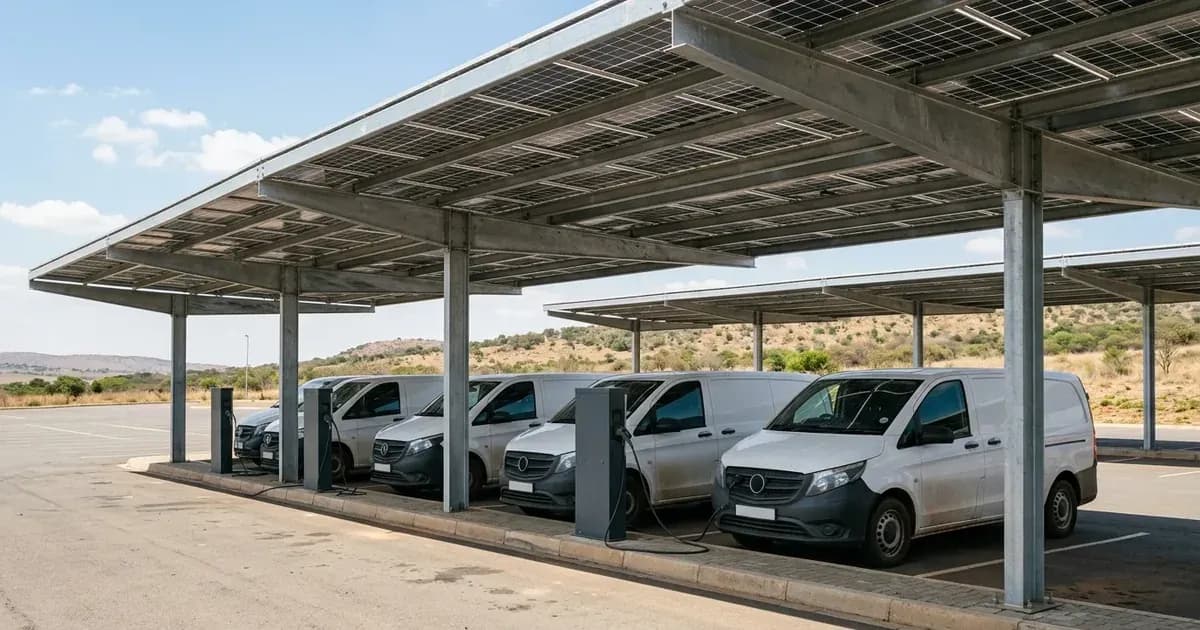
Commercial solar carports combined with EV fleet charging infrastructure offer a dual benefit: generating clean electricity and providing shaded parking with charging capabilities. In South Africa, these investments are supported by specific tax incentives and governed by clear regulatory frameworks. Understanding these is crucial for project viability and compliance.
Commercial and agricultural solar energy investments in South Africa qualify for accelerated 100% tax depreciation. This incentive, under Section 12B of the Income Tax Act, allows businesses to deduct the full cost of their solar energy assets from their taxable income within a single year, significantly improving project economics and payback periods.
All grid-tied and hybrid solar PV installations must be officially registered and approved by City Power. This ensures that the system meets local utility requirements and operates safely within the existing electrical network.
The Mechanism: How Commercial Solar Carports and EV Charging Work
A commercial solar carport integrates photovoltaic (PV) panels into the structure of a parking canopy. These panels convert sunlight into electricity, which can then be used on-site to power buildings, offset grid consumption, or charge electric vehicles. When integrated with EV fleet charging, the generated solar power directly feeds charging stations, reducing reliance on grid electricity for vehicle charging.
The primary benefit of integrating solar carports with EV charging is peak demand shaving. Commercial properties often face high electricity tariffs during periods of peak demand. By generating electricity on-site, especially during sunny daytime hours when demand is typically highest, businesses can reduce the amount of electricity purchased from the grid during these expensive periods. This lowers operational costs and enhances energy independence.
Hybrid solar PV installations often include battery storage, allowing excess solar energy generated during the day to be stored and used later, for example, during evening peak demand or to provide power during grid outages. This further enhances the system's ability to shave peak demand and ensure continuous operation of EV charging points.
Regulatory and Certification Requirements in South Africa
Compliance with South African electrical standards and utility regulations is mandatory for all commercial solar and EV charging installations. These standards ensure safety, reliability, and proper integration with the national grid.
Requirement | What it means | What to do |
|---|---|---|
Regulatory Standard Compliance | "All grid-tied and hybrid solar PV installations must be officially registered and approved by City Power." | Submit detailed system designs and documentation to City Power for approval prior to installation. |
Equipment Listing and Safety | "A registered Master Installation Electrician must issue a supplemental SANS 10142-1-2 CoC." | Ensure a qualified Master Installation Electrician oversees and certifies the electrical work. |
Overcurrent Protection Sizing | "Embedded generation inverters must be certified to NRS 097-2-1 and listed on the approved equipment register." | Select inverters that comply with NRS 097-2-1 and verify their listing on the approved equipment register. |
System Rapid Shutdown Architecture | "Zero-export installations must incorporate a certified reverse power relay that blocks unauthorized feed-in." | Install a certified reverse power relay to prevent any unintended export of power to the grid. |
Main Electrical Bonding Standard | "A lockable double-pole AC isolation switch must be positioned near the consumer distribution board." | Install a clearly marked, lockable double-pole AC isolation switch for safety and maintenance. |
Commissioning Sign-Off Protocol | "Class I and Class II surge arresters must protect all DC string inputs and main AC distribution panels." | Integrate appropriate surge protection devices on both DC and AC sides of the system. |
Circuit Arc-Fault Protection | "The installation must include automatic neutral-earth bonding relays during off-grid islanding operation." | Ensure the system design incorporates automatic neutral-earth bonding relays for safe off-grid operation. |
Switchboard Ampacity Rules | "The entire hybrid generating installation must be certified with a formal SANS 10142-1-2 CoC." | Obtain a comprehensive SANS 10142-1-2 CoC for the complete hybrid generating installation. |
What You Can Check Yourself, and What You Cannot
As a commercial property owner or facility manager, you can perform certain visual checks and monitor system performance, but most electrical work and system modifications require accredited professionals.
What you can check yourself:
- Visual inspection: Regularly check solar panels for obvious damage, dirt accumulation, or shading. Ensure charging stations are clean and free from obstructions.
- Performance monitoring: Review the system's energy generation and EV charging data through the inverter or energy management system's interface. Look for consistent output and identify any sudden drops in performance.
- Basic safety checks: Ensure all accessible safety signage is clear and intact. Verify that emergency stop buttons on EV chargers are not obstructed.
What you cannot do yourself:
- Electrical work: Any work involving wiring, connections, or components within the electrical system must be performed by a qualified and registered electrician. This includes tightening or disconnecting terminals. Always kill power first, use insulated tools, and be aware that a spanner across a battery bank can short hundreds of amps.
- Inverter settings: Do not attempt to change inverter settings. Grid-protection settings are configured by an accredited installer to comply with NRS 097-2-1 and utility requirements. Incorrect settings can breach your connection agreement or compromise safety.
- Opening electrical enclosures: Opening the inverter, distribution boards, or other electrical enclosures is authorised-service work only. Isolate PV, battery, and AC breakers, then wait the manual's capacitor-discharge time before any authorised service.
- Certification and compliance: Obtaining and maintaining the necessary Certificates of Compliance (CoCs) and utility approvals is the responsibility of accredited professionals.
What the published sources do not tell you
While official documentation outlines critical regulatory and tax information, it does not detail specific technical specifications for equipment, nor does it provide guidance on site-specific engineering challenges.
- System Architecture & Sizing: The optimal size and configuration of a solar carport and EV charging system are highly dependent on the specific site's energy consumption patterns, available space, and EV fleet size. This requires detailed engineering analysis, not general guidelines.
- Wiring & Isolation: Specific wiring diagrams, cable sizing, and isolation points are determined by the detailed electrical design, which must comply with national electrical codes and be verified by an accredited electrical engineer. These are unique to each installation.
- Commissioning & Maintenance: published guidance does not provide a step-by-step commissioning protocol or a detailed maintenance schedule. These are typically outlined in manufacturer manuals and project-specific documentation, including pre-commissioning checks, insulation resistance testing, and polarity verification prior to final energization.
- Utility-specific connection requirements: While City Power approval is mentioned, specific technical requirements can vary by local municipality or network service provider within South Africa. These details are often found in local bylaws or specific connection agreements.
- Section 12B application process: official documentation confirms the eligibility for 100% tax depreciation but does not detail the administrative process for claiming this incentive with the South African Revenue Service (SARS). This typically involves working with a tax professional.
Frequently asked questions
What are the primary technical requirements for south africa commercial solar carports and ev fleet charging guide?
Key requirements include compliance with local grid codes, correct equipment certification, and proper electrical isolation.
Who is authorized to install and inspect south africa commercial solar carports and ev fleet charging guide?
All high-voltage DC, AC grid tie-in, and switchboard modifications must be performed by a qualified, accredited electrical professional.
How is export power limited in south africa commercial solar carports and ev fleet charging guide?
Export limiting is achieved using certified bidirectional smart meters or power sensors providing dynamic feedback to the inverter system.
References
- Eskom Distribution: Small-Scale Embedded Generators (SSEG) registration and connection requirements — accessed 15 September 2026
Related guides
More from inverter errors & fixes.