Solar Inverter Arc Fault AFCI Troubleshooting in Ireland
Updated 19 September 2026 · By SolarNevs Research Desk, Dealer surveys + verified sources · 3 sources · Method ↗
Key Takeaways
- Diagnostic code 1040 afci protection triggers when an inverter senses electrical arcing across high-voltage DC string cabling.
- Due to loose connection inverter detect arc in dc circuit conditions; poor contact resistance creates intense thermal hotspots.
- Ensure crimping is proper done with crimp tool and verify that conductor insulation is not captured within connector blocks.
- Physical checks must include verifying that PV panels are not cracked or damaged and confirming string conductor polarity.
- Irish wiring regulations mandate compliance with NSAI I.S. 10101, incorporating an AC isolator 2 pole switching live and neutral.
What is a solar inverter arc fault (AFCI) in Ireland?
Modern solar inverters installed across Ireland are equipped with advanced Arc Fault Circuit Interrupter (AFCI) firmware. When the internal digital signal processor detects the characteristic high-frequency electrical noise of an electric arc on the DC lines, it trips code 1040 afci protection and shuts down power conversion within milliseconds.
Unlike alternating current, which crosses zero voltage fifty times per second, direct current from rooftop solar panels does not naturally extinguish once an arc ignites. A sustained DC arc can generate plasma temperatures exceeding several thousand degrees, presenting an immediate electrical fire risk.
Ginlong Solis technical service documentation confirms that due to loose connection inverter detect arc in dc circuit events most frequently. Homeowners and contractors must never ignore or bypass this critical protection feature.
In domestic installations across Ireland, cyclical weather variations between cold damp mornings and bright afternoon sun cause subtle thermal expansion and contraction across exterior DC cabling. If terminal connections or plug crimps were improperly torqued during initial installation, minute contact gaps emerge over time. Under high string current flow, these gaps generate electrical discharge and continuous thermal stress.
Primary Root Causes of DC Arc Faults
Systematic inspection of the DC cabling run between the rooftop solar array and the inverter reveals several common workmanship and environmental root causes.
Underlying Defect | Failure Mechanism | Verification Protocol |
|---|---|---|
Inadequate Terminal Torque | Loose screw blocks create micro-arcing | Check DC connection tightness and ensure crimping is proper done with crimp tool |
Poor MC4 Crimping | High-resistance conductor interface | Use calibrated ratchet tooling; avoid hand-pliers on terminal pins |
Trapped Insulation | Conductor stripping length too short | Verify improper stripping length can result in wire insulation being captured in terminals |
Module Damage | Cracked glass or delaminated backsheet | Inspect rooftop modules: pv panels are cracked or damaged |
DC String Polarity | Reversed positive and negative terminations | Confirm string polarity: please ensure that dc strings polarity also should be proper |
Workmanship and Terminal Integrity
The vast majority of 1040 alarms on newly installed or recently serviced systems trace back to termination workmanship:
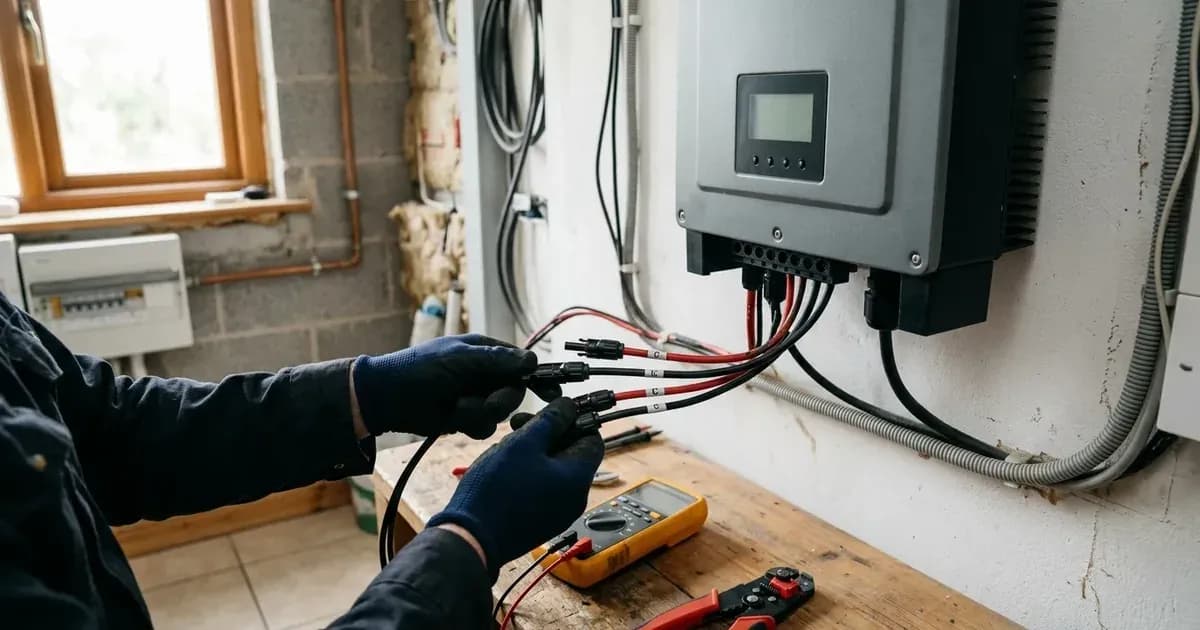
- Crimping Quality: Installers must check DC connection tightness and ensure crimping is proper done with crimp tool rather than generic pliers, ensuring tight copper contact.
- Insulation Stripping: Wire stripping requires precise calibration. Improper stripping length can result in wire insulation being captured in terminals, preventing solid metal-to-metal contact and creating a high-resistance point that arcs under load.
- Polarity Verification: Installers must ensure string polarity is aligned: please ensure that dc strings polarity also should be proper to avoid catastrophic internal bridge failure.
- Module Integrity: Environmental damage or physical impact during transit can breach cell laminates. Technicians must inspect whether pv panels are cracked or damaged, as physical fractures can cause internal arcing within the photovoltaic laminate.
String Multimeter Testing and Diagnostics
Before attempting to clear an AFCI fault code, an electrician must evaluate historical telemetry and perform physical electrical measurements.
Advanced Diagnostic Menus
To understand the operating conditions immediately preceding the trip, contractors should take reading from advance info alarm messages version running messages warning messages on the inverter display interface. This log details whether the arc occurred under maximum string current or during low-light startup.
Multimeter Earth Potential Ratio Test
To determine whether an arc fault is accompanied by an insulation breakdown to earth:
- Use a multimeter to check the voltages between PV positive and earth, and PV negative and ground across all strings.
- Measured values should be decreasing from values between 5% and 95% of single PV module VOC.
- If the voltage remains stuck above single module open-circuit voltage or increases instead of decreasing, there is an active ground fault or conductor breakdown on that string.
Safe Electric Standards & Irish Installation Compliance
Rectifying high-voltage DC arc faults in Ireland requires strict adherence to national electrical wiring rules and statutory isolation requirements.
Safe Electric & I.S. 10101 Safety Notice: Rooftop solar strings operate at hazardous DC voltages that cannot be shut off while sunlight hits the array. Never disconnect MC4 connectors under load, as drawing an open DC arc can cause severe burns and equipment fires. All physical testing and re-termination work must be completed by a Safe Electric Registered Electrical Contractor (REC).
Under Safe Electric technical requirements and NSAI I.S. 10101:2020:
- General Workmanship: All fixed wiring and conductor terminations must satisfy clause 134 1 7 of the national wiring rules.
- Isolation Devices: Isolating devices must be selected and positioned in accordance with clause 537 1 2.
- Photovoltaic Disconnection: Dedicated PV string disconnection switches must comply with clause 712 537 4 1 2, allowing complete mechanical isolation of the DC array from the inverter.
- Product Safety: Inverters must meet the requirements of EN 62109 and comply with EN50549.
- Efficiency Standards: Equipment must comply with I S 10101 and have a rated efficiency of 95 percent.
- AC Isolation: An AC isolator 2 pole switching live and neutral must be installed between the inverter and the consumer unit.
- Placard Requirements: A permanent warning placard stating "Inverter Isolate AC and DC before carrying out work" must be fixed on the inverter chassis.
By following Safe Electric isolation mandates, re-crimping loose terminals with calibrated tools, and verifying string earth potentials, contractors can permanently eliminate DC arcing risks and restore safe microgeneration.
Frequently asked questions
What does code 1040 AFCI protection mean on a solar inverter?
Diagnostic code 1040 indicates that the inverter detected an electrical arc in the DC circuit, usually caused by loose connections, damaged cables, or poor terminal crimping.
What causes an arc fault on a domestic solar PV array in Ireland?
Common causes include loose screw terminals, poorly crimped MC4 plugs, cracked solar panels, improper cable stripping length where insulation gets caught in terminals, or moisture-induced corrosion.
Can I simply reset an AFCI arc fault alarm on my inverter?
No. You should never simply clear or bypass an AFCI alarm without a physical inspection. An electrical arc generates intense localised heat that poses an active fire hazard until rectified by a qualified electrician.
What Safe Electric clauses govern solar PV disconnection devices in Ireland?
Under NSAI I.S. 10101 national wiring rules, workmanship is governed by clause 134 1 7, isolation device selection by clause 537 1 2, and dedicated PV array disconnection switches by clause 712 537 4 1 2.
References
- Solis Service Portal - 1040 AFCI Protection — accessed 17 September 2026
- Safe Electric Ireland - Relevant Clauses for Solar PV Systems — accessed 17 September 2026
- SEAI - Domestic Solar PV Code of Practice for Installers — accessed 17 September 2026
Related guides
More from inverter errors & fixes.