Total Generation Meter Stopped Working: UK Feed-in Tariff Diagnostic and Replacement Guide
Updated 18 September 2026 · By SolarNevs Research Desk, Dealer surveys + verified sources · 3 sources · Method ↗
Key Takeaways
- Introduced on 1 April 2010, the scheme requires participating licensed electricity suppliers to make payments on electricity generated and exported by accredited installations.
- The FIT scheme closed to new applicants from 1 April 2019, making existing accredited generation meters highly valuable financial assets with Retail Price Index (RPI) indexed payments.
- Under Ofgem rules, If you are the generator of an MCS-FIT installation, you only need to notify your FIT licensee when a meter fails or is replaced.
- Statutory regulations require that a generation meter must be replaced whenever it is replaced, removed or begins measuring electricity that is not generated by the accredited installation.
- Electrical safety warning: Generation meters are connected directly across live mains alternating current circuits; replacement requires certified safe isolation procedures and must never be attempted by unqualified homeowners.
1. Statutory framework and financial value of the Feed-in Tariff
The Feed-in Tariffs (FIT) scheme was designed by government to promote the uptake of renewable and low-carbon electricity generation. Introduced on 1 April 2010, the scheme requires participating licensed electricity suppliers to make payments on electricity generated and exported by accredited microgeneration installations.
The scheme’s legal framework is contained in the Feed-in Tariffs Order 2012. While The FIT scheme closed to new applicants from 1 April 2019, hundreds of thousands of British homeowners remain accredited under twenty-year contracts.
For these generators, maintaining an accurate Total Generation Meter is essential. Under scheme rules, Generation and export tariffs are adjusted every financial year by the Retail Price Index (RPI). Because early contracts pay generous rates (often exceeding 50p per kilowatt-hour generated), a stopped generation meter directly stops index-linked income.
Furthermore, Ofgem confirms that This page is for the owners of accredited installations, known as FIT Generators. Even though the scheme is closed to new applicants, existing generators can optimize earnings: Most accredited FIT installations will be eligible for the SEG, provided they have a smart or export meter capable of measuring exported power.
Scheme Parameter | Statutory Specification | Regulatory Reference |
|---|---|---|
Historical Scheme Launch | Introduced on 1 April 2010, the scheme requires participating licensed electricity suppliers to make payments on electricity generated and exported by | Ofgem FIT Overview |
Primary Legal Basis | The scheme’s legal framework is contained in the Feed-in Tariffs Order 2012 | Ofgem FIT Overview |
Closure to New Entrants | The FIT scheme closed to new applicants from 1 April 2019. | Ofgem FIT Overview |
Inflation Protection | Generation and export tariffs are adjusted every financial year by the Retail Price Index (RPI) | Ofgem FIT Generators |
Meter Replacement Notification | replaced, removed or begins measuring electricity that is not generated by the accredited installation | Ofgem FIT Generators |
Licensee Communication Protocol | If you are the generator of an MCS-FIT installation, you only need to notify your FIT licensee. | Ofgem FIT Generators |
2. Metrology standards and meter display diagnostics
Under British metering law, every trade instrument used to calculate payments must comply with strict physical standards. Statutory regulations state that Indication of the result shall be by means of a display or hard copy. Furthermore, The indication of any result shall be clear and unambiguous and accompanied by such marks and inscriptions necessary to inform the user of the significance of the result. To ensure consumer accessibility, Easy reading of the presented result shall be permitted under normal conditions of use.
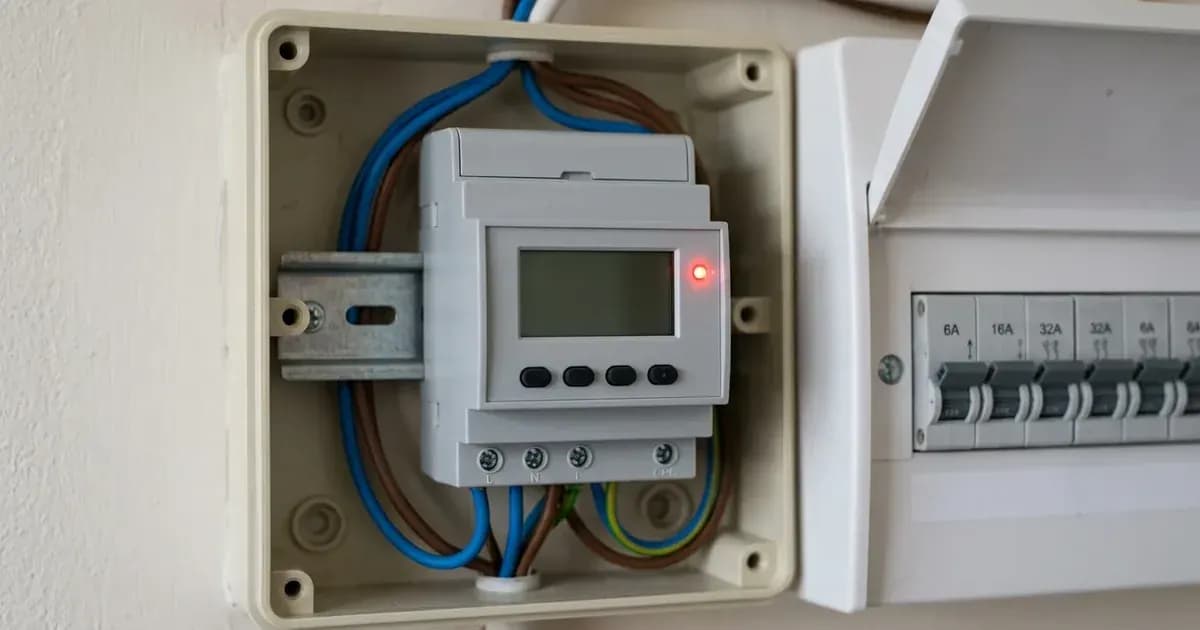
If your total generation meter stops recording, observe the display and the optical pulse LED on the meter face (such as an Elster A100C, Landis+Gyr, or Emlite ECA2 meter):
Symptom 1: Completely Blank LCD Screen
If the liquid crystal display is completely dead with no numbers showing:
- Check whether the solar generation breaker in your consumer unit has tripped.
- If the inverter is actively generating power, the meter internal power supply or LCD logic has failed.
- The meter must be replaced by an electrician, as internal non-volatile memory chips cannot be read from a burnt-out screen.
Symptom 2: Solid Red Indicator Light (Not Flashing)
On all UK generation meters, a red light-emitting diode (LED) flashes to signify energy flow (typically 1000 pulses per kilowatt-hour):
- If the red LED remains lit continuously without flashing, the meter has mains voltage power but detects zero current flow.
- Check your solar inverter screen: is the inverter displaying a grid fault, isolation alarm, or is it in night-time standby mode?
- If the inverter is generating power (for example, showing active kilowatt output), but the generation meter red light stays solid, the internal shunt metrology is defective or the AC output wiring has become open-circuit.
Symptom 3: Numbers Have Frozen Despite Bright Sun
If the mechanical cyclometer counter or digital LCD displays numbers that never advance across weeks of sunny weather:
- The internal register gear or metrology microcontroller has seized.
- Record the frozen number immediately; this represents the final closing reading for your licensee.
3. Mandatory notification procedures for meter replacement
When a generation meter fails, homeowners often fear losing their Feed-in Tariff accreditation. However, the regulatory framework clearly accommodates meter replacement.
Under Ofgem guidance:
- Licensee Notification: If you are the generator of an MCS-FIT installation, you only need to notify your FIT licensee. You do not need to notify Ofgem directly unless your system was originally certified under the commercial ROO-FIT process.
- Replacement Trigger: You must formally notify your licensee whenever a generation or export meter is replaced, removed or begins measuring electricity that is not generated by the accredited installation.
- Deemed Export Considerations: If your installation is on deemed export, replacing your generation meter does not impact your export status. However, if you subsequently install a smart meter for the SEG, deemed export payments’, then these will stop and you will instead receive export payments for the amount of electricity recorded by the meter exporte.
4. Step-by-step replacement and claim process
To protect your Feed-in Tariff revenue when your meter fails:
Step 1: Capture Evidential Photographs
Before anyone touches the installation, take high-resolution, timestamped photographs showing:
- The front face of the faulty generation meter, capturing the frozen reading and the unique serial number stamped on the case.
- The overall installation board, showing the meter, the AC rotary isolator, and the solar generation label.
- The active inverter display screen, proving that solar power is being generated.
Step 2: Contact Your Registered FIT Licensee
Inform your supplier's Feed-in Tariff department that your generation meter has ceased functioning. Request their standard Meter Replacement Form and ask what photographic evidence they require.
Step 3: Hire an Accredited Electrician
Hire a qualified electrician to install a replacement meter. The replacement meter MUST carry the official European Measuring Instruments Directive (MID) approval stamp (identifiable by the letter 'M' and year inside a rectangle). Non-MID meters are legally invalid for FIT payments.
Step 4: Submit Completion Documentation
Once installed, take clear photographs of the new meter showing its serial number and initial opening reading (which should be near zero kilowatt-hours). Submit the electrician's commissioning certificate, the old meter removal photograph, and the new meter installation photograph to your licensee.
Step 5: Request Estimated Generation Reconciliation
Your FIT licensee will close off your old meter account at the final recorded reading and open the new account. To recover generation revenue lost during the breakdown period, submit a formal request for estimated generation based on your historical generation readings from the same quarter in previous years.
Frequently asked questions
What should I do if my solar generation meter display goes completely blank?
First, verify whether your inverter is generating power. If the inverter green light is on and producing kilowatt-hours, the meter metrology or LCD battery has failed. Contact an accredited electrician to inspect the meter and notify your FIT licensee.
Will I lose my Feed-in Tariff payments while my generation meter is broken?
No, provided you act quickly. If you document the failure immediately with photographs and notify your FIT licensee, suppliers can calculate deemed or estimated generation payments based on your historic seasonal generation profile.
Can I replace my solar generation meter myself?
No. Generation meters are connected directly into the mains wiring between the inverter and consumer unit, carrying lethal shock hazards. Replacements must be installed by a qualified electrician and must carry official MID approval.
What does a solid red light on my solar generation meter mean?
A pulsing red LED indicates active power generation (typically 1000 pulses per kWh). A solid, continuous red light means the meter is energized with voltage but is detecting zero power flow, meaning the solar inverter is in standby, off, or disconnected.
References
- Ofgem: Feed-in Tariffs (FIT) Scheme Overview — accessed 29 August 2026
- Ofgem: Guidance for FIT Generators — accessed 29 August 2026
- UK Statutory Instruments: Measuring Instruments Regulations 2006 (SI 2006/2647) — accessed 29 August 2026
Related guides
More from inverter errors & fixes.