UK GivEnergy EV Charger Solar Integration Guide
Updated 18 September 2026 · By SolarNevs Research Desk, Dealer surveys + verified sources · 1 source · Method ↗
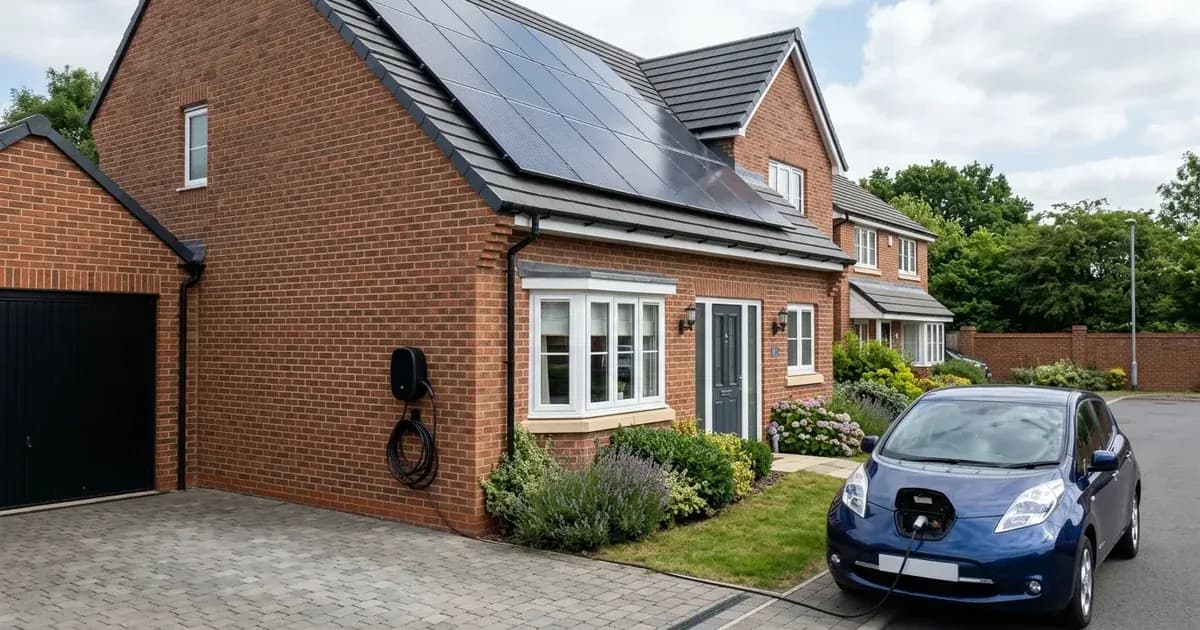
Pairing residential electric vehicle charging with domestic rooftop solar photovoltaic generation and home battery storage unlocks significant running-cost reductions for UK homeowners. While standard electric vehicle chargepoints draw indiscriminate power from the national grid at prevailing retail unit rates, a solar-integrated smart chargepoint dynamically diverts surplus daytime photovoltaic export directly into the vehicle battery.
The GivEnergy 7kW EV Charger is an intelligent, single-phase residential charging solution engineered to integrate natively into the wider GivEnergy energy management ecosystem. Operating alongside GivEnergy hybrid or AC-coupled inverters and Giv-Bat storage systems, the unit enables homeowners to charge vehicles using self-generated solar electricity, off-peak grid tariffs, or stored battery energy without requiring third-party diversion controllers.
<Callout type="info" title="Key Takeaways: GivEnergy 7kW EV Charger">
- Power Delivery: Delivers up to 7 kW continuous charging output at 32 A across standard 230 V single-phase domestic supplies.
- Solar Diversion Modes: Provides zero-export solar diversion to charge electric vehicles using self-generated photovoltaic, wind, or hydro generation.
- Integrated Safety: Features built-in Type B RCD protection and PEN fault detection, eliminating the need for an external driven earth electrode on PME (TN-C-S) supplies.
- Ecosystem Synchronization: Allows homeowners to manipulate energy flows directly between GivEnergy stationary batteries and the vehicle charger.
- Smart Tariff Integration: Supports automated scheduling to capitalise on off-peak electricity tariffs (such as Economy 7, Octopus Go, and Intelligent Octopus).
- Enclosure & Build: Encased in a rugged IP65 weather-resistant PC + ASA enclosure operating across temperatures from -30°C to +55°C.
</Callout>
Electrical Architecture & Charging Specifications
The GivEnergy EV Charger is designed for straightforward wall-mounted installation on UK residential domestic electrical systems. Operating from a nominal 230 V single-phase alternating current supply at 50/60 Hz, the unit supplies up to 7 kW of continuous charging power at 32 A.
Supply connection is established via a standard 3-wire arrangement comprising live, neutral, and protective earth conductors (L, N, PE). The vehicle charging interface uses a standard IEC 62196-2 Type 2 connection:
Electrical Parameter | Specification / Rating | Technical Description |
|---|---|---|
AC Nominal Input | 230 V, 32 A, 1-phase | Standard domestic alternating current supply |
Rated Charging Output | 7 kW / 32 A | Maximum continuous power delivery to vehicle onboard charger |
Supply Frequency | 50/60 Hz | National Grid synchronised operating frequency |
Wiring Configuration | 3-wire (L, N, PE) | Phase, neutral, and protective earth conductors |
Connector Standard | IEC 62196-2 Type 2 | Universal European standard vehicle inlet socket |
Enclosure Protection | IP65 | Weatherproof casing suitable for external and garage mounting |
Thermal Operating Range | -30°C to +55°C | Sub-zero to high-ambient thermal operating envelope |
Operating Humidity | Up to 95% non-condensing | High moisture resistance in external British conditions |
Cooling Architecture | Natural convection | Fanless silent passive cooling without mechanical moving parts |
Chassis Dimensions | 288H × 260W × 112D mm | Compact wall-mounted domestic form factor |
Chassis Net Weight | 4.5 kg | Lightweight wall-fixable structure |
Casing Material | PC + ASA | Impact-resistant polycarbonate composite housing |
```
GIVENERGY RESIDENTIAL SYSTEM ARCHITECTURE
══════════════════════════════════════════════════════════
Rooftop Solar PV Array ──┐
│ (DC)
▼
GivEnergy Hybrid / AC Inverter
│ │
(DC) │ │ (AC)
▼ ▼
Giv-Bat Storage Consumer Unit (230V / 32A)
│
▼
GivEnergy 7kW EV Charger
│
▼ (Type 2 / 5m)
Electric Vehicle (EV)
```
Integrated Electrical Protection: PEN Fault Detection & RCD
Under British Standard BS 7671 (The IET Wiring Regulations Section 722), connecting an electric vehicle chargepoint to a domestic protective multiple earthing (PME / TN-C-S) supply presents a potential electric shock hazard if the supply neutral conductor breaks upstream in the distribution network (loss of PEN). Historically, compliance required driving a copper earth rod deep into the ground adjacent to the chargepoint.
The GivEnergy EV Charger resolves this regulatory complexity through internal engineering:
- PEN Fault Protection: Built-in protective PEN fault detection continuously monitors the incoming supply voltage and disconnection thresholds. In the event of a broken supply neutral or supply phase imbalance, the internal contactors isolate phase, neutral, and earth simultaneously, preventing dangerous voltages on the vehicle body without requiring an external driven earth rod.
- Type B RCD: An integrated Type B RCD provides comprehensive residual current detection against both standard alternating current leakage and pure direct current (DC) smooth fault currents originating from the vehicle's onboard battery and rectifier systems.
Solar Diversion Modes & Operational Logic
The primary economic advantage of integrating a GivEnergy EV charger into a solar PV home is dynamic diversion. Standard electric vehicle charging draws up to 7 kW immediately upon connection, which exceeds typical domestic rooftop solar output (3 kW to 5 kW) and forces substantial grid imports. The GivEnergy charger offers smart operating modes via the GivEnergy mobile application and cloud portal:
1. Solar Diversion (Zero-Export Mode)
In solar divert mode, the charger continuously polls the GivEnergy inverter and household CT clamp telemetry. When photovoltaic generation exceeds the baseline household demand, the charger modulates its output to match available excess solar power, directing surplus energy into the car battery rather than exporting it to the grid for standard SEG export tariffs.
2. Off-Peak Smart Tariff Scheduling
Homeowners on half-hourly or time-of-use tariffs (such as Economy 7, Octopus Go, or Intelligent Octopus) can configure automated schedules to charge their vehicle during off-peak overnight hours when electricity rates drop to their lowest levels.
3. Battery-to-EV Manipulation
Within the GivEnergy ecosystem, users can manipulate the flow of energy from your storage battery to your EV charger. This allows a homeowner who charged their Giv-Bat stationary storage on cheap overnight off-peak power (or daytime solar) to discharge that stored battery energy directly into the vehicle battery during evening peak periods.
```
OPERATING CHARGING MODES
─────────────────────────────────────────────────────────
Mode A: Solar Divert ──► Directs 100% excess solar into EV
Mode B: Off-Peak Grid ──► Charges at night on cheapest tariffs
Mode C: Battery Boost ──► Transfers stored Giv-Bat energy to EV
```
Telemetry, Smart Standards & Network Connectivity
The GivEnergy EV charger features robust wired and wireless connectivity (LAN/WiFi), ensuring uninterrupted real-time telemetry communication with the GivEnergy Cloud Portal.
For commercial fleet compatibility and interoperability with public or employer energy billing systems, the charger incorporates native OCPP 1.6J compliance. This open protocol standard enables communication with standard Open Charge Point Protocol back-office platforms, future-proofing the charger for automated vehicle-grid integration and smart energy settlement.
Frequently asked questions
What is the charging capacity of the GivEnergy EV Charger?
The GivEnergy EV Charger delivers a continuous charging output of up to 7 kW at 32 A from a standard single-phase 230 V domestic supply.
Does the GivEnergy EV charger require an external earth rod?
No. The unit features integrated PEN fault detection and built-in Type B RCD protection, eliminating the need for an external earth electrode on PME supplies.
Can the GivEnergy charger divert surplus solar generation into an electric vehicle?
Yes. The charger provides zero-export solar diversion modes, allowing homeowners to charge vehicles directly using excess domestic solar generation.
Can the charger draw energy from a GivEnergy home battery?
Yes. Homeowners can manipulate energy flows directly within the ecosystem to dispatch stored battery energy into the vehicle when required.
References
- GivEnergy EV Charger Official Product Specification — accessed 29 August 2026
Related guides
More from sizing, net billing & installation.