Sunsynk and Deye Microgrid Frequency Droop Control Guide
Updated 16 September 2026 · By SolarNevs Research Desk, Dealer surveys + verified sources · 5 sources · Method ↗
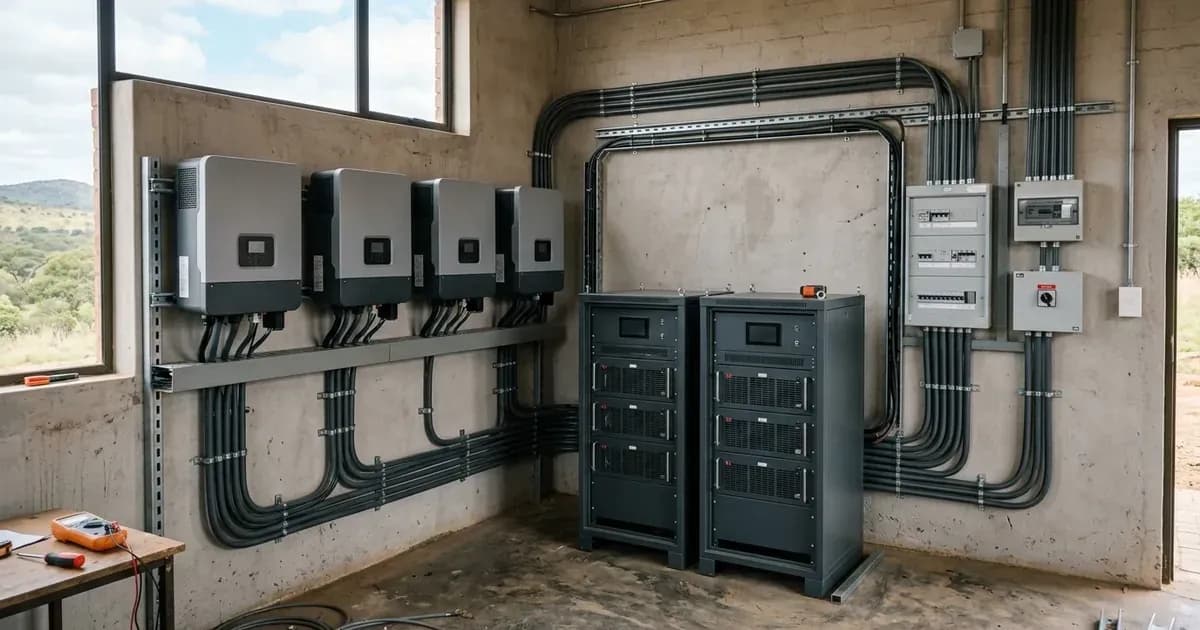
<!-- visual_plan: Architecture diagram comparing normal grid-tied microgrid frequency vs islanded frequency-watt droop curtailment response curves --> <!-- hero-pending: Detailed diagram illustrating AC-coupled microgrid frequency modulation from 50.0Hz to 52.0Hz for solar power curtailment -->
Overview: Frequency-Watt Control in Islanded Microgrids
In grid-forming microgrids and backup power installations, pairing existing grid-tied string inverters with a hybrid battery inverter allows facilities to utilize solar generation during outages and load-shedding. When the utility grid disconnects, the primary hybrid inverter forms the local AC voltage and frequency reference.
To prevent battery overcharging when solar generation exceeds instantaneous site demand, the hybrid inverter relies on frequency-watt droop control. Official technical documentation confirms that "the larger main Sunsynk unit controls the output of the connected inverter in string set-up by frequency shifting." As battery state-of-charge rises toward target thresholds, the master inverter increases local AC frequency above standard nominal 50.0Hz, prompting grid-tied string inverters to modulate their power output downward in accordance with standard overfrequency power reduction curves.
Microgrid frequency-watt regulation operates across three operational thresholds:
- Nominal Grid (50.0 Hz): Full 100% String Solar Output.
- Droop Modulation Begins: Linear Throttling Activated.
- Curtailment Cut-off (52.0 Hz): Complete Inverter Disconnection.
Sizing Ratios and Inverter Integration Rules
When integrating grid-tied string inverters or microinverters into an AC-coupled microgrid via the auxiliary/generator terminals of the hybrid inverter, strict sizing ratios must be maintained to prevent frequency instability and inverter tripping.
Parameter | Manufacturer Specification | Operational Impact |
|---|---|---|
Max String Inverter Sizing | "the string inverter size must NOT exceed the size of the Sunsynk inverter." | Prevents reverse power surge from overpowering the hybrid inverter AC stage. |
Combined DC and AC Solar | "recommend the string inverter connected has a power rating of no more than half of the Sunsynk Inverter." | Balances hybrid DC MPPT inputs with auxiliary AC input capacity. |
Minimum MPPT Voltage | "Generally, this is 125V per MPPT" | Minimum DC array operating threshold required to initiate solar production. |
Max PV Input Voltage | Exceeding limits "can disable export and can also risk damage to the MPPT inputs." | Protects internal DC bus capacitors and power electronics from overvoltage. |
Max Parallel Units | "The maximum number of Inverters in parallel is 10." | Governs multi-inverter microgrid scalability and cluster synchronization. |
Managing F47 AC Overfrequency Faults
During aggressive solar throttling or when microgrid loads drop suddenly with fully charged batteries, the hybrid inverter rapidly elevates the AC bus frequency toward the upper disconnection boundary. This triggers protective responses on the downstream string inverter:
- Expected Alarm State: When the downstream inverter senses the intentional frequency rise, an overfrequency alarm is logged. The manufacturer documentation explicitly states: "Therefore, when the smaller inverter detects a frequency shift outside the permitted range, an F47 AC_OverFreq_Fault is triggered. This alarm can therefore be expected in this set-up, and the unit is operating as designed."
- Automatic Reconnection: Once site load increases or battery storage capacity becomes available, the hybrid inverter restores nominal 50.0Hz frequency. After standard reconnection delay timers expire, the string inverter automatically resumes generation.
DC Bus Stability and Voltage Discrepancy Protection
Stable microgrid operation depends on precise DC battery bus voltage tracking between the inverter power stage and the battery management system (BMS):
- Voltage Divergence Cut-off: "If there is a voltage discrepancy of more than 1.5 volts between the inverter battery terminals and the BMS voltage, the inverter will halt PV production until the issue is resolved."
- Thermal De-rating Limits: When cold ambient conditions cause battery cell temperatures to fall toward 0°C, charging current is restricted to prevent lithium plating, requiring ambient recovery above 12°C to restore full charge throughput.
What You Can Change Yourself, and What You Cannot
Plant managers and qualified system operators can configure basic operational parameters via local console interfaces or mobile monitoring portals:
- Basic Operational Adjustments: Users can monitor real-time microgrid power flow, state-of-charge percentage, and frequency levels on the main display.
- Safety and Electrical Work: Physical AC coupling interconnections, auxiliary breaker installations, and subboard modifications must be executed by a registered person in compliance with South African embedded generation standards. Working with live AC switchgear or DC high-voltage battery terminals carries severe electric shock and arc-flash hazards.
What the Published Sources Do Not Tell You
While manufacturer technical notes provide clear guidance on frequency shifting principles and sizing thresholds, certain commercial system parameters require specialized engineering review:
- Specific Droop Ramp Rates per Third-Party Brand: Detailed frequency-watt slope settings vary between string inverter manufacturers and must be configured directly within the string inverter grid-profile settings.
- Dynamic Response Latency: The exact response time required for frequency stabilization across mixed solar-diesel-battery hybrid microgrids is subject to total rotating inertia and localized system impedance.
Frequently asked questions
How does frequency-watt droop control work in an AC-coupled microgrid?
In island mode, the master Sunsynk hybrid inverter creates the microgrid AC reference and manages string inverter output by frequency shifting, modulating the AC frequency upward (from 50.0Hz toward 52.0Hz) to force third-party inverters to ramp down production as batteries approach full charge.
Is an F47 AC Overfrequency fault normal in AC-coupled setups?
Yes. When the master inverter shifts frequency to throttle or disconnect the downstream string inverter during high solar yield or full battery conditions, the string inverter may log an F47 AC_OverFreq_Fault. The manufacturer confirms this alarm is expected behavior in frequency-shifting setups. No action is needed at the fault itself; any change to the AC-coupling wiring or GEN terminal connections is a registered installer's job, done with the supply isolated.
What is the maximum allowed string inverter size when AC coupling to GEN terminals?
The manufacturer specifies that the connected string inverter capacity must not exceed the continuous power rating of the host Sunsynk hybrid inverter, and should be no more than half if DC solar arrays are also connected to the hybrid inverter MPPTs.
What happens if DC array voltage exceeds the maximum inverter rating?
If DC voltage exceeds the maximum PV input voltage, the inverter will disable solar export and risks hardware damage to the internal MPPT inputs.
How does battery voltage discrepancy affect PV production?
If there is a voltage discrepancy of more than 1.5 volts between the inverter battery terminals and the BMS voltage, the inverter halts PV production as a protective safety measure.
References
- Sunsynk Support: F47 AC OverFreq Fault in MI/String Inverter Set-Up — accessed 27 August 2026
- Sunsynk Support: Classic, Acure, Elite AC Coupled System Guide — accessed 27 August 2026
- Sunsynk Support: PV Not Generating Diagnostic Guide — accessed 27 August 2026
- Sunsynk Support: Paralleling High Voltage Inverters — accessed 27 August 2026
- Sunsynk Support: Generator Connections Guide — accessed 27 August 2026
Related guides
More from inverter errors & fixes.