Sunsynk Essential Load Subboard and ATS Wiring Guide
Updated 16 September 2026 · By SolarNevs Research Desk, Dealer surveys + verified sources · 14 sources · Method ↗
Key Takeaways
- Sunsynk inverters provide backup power to essential loads connected to their dedicated UPS or load output port.
- Neutral-earth bonding is critical for safe islanded operation in South Africa and is managed by inverter settings and external relays.
- Automatic Transfer Switches (ATS) or generator auto-start features allow seamless transition to a generator during grid outages.
- Wiring for essential loads, E-N bonding, and ATS integration must comply with South African standards like NRS 097-2-1.
- Any work involving AC wiring, earthing, or grid-protection settings requires a registered person and a Certificate of Compliance (CoC).
Understanding Sunsynk Essential Load Wiring
Sunsynk hybrid inverters are designed to provide uninterrupted power to critical circuits during grid outages, a common requirement in South Africa due to load-shedding. This is achieved by separating your home's electrical circuits into "essential" and "non-essential" loads. Essential loads are those you need to keep running, such as lights, refrigeration, and Wi-Fi. Non-essential loads, like geysers or pool pumps, can be shed during backup operation.
Your Sunsynk inverter has a dedicated UPS port or load output port specifically for these essential loads. When the grid fails, the inverter automatically switches to battery and PV power to supply only the circuits connected to this port.
To ensure only essential loads are powered, the inverter is typically configured in a mode such as "Zero export + Limit to Load only". In this mode, the inverter will only provide power to any essential loads connected to the inverter's load terminals. This prevents the inverter from attempting to power the entire property or export power to the grid when operating in backup mode.
Neutral-Earth Bonding for Backup Power in South Africa
Neutral-earth (E-N) bonding is a critical safety requirement for electrical installations, particularly when an inverter operates in islanded mode (disconnected from the grid). In South Africa, compliance with NRS 097-2-1 and SANS 10142 is essential. the manufacturer documentation indicates that an E-N bond is required to change the classification of a Sunsynk Inverter from a Class II to a Class I.
Sunsynk inverters manage E-N bonding using specific settings and, in some cases, external relays:
E-N Bond Configuration
Setting/Feature | What it does | Configuration Detail |
|---|---|---|
Earth-Neutral Bond (General) | Required to change inverter classification from Class II to Class I. | This bond is crucial for safety when the inverter is operating independently of the grid. |
E-N Bond Activation | Activates the E-N bond when grid power is lost. | "Signal Island Mode MUST be selected in the battery settings" to activate the Earth-Neutral Bond when GRID power is lost. |
E-N Bond with Dry Contacts | Uses a Normally Closed (NC) contact relay on the LOAD side. | When the GRID is active, the relay is open. When the GRID is lost, the relay closes and creates the Earth-Neutral Bond. |
E-N Bond with Hot Contacts | Uses a Normally Open (NO) contact relay on the LOAD side (pins labelled 'hot contacts' or L and N). | When the GRID is active, the relay is open. When the GRID power is lost, the relay closes and the Earth-Neutral Bond is created. |
E-N Bond in Parallel Systems | Ensures correct bonding in multi-inverter setups. | When installing in parallel, the Earth-Neutral bond relay should only be connected to the Master inverter. |
Sunsynk Elite E-N Bond | Automatic E-N bond for grid outages on specific models. | The internal Normally Open EN Bond Relay is triggered when the ATS Port goes ‘Live’ (230Vac) when the Grid is lost. For the ATS to go ‘Live’, "Signal Island Mode" must be enabled and "ATS Port Switches" must be in the ‘ON’ position. |
Signal Island Mode Function | Controls the ATS port voltage based on grid connection. | When "signal island mode" is checked and the inverter connects the grid, the ATS port voltage will be 0. When "signal island mode" is checked and the inverter disconnected from the grid, the ATS port voltage will output 230Vac voltage. |
Important Note for South Africa: The provided documentation is primarily UK-centric. While the principles of E-N bonding are universal, the specific implementation must adhere to South African wiring codes and standards, such as NRS 097-2-1 and SANS 10142. Always consult with a qualified electrician for compliance.
Integrating an Automatic Transfer Switch (ATS) or Generator Auto-Start
An Automatic Transfer Switch (ATS) or generator auto-start system ensures a seamless transition to a backup generator when grid power is lost. Sunsynk inverters offer features to integrate with compatible generators.
Generator Auto-Start Connections and Requirements
Feature | Detail | Condition |
|---|---|---|
Generator Auto-Start Pins | G-S or G-Start pins for auto-start connection. | On some single-phase low voltage inverters, the signal may instead operate on G-V or G-Valve. |
Generator Auto-Start Requirement | Generator must have an ‘Auto’ or ‘Standby’ selection option and this option MUST be selected. | The Auto-Start or ATS feature is NOT possible for a Manual Generator. |
Connecting a Generator with an RCD
If your generator has a built-in Residual Current Device (RCD), specific wiring and settings are required:
- Connection Point: When using a generator that has built in leakage current detection such as an RCD, it is not possible to use the GEN input terminals on the inverter. Instead, the generator MUST be connected to the GRID input terminals.
- Inverter Setting: The "Gen connect to grid" setting MUST be enabled in the inverter settings.
- E-N Bond with RCD Generator: It is not possible to create a permanent earth-neutral bond on the LOAD output side of the inverter if your generator has an RCD. The reason the GRID terminals must be used is because the earth-neutral bond will need to be created when the generator is off and disconnected when the generator is on which is done using 'Signal Island Mode' which operates through the GRID terminals only.
- Three-phase Units: Three-phase units have the built in Earth-Neutral bond switching and all you will need to do is enable 'Signal-Island Mode' in the inverter settings.
- Single-phase Units: On single-phase units, you will need to use the hot/dry contacts on the inverter and a contact relay for E-N bonding.
- Off-grid Systems with RCD Generator: Because there is no grid, an E-N bond needs to be created at the generator itself which should also be earthed using a local earth rod. On the load side, create an E-N bond in the distribution board connected to the load terminals using an NC or NO relay. Common both earth rods to each other so they share a reference to earth.
Generator Charge Conditions
For the inverter to automatically start and charge from the generator, specific battery settings must be enabled:
- The ‘Gen Charge’ and ‘Gen Signal’ must be enabled in the battery settings.
- The battery SOC% must be lower than the ‘GEN Load ON Batt’%.
- Enabling ‘Gen Force’ in the battery settings will override the SOC conditions.
Wiring Considerations for Essential Load Subboards
While the manufacturer documentation does not provide detailed wiring diagrams for essential load subboards, the principle involves physically separating the essential circuits from the non-essential ones.
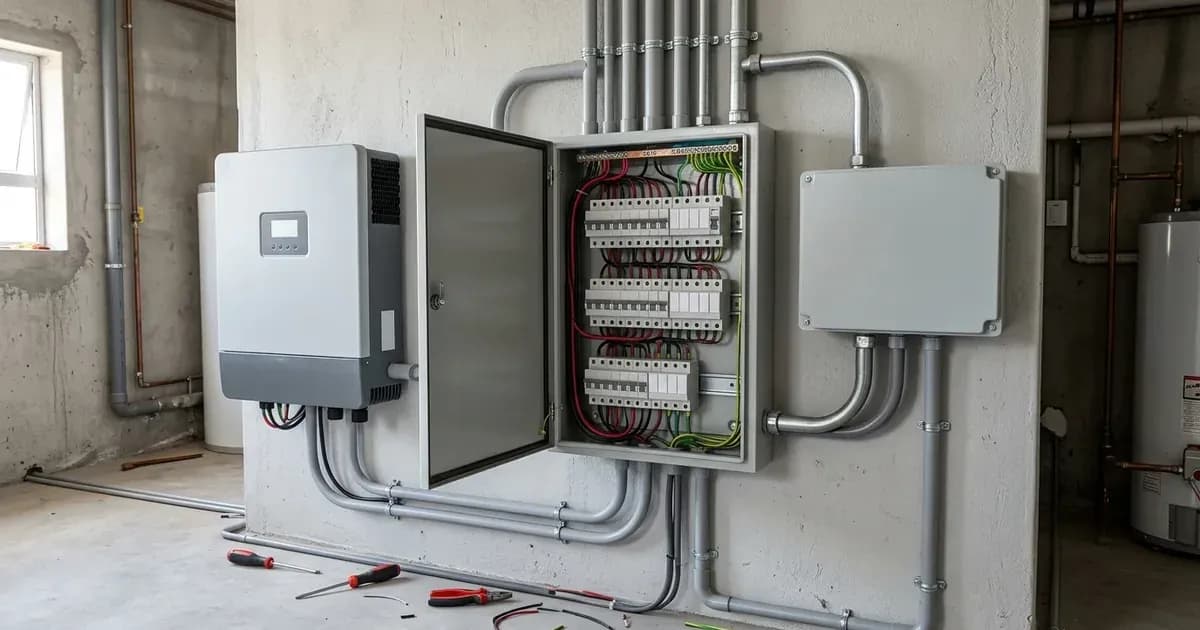
- Dedicated Subboard: A common practice is to install a dedicated subboard that receives power exclusively from the Sunsynk inverter's UPS/load output terminals.
- Circuit Separation: All essential circuits (e.g., specific lights, plugs for critical appliances) are then wired into this new subboard. Non-essential circuits remain connected to the main distribution board, which is supplied by the grid (and potentially the inverter when the grid is active).
- CT Placement: For accurate load readings, the corresponding CT should always be placed on the live incomer of the property before any henley blocks, distribution boards etc. so that the inverter can read the full load demand as well as import and export before they come in/out of the property. Ensure CT cables are not run closely paralleled to any AC cables or contained in the same trunking to avoid interference.
What you can change yourself, and what you cannot
Understanding the boundary between user-adjustable settings and those requiring a qualified professional is crucial for safety and compliance in South Africa.
What you can change yourself:
You can typically adjust settings related to the inverter's operational mode, such as:
- System Mode: Changing between modes like "Zero export + Limit to Load only" (see
/za/guides/fixes/sunsynk-system-mode-and-timer-settings). - Generator Charge Conditions: Enabling ‘Gen Charge’ and ‘Gen Signal’, and setting the ‘GEN Load ON Batt’% threshold.
- Signal Island Mode: Enabling this in battery settings to activate E-N bonding or ATS port output.
These settings primarily affect how your system uses its stored energy and interacts with your loads, and generally do not impact grid protection.
What you cannot change yourself:
Any work involving AC wiring, earthing, or grid-protection settings must be performed by a registered person (qualified electrician) and requires a Certificate of Compliance (CoC). This includes:
- Physical Wiring: Connecting essential load subboards, ATS units, or generators to the inverter's AC terminals.
- Neutral-Earth Bonding Hardware: Installing contact relays for E-N bonding.
- Grid Settings: Adjusting any parameters that affect the inverter's interaction with the Eskom or municipal grid. the manufacturer documentation explicitly states for UK regulations: "YOU MUST NOT TAKE YOUR INVERTER GRID SETTINGS OUTSIDE OF G98/G99 THIS WILL EFFECT YOUR INVERTER COMPLIANCE WITH UK GRID REGULATIONS." While this refers to UK standards, the principle applies equally to South African NRS 097-2-1 compliance.
- Opening the Inverter Enclosure: This is authorised-service work. If you need to replace a fan, clean heatsink fins, or re-pin a connector, you must isolate PV, battery, and AC breakers, wait the manual's capacitor-discharge time, and ensure the work is done by a qualified technician.
Failure to comply with these requirements can lead to unsafe conditions, damage to equipment, and invalidate your Certificate of Compliance.
What the published sources do not tell you
The Sunsynk documentation provides robust guidance on inverter settings and general wiring principles. However, for a South African context, there are specific gaps:
- South African Standards: The documentation is largely UK-centric, referencing G98/G99 regulations. It does not explicitly detail compliance with South African standards such as NRS 097-2-1 or SANS 10142 for neutral-earth bonding or wiring configurations. Installers must ensure local compliance independently.
- Detailed Essential Load Subboard Wiring Diagrams: While the concept of connecting essential loads to the UPS port is clear, detailed wiring schematics for physically separating an essential load subboard from the main distribution board are not explicitly provided. This requires an installer's expertise to design and implement according to local codes.
- Specific Inverter E-N Bond Capabilities by Model: The documents state that some inverter models have built-in E-N bonds, while others use hot or dry contacts. However, they do not list which specific models fall into each category, requiring installers to consult individual product manuals.
- Manual Transfer Switch Bypass: The articles focus on automatic generator start/stop and relay-based E-N bonding. There is no explicit information regarding the installation or operation of a manual transfer switch bypass for the inverter system itself, which some installations might require for maintenance or fault isolation.
Frequently asked questions
What is the Sunsynk essential load subboard wiring?
Essential loads connect to the inverter's UPS or load output port, often via a dedicated subboard. This ensures these critical circuits receive power during grid outages, especially when the inverter is set to 'Zero export + Limit to Load only' mode.
How do I set up neutral-earth bonding with a Sunsynk inverter in South Africa?
Neutral-earth bonding is required to change the inverter's classification from Class II to Class I during islanded operation, as per NRS 097-2-1. Sunsynk inverters use 'Signal Island Mode' in battery settings, often combined with a contact relay (dry or hot contacts) on the load side. For parallel systems, the E-N bond relay should only be on the master inverter.
How do I connect a generator with an RCD to a Sunsynk inverter?
Generators with built-in RCDs must connect to the inverter's GRID input terminals, not the GEN input. The 'Gen connect to grid' setting must be enabled. For E-N bonding, 'Signal Island Mode' is used via the GRID terminals, creating the bond when the generator is off and disconnecting it when on.
What are the auto-start pins for a Sunsynk inverter?
Sunsynk inverters use G-S or G-Start pins for generator auto-start connections. Some single-phase low-voltage models may use G-V or G-Valve pins. The generator itself must have an 'Auto' or 'Standby' selection option enabled for this feature to work.
Can I connect an ATS to a Sunsynk inverter?
Sunsynk inverters support automatic transfer functions, particularly for generators. The 'Signal Island Mode' and specific ATS port settings on models like the Sunsynk Elite can trigger external relays or internal E-N bonds when the grid is lost, facilitating a seamless transition to backup power.
References
- Sunsynk Support Articles (General) — accessed 27 August 2026
- Sunsynk Earth-Neutral Bond — accessed 27 August 2026
- Sunsynk Elite E-N Bond — accessed 27 August 2026
- Sunsynk Signal Island Mode — accessed 27 August 2026
- Sunsynk Generator with RCD — accessed 27 August 2026
- Sunsynk Off-grid E-N Bond for Generator — accessed 27 August 2026
- Sunsynk System Mode Settings — accessed 27 August 2026
- Sunsynk PV Not Generating — accessed 27 August 2026
- Sunsynk Generator Auto-Start — accessed 27 August 2026
- Sunsynk Generator Auto-Start Not Operating — accessed 27 August 2026
- Sunsynk Generator Settings — accessed 27 August 2026
- Sunsynk Generator Connect on Grid Input — accessed 27 August 2026
- Sunsynk CT Clamp Guide — accessed 27 August 2026
- Sunsynk RCD Nuisance Tripping — accessed 27 August 2026
Related guides
More from inverter errors & fixes.